- Animals
- ›Chordates
- ›Vertebrates
- ›Mammals
- ›Therians
- ›Placental Mammals
- ›Ungulates, Carnivorans, and Allies
- ›Even-toed Ungulates and Cetaceans
- ›Ruminants
- ›Bovids
- ›Antelopes, Goats, and Sheep
- ›Alcelaphines
- ›Damaliscus
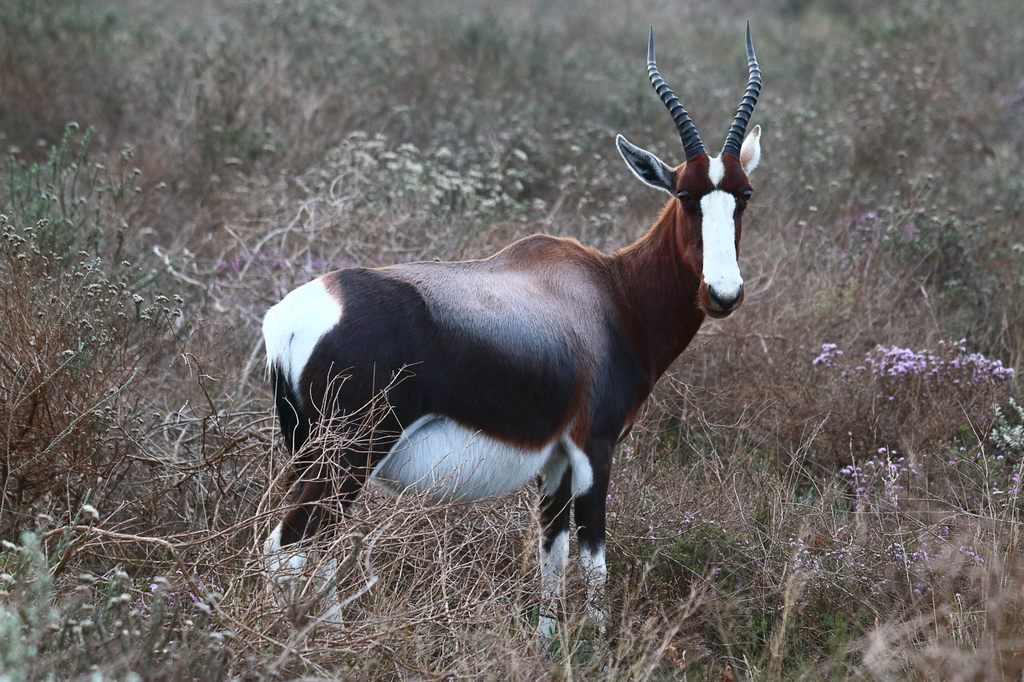
Bontebok/Blesbok
Damaliscus pygargus
The bontebok (Damaliscus pygargus) is an antelope found in South Africa, Lesotho and Namibia. D. pygargus has two subspecies; the nominate subspecies (D. p. pygargus), occurring naturally in the Fynbos and Renosterveld areas of the Western Cape, and the blesbok (D. p. phillipsi) occurring in the Highveld.
The bontebok is related to the common tsessebe.
From the article Bontebok on Wikipedia (CC BY-SA), quoted section by section
Description
The bontebok is a tall, medium-sized antelope. They typically stand 0.8 to 1 m (2.6 to 3.3 ft) high at the shoulder and measure 1.2 to 1.6 m (3.9 to 5.2 ft) along the head and body. The tail can range from 30 to 60 cm (12 to 24 in). Body mass can vary from 50 to 68 kg (110 to 150 lb). Males are slightly larger and noticeably heavier than females. The bontebok is a chocolate brown colour, with a white underside and a white stripe from the forehead to the tip of the nose, although there is a brown stripe across the white near the eyes in most blesbok. The bontebok also has a distinctive white patch around its tail (hence the Latin name), while this patch is light brown/tan in the blesbok. The horns of the bontebok are lyre-shaped and clearly ringed. They are found in both sexes and can reach a length of half a metre.
Range & habitat
Blesbok live in the Highveld, where they eat short grasses, while bontebok are restricted to the coastal Fynbos and the Renosterveld. They are diurnal, though they rest during the heat of the day. Herds may contain only males, only females, or be mixed, and do not exceed 40 animals for bontebok or 70 for blesbok.
Wikipedia: “Habitat”
What it does
Bontebok are not good jumpers, but they are very good at crawling under obstacles. Mature males establish territories, confront other males in displays, and occasionally fight them.
Wikipedia: “Behavior”
Listen
Looking for field recordings…
Where it lives
Recorded sightings
—
geo-referenced records in GBIF, from museums, herbaria and field observers.
Drag the globe to turn it. Dots are where records exist, not a range map; darker means more records.
In the stacks
Searching the stacks…
Every page naming Damaliscus pygargus in the Biodiversity Heritage Library →
This page is assembled live from iNaturalist, GBIF, Wikipedia, the Source Library and the Internet Archive. It is not yet part of the hand-edited codex. iNaturalist taxon 42275.