On eBird ↗
Silvery Grebe
Live sightings near you, the range map, bar charts of when it is seen, and Macaulay Library photos and recordings.
Silvery Grebe
Podiceps occipitalis
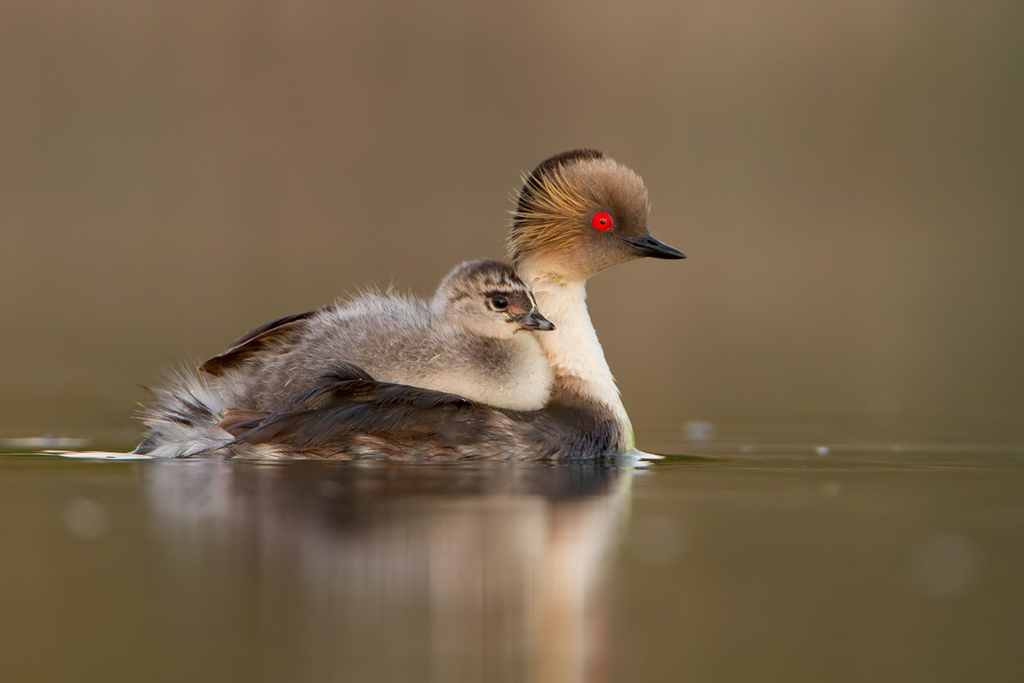
The silvery grebe (Podiceps occipitalis) is a species of grebe in the family Podicipedidae. It is found in the western and southern part of South America where it inhabits lakes and other types of open wetlands. There are two subspecies, which by some recent authorities are considered separate species.
From the article Silvery grebe on Wikipedia (CC BY-SA), quoted section by section
Description
The silvery grebe is about 28 cm (11 in) in length. There are two different subspecies which differ in the colouring on their head and facial plumes. In the southern form, the ear plumes are yellowish and the side of the head and throat are grey. In the northern form, the ear plumes are grey and the side of the head and throat are white. Both have a crown that is black and the neck, chest and belly are white while the back is dark grey and the sides and flanks blackish. The beak and feet are black and the eye red. The northern form in particular is similar in appearance to the rare and highly localized Junin grebe (Podiceps taczanowskii), and their ranges overlap.
Range & habitat
The silvery grebe nests in Argentina, the Falkland Islands, Chile, and the western parts of Bolivia, Peru, Ecuador and Colombia. The southern silvery grebe is migratory, in winter ranging north to Paraguay, southern Bolivia and southern Brazil and possibly also in Uruguay. Its habitat is freshwater lakes, lagoons, reservoirs and ponds. In the Andes it tends to have a preference for weakly alkaline lakes and is sometimes found foraging on hypersaline lakes. In Patagonia, it sometimes inhabits saline lakes where it can be found in the company of flamingoes.
Wikipedia: “Distribution and habitat”
Listen
Looking for field recordings…
Where it lives
Recorded sightings
—
geo-referenced records in GBIF, from museums, herbaria and field observers.
Drag the globe to turn it. Dots are where records exist, not a range map; darker means more records.
In the stacks
Searching the stacks…
Every page naming Podiceps occipitalis in the Biodiversity Heritage Library →
This page is assembled live from iNaturalist, GBIF, Wikipedia, the Source Library and the Internet Archive. It is not yet part of the hand-edited codex. iNaturalist taxon 4227.