On eBird ↗
Colombian Grebe
Live sightings near you, the range map, bar charts of when it is seen, and Macaulay Library photos and recordings.
Colombian Grebe
Podiceps andinus
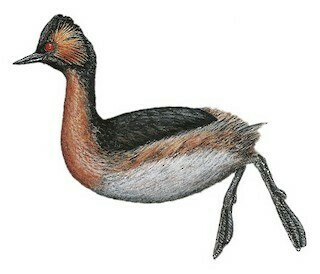
The Colombian grebe (Podiceps andinus) is an extinct species of flightless grebe that inhabited the Bogotá wetlands on the Bogotá savanna in the Eastern Ranges of the Andes of Colombia. The species was still abundant in Lake Tota in 1945. The species has often been considered a subspecies of black-necked grebe (P. nigricollis), and is genetically nested within it; it differed from black-necked grebe most notably in having a reddish-brown (not black) foreneck, and more orangey-toned (rather than yellow) ear tufts.
The decline of the Colombian grebe is attributed to wetland drainage, siltation, pesticide pollution, disruption by reed harvesting, hunting, competition, and predation of chicks by invasive introduced rainbow trout (Oncorhynchus mykiss). The primary reason was loss of habitat: drainage of wetlands and siltation resulted in higher concentrations of pollutants, causing eutrophication across Lake Tota. This destroyed the open, submergent pondweed (Potamogeton) vegetation and resulted in the formation of a dense monoculture of water weed (Elodea).
Listen
Looking for field recordings…
Where it lives
Recorded sightings
—
geo-referenced records in GBIF, from museums, herbaria and field observers.
Drag the globe to turn it. Dots are where records exist, not a range map; darker means more records.
In the stacks
Searching the stacks…
Every page naming Podiceps andinus in the Biodiversity Heritage Library →
This page is assembled live from iNaturalist, GBIF, Wikipedia, the Source Library and the Internet Archive. It is not yet part of the hand-edited codex. iNaturalist taxon 4223.