On eBird ↗
Junin Grebe
Live sightings near you, the range map, bar charts of when it is seen, and Macaulay Library photos and recordings.
Junín Grebe
Podiceps taczanowskii
The Junín grebe, Junin flightless grebe or puna grebe (Podiceps taczanowskii) is a grebe found only on Lake Junin in the highlands of Junín, west-central Peru. The grebe generally breeds in bays and channels around the edge of the Lake, within 8–75 m (26–246 ft) of reed beds, entering the reeds only for nesting or roosting. When not breeding, Junin grebe prefer open water, moving far out from lake shores. The current population is estimated at less than...
From the article Junin grebe on Wikipedia (CC BY-SA), quoted section by section
Description
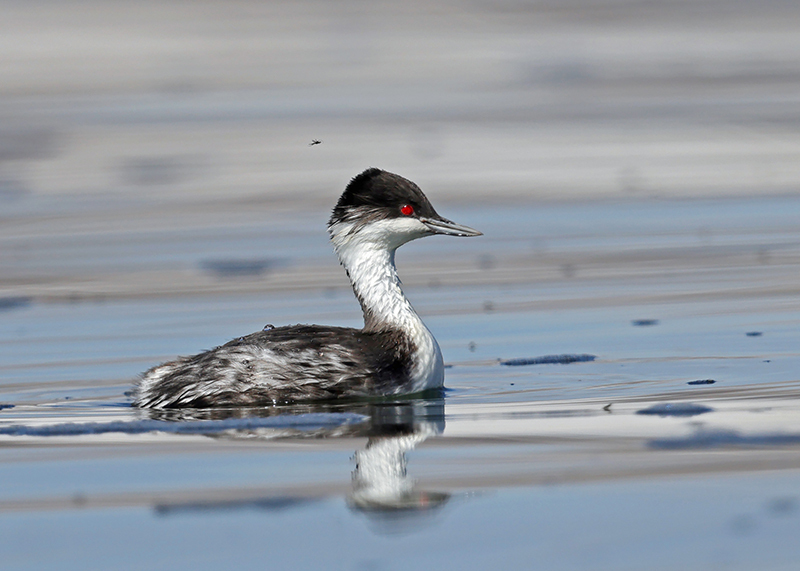
With a size of approximately 35 cm (14 in), the Junin grebe has a dark grey crown extending down the back of its neck to a black back. It has white lower parts of the face, neck and underparts, with a narrow grey bill. Perhaps the most striking feature is its bright red eyes. On the side of the head of adults there are silvery grey feathers, which are absent on non-breeding adults and juveniles. The Junin grebe closely resembles the smaller, shorter-necked and shorter-billed northern silvery grebe, which also is found in Lake Junin. The calls of the Junin grebe include melodic whistles doo' ith, wit, and a longer phooee-th when trying to attract a mate.
Range & habitat
Junin grebes are found only in and around Lake Junin, in west-central Peru. The lake covers approximately 140 km2 (54 sq mi) and at its deepest is 10 m (33 ft) deep, although most of the lake is less than 5 m (16 ft) deep. Around the borders of the lake are substantial reed marshes, where the grebes nest and roost.
Wikipedia: “Distribution and habitat”
What it does
About 90% of the diet of the Junin grebe is small fish, especially those less than 2.5 cm (1 in) long, with the remaining part of its diet being small invertebrates. Fish are caught with its excellent diving skills, but insects may also be caught at the surface. They can be often seen feeding and diving simultaneously in small groups.
Wikipedia: “Feeding”
Listen
Looking for field recordings…
Where it lives
Recorded sightings
—
geo-referenced records in GBIF, from museums, herbaria and field observers.
Drag the globe to turn it. Dots are where records exist, not a range map; darker means more records.
In the stacks
Searching the stacks…
Every page naming Podiceps taczanowskii in the Biodiversity Heritage Library →
This page is assembled live from iNaturalist, GBIF, Wikipedia, the Source Library and the Internet Archive. It is not yet part of the hand-edited codex. iNaturalist taxon 4222.