- Animals
- ›Chordates
- ›Vertebrates
- ›Mammals
- ›Therians
- ›Placental Mammals
- ›Ungulates, Carnivorans, and Allies
- ›Carnivorans
- ›Felids
- ›Small Cats
- ›Lynx
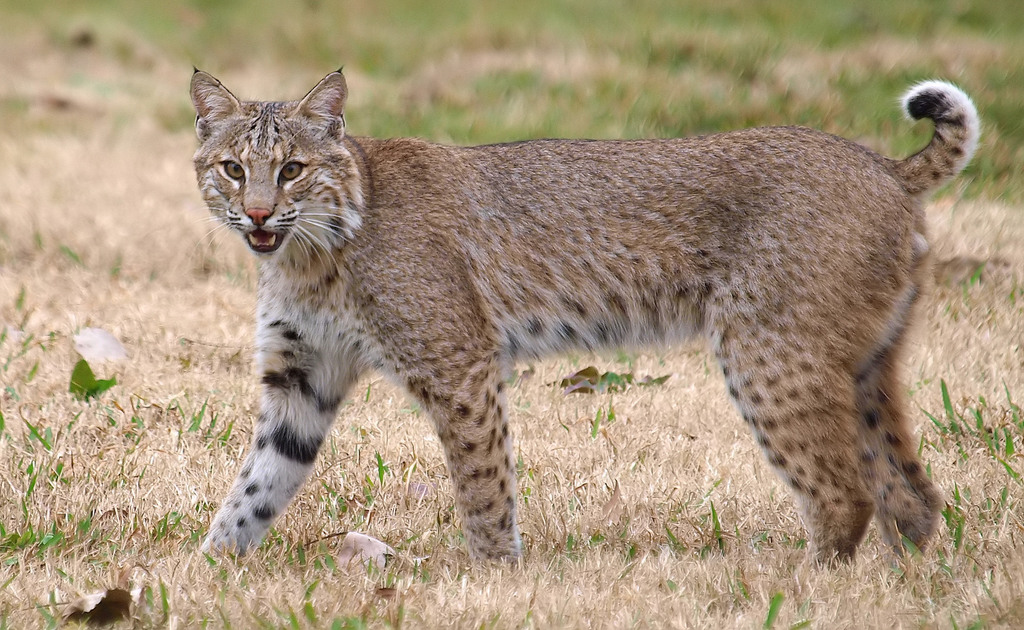
Bobcat
Lynx rufus
The bobcat (Lynx rufus), also known as the wildcat, bay lynx, or red lynx, is one of the four extant species within the medium-sized wild cat genus Lynx. Native to North America, it ranges from southern Canada through most of the contiguous United States to Oaxaca in Mexico. It is listed as Least Concern on the IUCN Red List since 2002, due to its wide distribution and large population. Although it has been hunted extensively both for sport and fur, populations have proven stable, though declining in some areas.
It has distinctive black bars on its forelegs and a black-tipped, stubby (or "bobbed") tail, from which it derives its name. It reaches a total length (including the tail) of up to 125 cm (50 in). It is an adaptable predator inhabiting wooded areas, semidesert, urban edge, forest edge, and swampland environments. It remains in some of its original range, but populations are vulnerable to extirpation by coyotes and domestic animals.
From the article Bobcat on Wikipedia (CC BY-SA), quoted section by section
Description
The bobcat resembles other species of the midsize genus Lynx, but is on average the smallest of the four. Its coat is variable, though generally tan to grayish-brown, with black streaks on the body and dark bars on the forelegs and tail. Its spotted patterning acts as camouflage. The ears are black-tipped and pointed, with short, black tufts. Generally, an off-white color is seen on the lips, chin, and underparts. Bobcats in the desert regions of the southwest have the lightest-colored coats, while those in the northern, forested regions are darkest. Kittens are born well-furred and already have their spots. A few melanistic bobcats have been sighted and captured in Florida, USA, and New Brunswick, Canada. They appear black, but may still exhibit a spot pattern. The face appears wide due to ruffs of extended hair beneath the ears. Bobcat eyes are yellow with black slit pupils. The nose of the bobcat is pinkish-red, and it has a base color of gray or yellowish- or brownish-red on its face, sides, and back. The pupils widen during nocturnal activity to maximize light reception. The bobcat has sharp hearing and vision, and a good sense of smell. …
Range & habitat
The bobcat is an adaptable species. It prefers woodlands—deciduous, coniferous, or mixed—but does not depend exclusively on the deep forest. It ranges from the humid swamps of Florida to desert lands of Texas or rugged mountain areas. It makes its home near agricultural areas, if rocky ledges, swamps, or forested tracts are present; its spotted coat serves as camouflage. The population of the bobcat depends primarily on the population of its prey; other principal factors in the selection of habitat type include protection from severe weather, availability of resting and den sites, dense cover for hunting and escape, and freedom from disturbance. The bobcat's range does not seem to be limited by human populations, but by the availability of suitable habitat; only large, intensively cultivated tracts are unsuitable for the species. The animal may appear in backyards in "urban edge" environments, where human development intersects with natural habitats. When chased by a dog, bobcats usually climb a tree. The historical range of the bobcat was from southern Canada, throughout the United States, and as far south as the Mexican state of Oaxaca, and it persists across much of this area. …
Wikipedia: “Distribution and habitat”
What it does
The bobcat is crepuscular and is active mostly during twilight. It keeps on the move from three hours before sunset until about midnight, and then again from before dawn until three hours after sunrise. Each night, it moves from 3 to 11 km (2 to 7 mi) along its habitual route. This behavior may vary seasonally, as bobcats become more diurnal during fall and winter in response to the activity of their prey, which are more active during the day in colder weather.
Social structure and home range. Bobcat activities are confined to well-defined territories, which vary in size depending on the sex and the distribution of prey. The home range is marked with feces, urine scent, and by clawing prominent trees in the area. In its territory, the bobcat has numerous places of shelter, usually a main den, and several auxiliary shelters on the outer extent of its range, such as hollow logs, brush piles, thickets, or under rock ledges. Its den smells strongly of the bobcat. The sizes of bobcats' home ranges vary significantly from 0.596–326 km2 (0.23–126 sq mi). One study in Kansas found resident males to have ranges of roughly 21 km2 (8 sq mi), and females less than half that area. Transient bobcats were found to have home ranges of 57 km2 (22 sq mi) and less well-defined home ranges. Kittens had the smallest range at about 8 km2 (3 sq mi). …
Wikipedia: “Behavior and ecology”
In human culture
Stories featuring the bobcat, in many variations, are found in some Indigenous cultures of North America, with parallels in South America. A story from the Nez Perce, for instance, depicts the bobcat and coyote as opposed, antithetical beings. However, another version represents them with equality and identicality. Claude Lévi-Strauss argues that the former concept, that of twins representing opposites, is an inherent theme in New World mythologies, but that they are not equally balanced figures, representing an open-ended dualism rather than the symmetric duality of Old World cultures. The latter notion, then, Lévi-Strauss suggests, is the result of regular contact between Europeans and native cultures. Additionally, the version found in the Nez Perce story is of much greater complexity, while the version of equality seems to have lost the tale's original meaning.
In a Shawnee tale, the bobcat is outwitted by a rabbit, which gives rise to its spots. After trapping the rabbit in a tree, the bobcat is persuaded to build a fire, only to have the embers scattered on its fur, leaving it singed with dark brown spots. The Mohave people believed dreaming habitually of beings or objects would afford them their characteristics as supernatural powers. Dreaming of two deities, cougar and lynx, they thought, would grant them the superior hunting skills of other tribes. …
Wikipedia: “Importance in human culture”
Listen
Looking for field recordings…
Where it lives
Recorded sightings
—
geo-referenced records in GBIF, from museums, herbaria and field observers.
Drag the globe to turn it. Dots are where records exist, not a range map; darker means more records.
In the stacks
Searching the stacks…
Every page naming Lynx rufus in the Biodiversity Heritage Library →
This page is assembled live from iNaturalist, GBIF, Wikipedia, the Source Library and the Internet Archive. It is not yet part of the hand-edited codex. iNaturalist taxon 41976.