- Animals
- ›Chordates
- ›Vertebrates
- ›Mammals
- ›Therians
- ›Placental Mammals
- ›Ungulates, Carnivorans, and Allies
- ›Carnivorans
- ›Felids
- ›Small Cats
- ›Felis
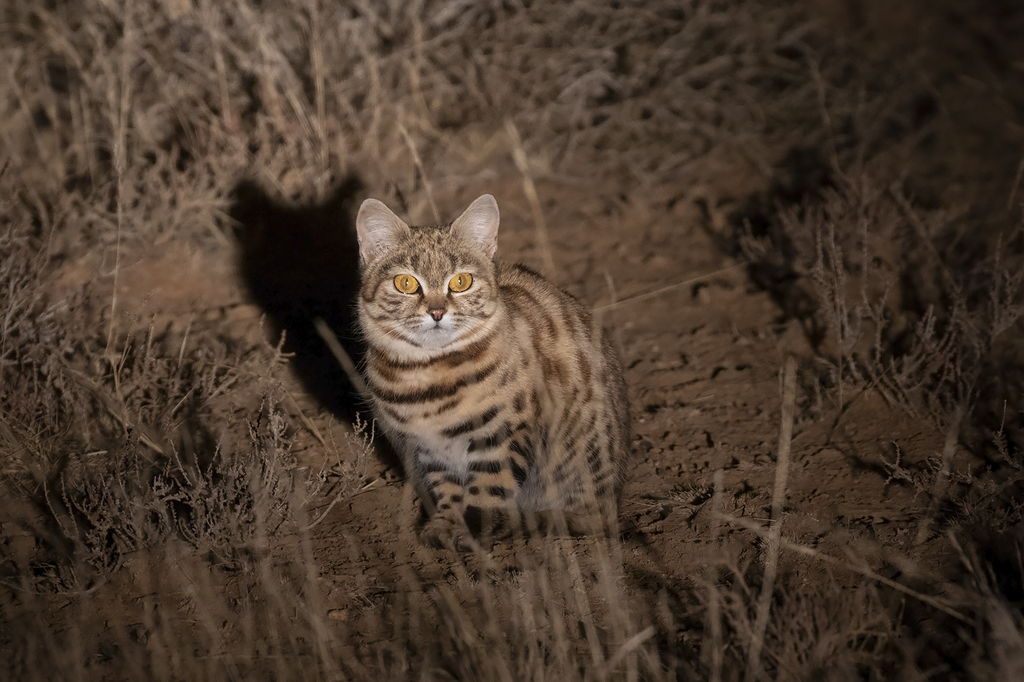
Black-footed Cat
Felis nigripes
The black-footed cat (Felis nigripes), also called the small-spotted cat, is the smallest wild cat in Africa, having a head-and-body length of 35–52 cm (14–20 in). Despite its name, only the soles of its feet are black or dark brown. With its bold small spots and stripes on the tawny fur, it is well camouflaged, especially on moonlit nights. It bears black streaks running from the corners of the eyes along the cheeks, and its banded tail has a black tip.
The first black-footed cat known to science was discovered in the northern Karoo of South Africa and described in 1824. It is endemic to the arid steppes and grassland savannas of Southern Africa. It was recorded in southern Botswana, but only a few authentic records exist in Namibia, in southern Angola and in southern Zimbabwe. Due to its restricted distribution, it has been listed as a vulnerable species on the IUCN Red List since 2002. The population is suspected to be declining due to poaching of prey species for human consumption as bushmeat, persecution, traffic accidents, and predation by herding dogs.
From the article Black-footed cat on Wikipedia (CC BY-SA), quoted section by section
Description
The black-footed cat has tawny fur that is entirely covered with black spots. Its head is darker than the rest of the body but paler above the eyes. Its whiskers are white, and its ears bear grizzled dark brown hairs. On the neck and back, some spots are elongated into stripes. The spots form transverse stripes on the shoulders. The forelegs and the hind legs bear irregular stripes. Its tail is confusedly spotted. The underparts of the feet are black or dark brown. The throat rings form black semi-circles that vary in colour from dusky brown to pale rufous and are narrowly edged with rufous. Some individuals have a pure white belly with a tawny tinge where it blends into the tawny colour of the flanks. The ears, eyes and mouth are lined with pale off-white. Two black streaks run from the corners of the eyes across the cheeks. Individuals vary in background colour from sandy and pale ochre to dark ochre. In the northern part of its range, it is lighter than in the southern part, where its spots and bands are more clearly defined. The three rings on the throat are reddish brown to black, with the third ring broken in some individuals. The black bands are broad on the upper legs and become narrower towards the paws. The 25 to 30 mm (1.0 to 1.2 in) long guard hairs are gray at the base and have either white or dark tips. The underfur is dense with short and wavy hair. …
Wikipedia: “Characteristics”
Range & habitat
The black-footed cat is endemic to Southern Africa; its distribution is much more restricted than other small cats in this region. Its range extends from South Africa northward into southern Botswana, where it was recorded in the late 1960s. It has also been recorded in Namibia, extreme southern Angola and southern Zimbabwe. It is unlikely to occur in Lesotho and Eswatini. It inhabits open, arid savannas and semi-arid shrubland in the Karoo and the southwestern Kalahari with short grasses, low bush cover, and scattered clumps of low bush and higher grasses. The mean annual precipitation in this region ranges from 100 to 500 mm (3.9 to 19.7 in). In the Drakensberg area, it was recorded at an elevation of 2,000 m (6,600 ft).
Wikipedia: “Distribution and habitat”
What it does
The black-footed cat is nocturnal and usually solitary, except when females care for dependent kittens. It spends the day resting in hollow termite mounds and dense cover in unoccupied burrows of South African springhare (Pedetes capensis), aardvark (Orycteropus afer), and Cape porcupine (Hystrix africaeaustralis). It digs vigorously to extend or modify these burrows for shelter. Five female black-footed cats were monitored in a farmland in southern Namibia in autumn 2022; they chose burrows with entrance diameters of 10–27 cm (3.9–10.6 in) and rested inside the burrows 72–290 cm (28–114 in) away from the entrances. The black-footed cat seeks refuge at the slightest disturbance and often uses termite mounds for cover or for bearing its young. When cornered, it defends itself fiercely. Due to this habit and its courage, it is called miershooptier in parts of the South African Karoo, meaning 'anthill tiger'. A San legend claims that a black-footed cat can kill a giraffe by piercing its jugular. This exaggeration is intended to emphasize its bravery and tenacity. Unlike most other cats, it is a poor climber, as its stocky body and short tail are thought not to be conducive for climbing trees. …
Wikipedia: “Behaviour and ecology”
Listen
Looking for field recordings…
Where it lives
Recorded sightings
—
geo-referenced records in GBIF, from museums, herbaria and field observers.
Drag the globe to turn it. Dots are where records exist, not a range map; darker means more records.
In the stacks
Searching the stacks…
Every page naming Felis nigripes in the Biodiversity Heritage Library →
This page is assembled live from iNaturalist, GBIF, Wikipedia, the Source Library and the Internet Archive. It is not yet part of the hand-edited codex. iNaturalist taxon 41957.