- Animals
- ›Chordates
- ›Vertebrates
- ›Mammals
- ›Therians
- ›Placental Mammals
- ›Ungulates, Carnivorans, and Allies
- ›Carnivorans
- ›Felids
- ›Small Cats
- ›Prionailurus
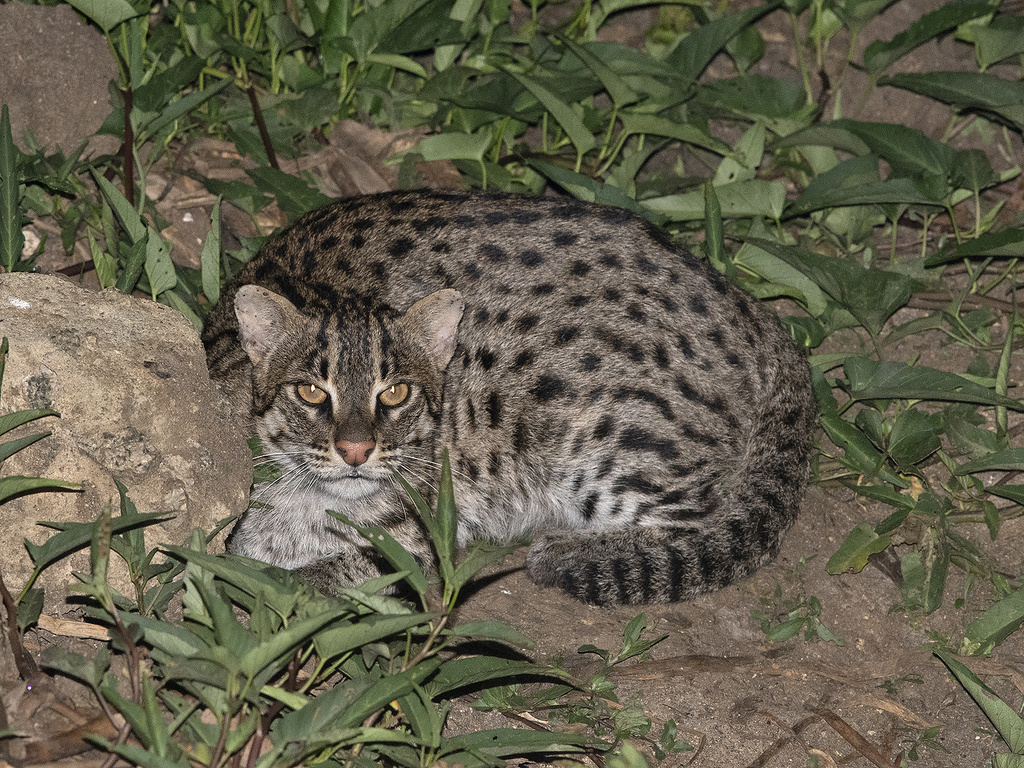
Fishing Cat
Prionailurus viverrinus
The fishing cat (Prionailurus viverrinus) is a medium-sized wild cat of South and Southeast Asia. It has a deep yellowish-grey fur with black lines and spots. Adults have a head-to-body length of 57 to 78 cm (22 to 31 in), with a 20 to 30 cm (8 to 12 in) long tail. Males are larger than females, weighing 8 to 17 kg (18 to 37 lb), while females average 5 to 9 kg (11 to 20 lb). It lives mostly in the vicinity of wetlands, along rivers, streams, oxbow lakes, in swamps and mangroves where it preys mostly on fish. Other prey items include birds, insects, small rodents, molluscs, reptiles including snakes, amphibians and carrion of cattle. The fishing cat is thought to be primarily nocturnal. It is a good swimmer and can swim long distances, even underwater.
The fishing cat has been listed as a vulnerable species on the IUCN Red List since 2016, as the global population is thought to have declined by about 30% in the past three fishing cat generations during the period 2010–2015. The destruction of wetlands and killing by local people are the major threats throughout its range.
From the article Fishing cat on Wikipedia (CC BY-SA), quoted section by section
Description
The fishing cat has a deep yellowish-grey fur with black lines and spots. Two stripes are on the cheeks, and two are above the eyes running to the neck with broken lines on the forehead. It has two rows of spots around the throat. The spots on the shoulder are longitudinal, and those on the sides, limbs and tail are roundish. The background colour of its fur varies between individuals from yellowish tawny to ashy grey, and the size of the stripes ranges from narrow to broad. The fur on the belly is lighter than on the back and sides. The short and rounded ears are set low on the head, and the back of the ears bear a white spot. The tail is short, less than half the length of head and body, and with a few black rings at the end. The short dense layered fur is thought to be an aquatic adaptation providing a water barrier and thermal insulation, while another layer of protruding long guard hairs provides its pattern and glossy sheen. The fishing cat is the largest cat of the Prionailurus. It is stocky and muscular with a head-to-body length ranging from 57 to 78 cm (22 to 31 in), a tail length of 20 to 30 cm (8 to 12 in) and medium to short legs. Females weigh 5 to 9 kg (11 to 20 lb) and males 8 to 17 kg (18 to 37 lb), showing pronounced sexual dimorphism. Its skull is elongated, with a basal length of 123–153 mm (4.8–6.0 in) and a post-orbital width of 27–31 mm (1.1–1.2 in). …
Wikipedia: “Characteristics”
Range & habitat
The fishing cat is broadly but discontinuously distributed in South and Southeast Asia. It predominantly inhabits densely vegetated wetlands around slow-moving bodies of water like swamps and marshes. These include low-salinity bodies such as oxbow lakes, and high-salinity ones such as tidal creeks and mangrove forests. Along these bodies of water, it conceals itself within the thick cover of forests, shrublands, reed beds and grasslands. Most records are from lowland areas. In Pakistan's Sindh Province, the fishing cat was recorded in the Chotiari Dam area in 2012. In the Nepal Terai, it has been recorded in Shuklaphanta, Bardia, Chitwan and Parsa National Parks and in Koshi Tappu Wildlife Reserve. In India, its presence has been documented in Ranthambore National Park, in Pilibhit, Dudhwa and Valmiki Tiger Reserves, in Sur Sarovar Bird Sanctuary, outside protected areas in West Bengal, in Lothian Island Wildlife Sanctuary in the Sundarbans, in Odisha's Bhitarkanika Wildlife Sanctuary and coastal districts outside protected areas, in Andhra Pradesh's Coringa Wildlife Sanctuary, Krishna Wildlife Sanctuary and adjoining reserve forests. Reports in Bangladeshi newspapers indicate that fishing cats live in most divisions of Bangladesh. …
Wikipedia: “Distribution and habitat”
What it does
The fishing cat lives among dense vegetation near water and is thought to be primarily nocturnal. It is known to be a proficient long-distance and underwater swimmer. Adult males and females without dependent young are solitary. Females have been reported to range over areas of 4 to 6 km2 (1.5 to 2.3 sq mi), while males range over 16 to 22 km2 (6.2 to 8.5 sq mi). It has been observed resting in thick grassy habitats, often near a water body but sometimes far away from them. Adults have been recorded to vocalise "chuckling" sounds. It marks its home range using cheek-rubbing, head rubbing, chin rubbing, neck rubbing and urine-spraying to leave scent marks; it also sharpens its claws and displays flehmen. The pungent smell of fishing cat urine markings is due to 3-Mercapto-3-methylbutan-1-ol, a breakdown product of felinine. Fishing cat feces collected in India's Keoladeo National Park revealed that fish comprises about three-quarter of its diet, with the remainder consisting of birds, small rodents and insects; molluscs, reptiles, amphibians, carrion of cattle and grass supplement its diet. Its main prey in the Godavari River delta is fish, including flathead grey mullet, green chromide and Mozambique tilapia, which comprised three fifths of its diet, whereas rodents and crabs made up the remainder of the diet. The diet make-up remained relatively constant throughout the year. …
Wikipedia: “Behaviour and ecology”
Listen
Looking for field recordings…
Where it lives
Recorded sightings
—
geo-referenced records in GBIF, from museums, herbaria and field observers.
Drag the globe to turn it. Dots are where records exist, not a range map; darker means more records.
In the stacks
Searching the stacks…
Every page naming Prionailurus viverrinus in the Biodiversity Heritage Library →
This page is assembled live from iNaturalist, GBIF, Wikipedia, the Source Library and the Internet Archive. It is not yet part of the hand-edited codex. iNaturalist taxon 41946.