- Animals
- ›Chordates
- ›Vertebrates
- ›Mammals
- ›Therians
- ›Placental Mammals
- ›Ungulates, Carnivorans, and Allies
- ›Carnivorans
- ›Mustelids
- ›Otters
- ›Lontra
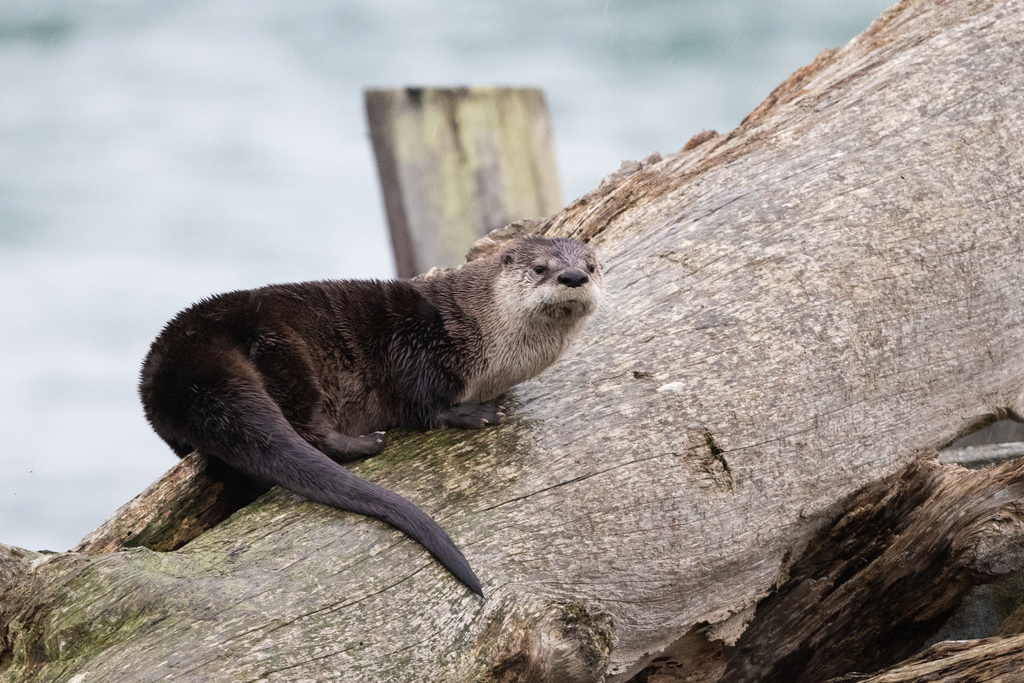
North American River Otter
Lontra canadensis
The North American river otter (Lontra canadensis), also known as the northern river otter and river otter, is a semiaquatic mammal that is endemic to the North American continent throughout most of Canada and along the coasts of the United States and its inland waterways. An adult North American river otter can weigh between 5 and 14 kilograms (11–31 lb). The river otter is protected and insulated by a thick, water-repellent coat of fur.
The North American river otter, a member of the subfamily Lutrinae in the weasel family (Mustelidae), is equally versatile in the water and on land. It establishes a burrow close to the water's edge in river, lake, swamp, coastal shoreline, tidal flat, or estuary ecosystems. The den typically has many tunnel openings, one of which generally allows the otter to enter and exit the body of water. Females give birth in these burrows, producing litters of one to six young.
From the article North American river otter on Wikipedia (CC BY-SA), quoted section by section
Description
The North American river otter has long and thin whiskers that are used to detect prey in dark waters. An average adult male weighs about 11.3 kilograms (25 lb) against the female's average of 8.3 kg (18 lb). Its body length ranges from 66 to 107 cm (26–42 in). About one-third of the animal's total length consists of a long, tapered tail. Tail lengths range from 30 to 50 cm (12–20 in). Large males can exceed a weight of 15 kg (33 lb). It differs from the Eurasian otter by its longer neck, narrower visage, the smaller space between the ears, and shorter tail. Males and female river otters show different nonsexual physical characteristics, with males typically being larger. North American river otters can live 21–25 years in captivity, or 8–13 years in the wild.
Form and function. North American river otters characteristically approach within a few meters (a few feet) of a boat or a person on shore due to their near-sightedness, a consequence of vision adapted for underwater sight. These otters have a transparent inner eyelid (called a nictitating membrane) to protect their eyes while swimming. Otters, like most mustelids, have 36 specialized teeth, including sharp canines and carnassials that inflict lethal bites to prey. Also, North American river otters have large molars used for crushing hard objects, such as the shells of molluscs. Additional premolars may be present. …
Range & habitat
The North American river otter is found throughout North America, inhabiting inland waterways and coastal areas in Canada, the Pacific Northwest, the Atlantic states, and states on the Gulf of Mexico. They also inhabit the forested regions near the Pacific coast in North America. The species is also present throughout Alaska, including the Aleutian Islands, and the north slope of the Brooks Range. Urbanization and pollution, though, have resulted in a reduction in the otters' range in the United States. They are now absent or rare in Arizona, Kansas, Nebraska, New Mexico, North Dakota, Ohio, Oklahoma, South Dakota, and Tennessee. Reintroduction projects have expanded their distribution in recent years, such as in West Virginia, and especially in the Midwestern United States. Since their reintroduction to Kentucky in the early 1990s, the otters have recovered to the point that a trapping season was implemented in 2006, and the species is now found in all of the state's major waterways. In 2010, the Colorado Department of Wildlife reported the river otter, reintroduced to the state in the 1980s, was "thriving" and recommended its protection status be reconsidered. In late 2012, a river otter nicknamed Sutro Sam took up residence around the former site of the Sutro Baths in San Francisco, the first river otter sighting in that city since the 1950s. …
Wikipedia: “Distribution and habitat”
What it does
North American river otters only settle in areas that consist of vegetation, rock piles, and sufficient coverage.
Playing. North American river otters are renowned for their sense of play. Otter play mostly consists of wrestling with conspecifics. Chasing is also a common game. They rely upon play to learn survival skills, such as fighting and hunting.
Hunting. A highly active predator, the North American river otter has adapted to hunting in water and eats aquatic and semiaquatic animals. The vulnerability and seasonal availability of prey animals mainly governs its food habits and prey choices. This availability is influenced by detectability and mobility of the prey, habitat availability for the various prey species, environmental factors, such as water depth and temperature, and seasonal changes in prey supply and distribution in correspondence with otter foraging habitat. The diet of the North American river otter can be deduced by analyzing either stool obtained in the field, or gut contents removed from trapped otters. Fish are the primary component of the North American river otter's diet throughout the year. Every study done on the food habits of the North American river otter has identified varying fish species as being the primary component of its diet. …
Wikipedia: “Behavior”
Listen
Looking for field recordings…
Where it lives
Recorded sightings
—
geo-referenced records in GBIF, from museums, herbaria and field observers.
Drag the globe to turn it. Dots are where records exist, not a range map; darker means more records.
In the stacks
Searching the stacks…
Every page naming Lontra canadensis in the Biodiversity Heritage Library →
This page is assembled live from iNaturalist, GBIF, Wikipedia, the Source Library and the Internet Archive. It is not yet part of the hand-edited codex. iNaturalist taxon 41777.