- Animals
- ›Chordates
- ›Vertebrates
- ›Mammals
- ›Therians
- ›Placental Mammals
- ›Ungulates, Carnivorans, and Allies
- ›Carnivorans
- ›Pinnipeds
- ›Eared Seals
- ›Arctocephalus
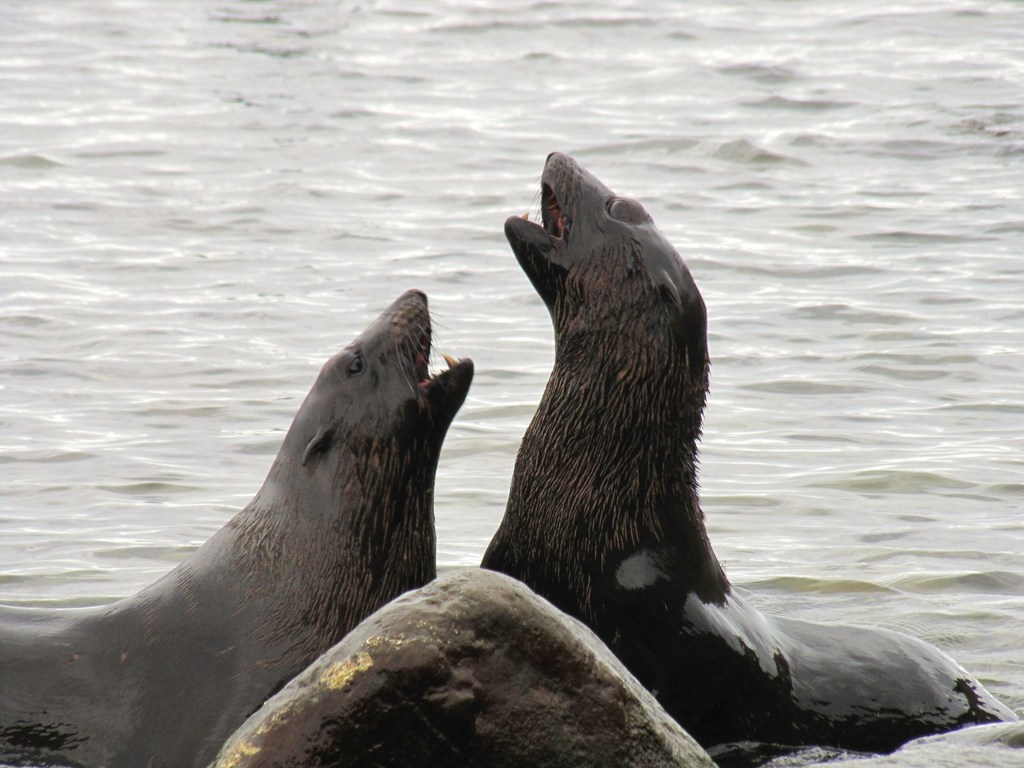
Juan Fernández Fur Seal
Arctocephalus philippii
The Juan Fernández fur seal is the second smallest of the fur seals, second only to the Galápagos fur seal. They are found only on the Pacific Coast of South America, more specifically on the Juan Fernández Islands and the Desventuradas Islands. There is still much that is unknown about this species. Scientists still do not know the average life span of this species, or the diet and behavior of males apart from the breeding season.
From the article Juan Fernández fur seal on Wikipedia (CC BY-SA), quoted section by section
Description
The Juan Fernandez fur seal is part of the group of eared seals. Fur seals in general have thick insulating fur that protects the skin from cold water, they have small ear flaps on the side of their head, and they hold their weight on their front flippers which are also used for land locomotion. Fur seals are different from true seals because they have external ear flaps, but also true seals use their chest for support and movement, and fur seals walk on their front flippers. The Juan Fernandez fur seal is the second smallest fur seal, second only to the Galápagos fur seal. Their bodies are short and robust with brown pelage. Both the fore flippers and the hind flippers are relatively short, and the hind flippers have fleshy tips on the digits. Females are lighter brown and average 100 pounds (45 kg) and 4 feet 6 inches (1.37 m) long. Males are significantly larger and average 300 pounds (140 kg) and 6 feet 6 inches (1.98 m) in length. Males have thicker necks than females and have generally darker brown pelage. Male seals have golden-tipped thick guard hairs on the back of the head, neck, and shoulders. This seal species has a trait called sexual dimorphism, meaning the males look much different from the females after reaching sexual maturity.
What it does
This particular seal lives a solitary life. Seals forage out at sea and haul out on rocky shores to rest. Females seem to be fairly particular about where she rests during the day and prefer tide pools and rocky caves. The resting areas that females prefer often become areas of male competition for breeding rights. Although females will typically rest in close regions, they are sure to be a few feet away from each other and never touch one another.
Wikipedia: “Behavior”
In human culture
The Juan Fernández fur seal was discovered, and named, by Juan Fernández in the mid-1500s. Once the seal was discovered the population was decimated by over hunting for the fur trade. It was believed that the Juan Fernández fur seal was extinct until a small group of 200 was found on the Juan Fernández islands in the 1960s. Now it is estimated that over 12,000 individuals exist today. In 1864 the naturalist Rodolfo Philippi, working at the Chilean National Museum of Natural History sent the fur and skeleton of a specimen to Wilhelm Peters in Berlin's Museum für Naturkunde for taxonomic classification. Classification in Chile was not possible at the time as specimens for comparison and relevant literature on the topic were not available in the country. Also, early naturalists in Chile had also to deal with a wide range of topics while those in Europe were more specialized. The resulting classification by Peters became the subject of a long-running scientific controversy. Hermann Burmeister compared drawings and the written description of the species with specimens at the La Plata Museum and concluded in 1866 that it was not a new species but a Phoca porcina that was described by the Jesuit Juan Ignacio Molina many years ago. …
Wikipedia: “History”
Listen
Looking for field recordings…
Where it lives
Recorded sightings
—
geo-referenced records in GBIF, from museums, herbaria and field observers.
Drag the globe to turn it. Dots are where records exist, not a range map; darker means more records.
In the stacks
Searching the stacks…
Every page naming Arctocephalus philippii in the Biodiversity Heritage Library →
This page is assembled live from iNaturalist, GBIF, Wikipedia, the Source Library and the Internet Archive. It is not yet part of the hand-edited codex. iNaturalist taxon 41745.