- Animals
- ›Chordates
- ›Vertebrates
- ›Mammals
- ›Therians
- ›Placental Mammals
- ›Ungulates, Carnivorans, and Allies
- ›Carnivorans
- ›Pinnipeds
- ›Eared Seals
- ›Zalophus
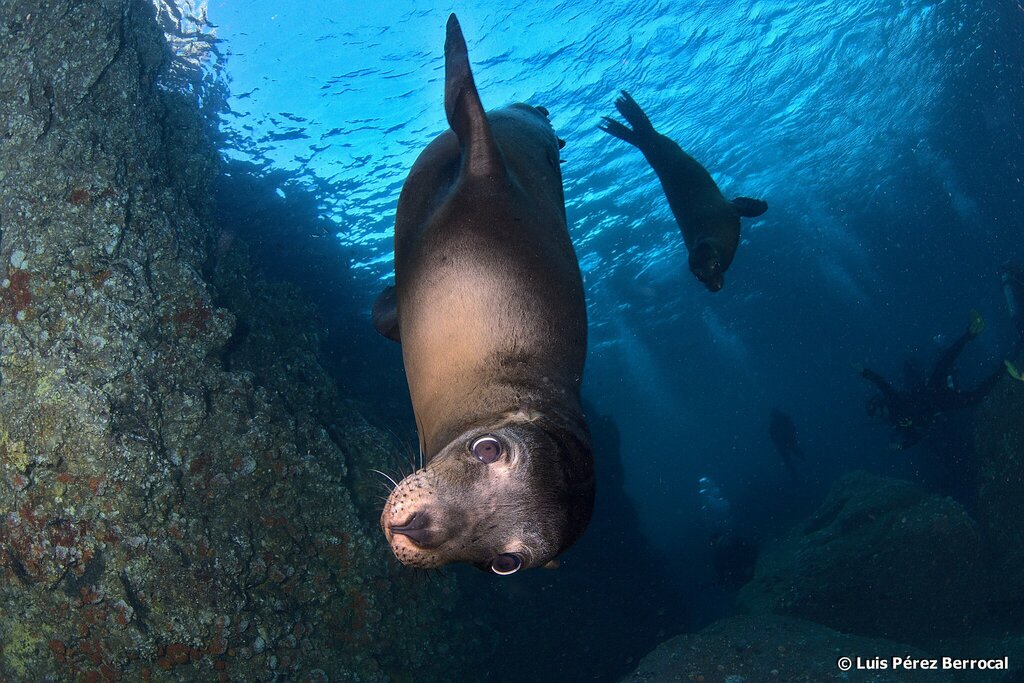
California Sea Lion
Zalophus californianus
The California sea lion (Zalophus californianus) is a coastal eared seal native to western North America. It is one of six species of sea lions. Its natural habitat ranges from southeast Alaska to central Mexico, including the Gulf of California. California sea lions are sexually dimorphic; males are larger than females, and have a thicker neck, and a protruding sagittal crest. They mainly haul out on sandy or rocky beaches, but they also frequent manmade environments such as marinas and wharves. California sea lions feed on a number of species of fish and squid, and are preyed on by orcas and great white sharks.
California sea lions have a polygynous breeding pattern. From May to August, males establish territories and try to attract females with which to mate. Females are free to move in between territories, and are not coerced by males. Mothers nurse their pups in between foraging trips. California sea lions communicate with numerous vocalizations, notably with barks and mother-pup contact calls. Outside their breeding season, California sea lions spend much of their time at sea, but they come to shore to molt.
From the article California sea lion on Wikipedia (CC BY-SA), quoted section by section
Description
Being sexually dimorphic, California sea lions differ in size, shape, and coloration between the sexes. Males can grow up to 2.5–2.7 m (8.2–8.9 ft) long and weigh around 350 kg (770 lb), while females are typically around 2.1 m (6.9 ft) and weigh around 100 kg (220 lb). The heaviest recorded male weighed 660 kg (1,460 lb). Females and juveniles have a tawny brown pelage, although they may be temporarily light gray or silver after molting. The pelage of adult males can be anywhere from light brown to black, but is typically dark brown. The face of adult males may also be light tan in some areas. Pups have a black or dark brown pelage at birth. Although the species has a slender build, adult males have robust necks, chests, and shoulders. Adult males also have a protruding crest which gives them a "high, domed forehead"; it is tufted with white hairs. They also have manes, which are less developed than those of adult male South American and Steller sea lions. Both sexes have long, narrow muzzles.
Locomotion. As an otariid, the California sea lion relies on its foreflippers to propel itself when swimming. This form of aquatic locomotion, along with its streamlined body, effectively reduces drag underwater. Its foreflipper movement is not continuous; the animal glides in between each stroke. …
Wikipedia: “Appearance, physiology, and movement”
Range & habitat
The California sea lion ranges along the western coast and islands of North America, from southeast Alaska to central Mexico. Mitochondrial DNA sequences in 2009 have identified five distinct California sea lion populations: the U.S. or Pacific Temperate stock, the Western Baja California or Pacific Tropical stock, and the Southern, Central, and Northern Gulf of California stocks. The U.S. stock breeds mainly in the Channel Islands, although some breeding sites may be established in northern California, and females are now commonly found there. The Western Baja California stock mainly breeds near Punta Eugenia and at Isla Santa Margarita. The above-mentioned stocks are separated by the Ensenada Front. The stocks of the Gulf of California live in the shallow waters of the north (Northern stock), the tidal islands near the center (Central stock), and the mouth of the bay (Southern stock). The stock status of the California sea lions at the deep waters of the central bay has not been analyzed. Vagrants can reach the north-western Pacific such as on the Commander Islands. Although several otariinae have been recorded around the Japanese archipelago in recent years, their exact origins are unclear. During the breeding season, California sea lions gather on both sandy and rocky shores. On warm days, they lie closer to the water. …
Wikipedia: “Distribution and habitat”
What it does
California sea lions feed on a wide variety of seafood, mainly octopus, squid and fish, and sometimes clams. Commonly eaten fish and squid species include salmon, hake, Pacific whiting, anchovy, herring, rockfish, lamprey, dogfish, and market squid. They mostly forage near mainland coastlines, the continental shelf, and seamounts. They may also search along the ocean bottom. California sea lions may eat alone or in small to large groups, depending on the amount of food available. They sometimes cooperate with other predators, such as dolphins, porpoises, and seabirds, when hunting large schools of fish. California sea lions sometimes follow dolphins and exploit their hunting efforts. Adult females feed between 10–100 km (6.2–62.1 mi) from shore. Adult males may forage as far as 450 km (280 mi) from shore when water temperatures rise. They also have learned to feed on steelhead and salmon below fish ladders at Bonneville Dam and at other locations where fish must queue in order to pass through dams and locks that block their passage.
Wikipedia: “Diet”
Listen
Looking for field recordings…
Where it lives
Recorded sightings
—
geo-referenced records in GBIF, from museums, herbaria and field observers.
Drag the globe to turn it. Dots are where records exist, not a range map; darker means more records.
In the stacks
Searching the stacks…
Every page naming Zalophus californianus in the Biodiversity Heritage Library →
This page is assembled live from iNaturalist, GBIF, Wikipedia, the Source Library and the Internet Archive. It is not yet part of the hand-edited codex. iNaturalist taxon 41740.