- Animals
- ›Chordates
- ›Vertebrates
- ›Mammals
- ›Therians
- ›Placental Mammals
- ›Ungulates, Carnivorans, and Allies
- ›Carnivorans
- ›Raccoons, Coatis, and Allies
- ›Procyon
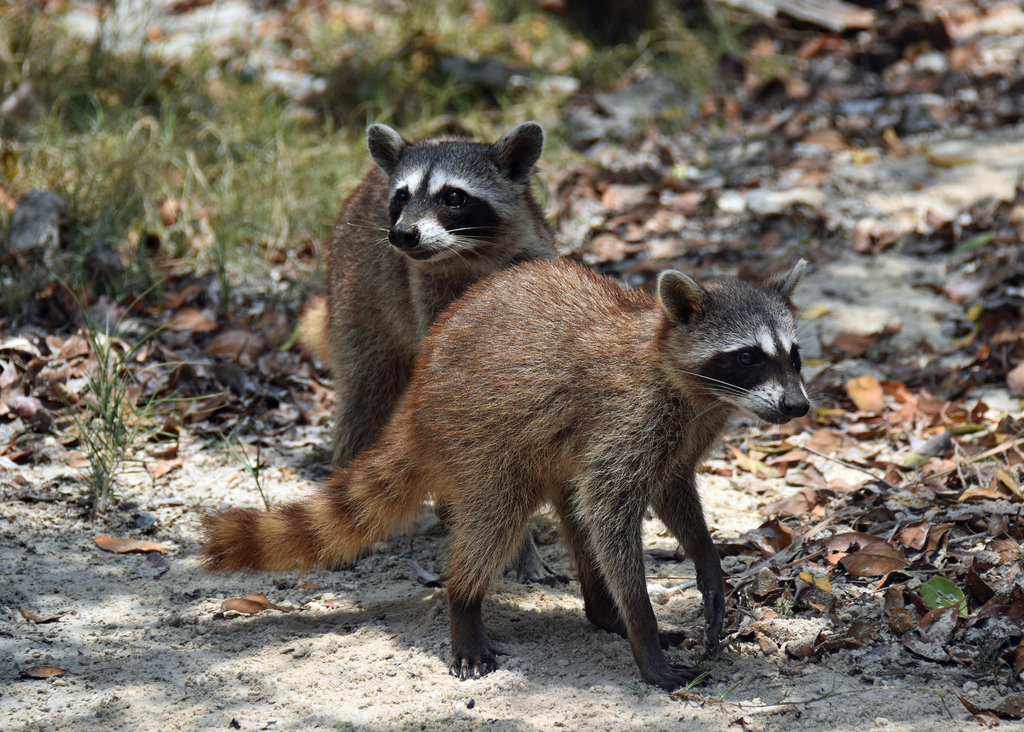
Pygmy Raccoon
Procyon pygmaeus
The Cozumel raccoon (Procyon pygmaeus) is a critically endangered species of island raccoon endemic on Cozumel Island off the coast of the Yucatan Peninsula, Mexico. It is sometimes also called the pygmy raccoon, dwarf raccoon, Cozumel Island raccoon, and Cozumel raccoon bear.
From the article Cozumel raccoon on Wikipedia (CC BY-SA), quoted section by section
Description
Merriam described the Cozumel raccoon as being markedly smaller, both externally and cranially and easy to distinguish from the common raccoon because of its "broad black throat band and golden yellow tail, short posteriorly expanded and rounded nasals and peculiarities of the teeth". Its reduced teeth point to a long period of isolation. Apart from its smaller size and more rounded snout, the Cozumel raccoon is similar in appearance to the common raccoon. The fur over the upper body is buff-grey ticked with occasional black hairs, while the underparts and legs are pale buff in color. The top of the head lacks the buff tinge of the rest of the body, and has a grizzled grey coloration, contrasting with the white fur of the muzzle and chin, and with the black "mask" pattern around the eyes. A line of brownish-grey fur runs down the middle of the snout, joining the "mask" patterns on either side. The tail is yellowish, with six or seven black or brown rings that become fainter on the underside. In males, the scruff of the neck has a patch of relatively bright, orange fur. Adults range from 58 to 82 centimeters (23 to 32 in) in total length, including the 23 to 26 centimeters (9.1 to 10.2 in) tail, and weigh between 3 and 4 kilograms (6.6 and 8.8 lb). …
Range & habitat
The Cozumel raccoon is endemic to Cozumel Island, an island around 478 square kilometers (185 sq mi) in area, lying off the east coast of the Yucatan Peninsula in Mexico. It is one of two raccoon species in Mexico, the other being the common raccoon (Procyon lotor), and is the only raccoon species present on Cozumel Island. Cozumel Island supports several other carnivores, including the dwarf coati (Nasua narica nelsoni) and dwarf gray fox (Urocyon sp.). Islands usually lack terrestrial mammals, especially carnivores, making the Cozumel raccoon and the others unique. On the island, the raccoon inhabits a range of habitats, but is primarily limited to the mangrove forests and sandy wetlands in the northwest tip of the island. However, it has also been captured in semi-evergreen forests and agricultural lands surrounding these preferred habitats., and in the Punta Sur ecological park at the south end of the island. A study on home range and activity patterns of the Cozumel raccoon found that individuals exhibit relatively small home ranges compared to mainland raccoons. Males maintain larger territories than females, and the species exhibits primarily nocturnal behavior, with peak activity occurring between sunset and 4:00 AM. Their movements are influenced by habitat quality and the presence of anthropogenic disturbances.
Wikipedia: “Distribution and habitat”
What it does
Relatively little is known about the group size of the raccoons. They are primarily nocturnal and solitary animals, but may sometimes form family groups possibly consisting of the mother and cubs. They have been observed making balls out of rolled paper and using them as toys. This behavior is passed between individuals through social learning within family groups.
The raccoons live in densities of about 17–27 individuals per km2, and inhabit home ranges of around 67 hectares (170 acres) on average. However, individuals do not appear to defend territories to any great extent, and their close relative, the common raccoon, can exist at very high densities when food is abundant. Although there have been no detailed studies of their reproductive habits, females seem to give birth primarily between November and January, possibly with a second litter during the summer months.
Wikipedia: “Behavior”
Listen
Looking for field recordings…
Where it lives
Recorded sightings
—
geo-referenced records in GBIF, from museums, herbaria and field observers.
Drag the globe to turn it. Dots are where records exist, not a range map; darker means more records.
In the stacks
Searching the stacks…
Every page naming Procyon pygmaeus in the Biodiversity Heritage Library →
This page is assembled live from iNaturalist, GBIF, Wikipedia, the Source Library and the Internet Archive. It is not yet part of the hand-edited codex. iNaturalist taxon 41662.