- Animals
- ›Chordates
- ›Vertebrates
- ›Mammals
- ›Therians
- ›Placental Mammals
- ›Ungulates, Carnivorans, and Allies
- ›Carnivorans
- ›Bears
- ›Short-faced Bears
- ›Tremarctos
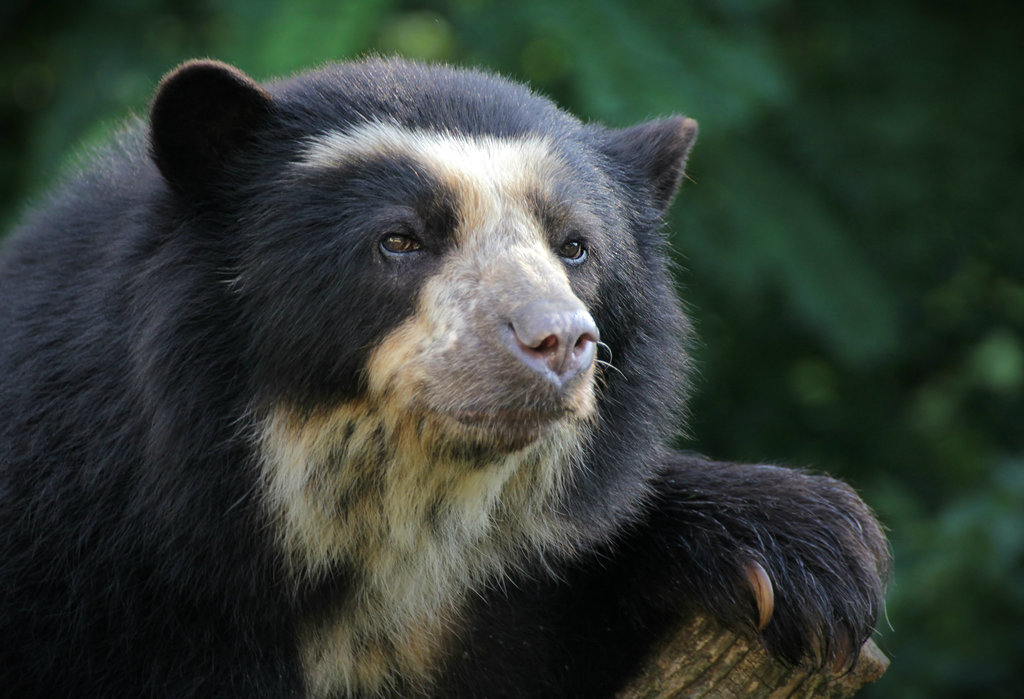
Spectacled Bear
Tremarctos ornatus
The spectacled bear (Tremarctos ornatus), also known as the Andean bear or Andean short-faced bear and locally as jukumari (Aymara), ukumari (Quechua) or ukuku, is the last remaining short-faced bear (subfamily Tremarctinae). Its closest relatives are the extinct Florida spectacled bear, and the giant short-faced bears of the Middle Pleistocene to Late Pleistocene age. Spectacled bears are the only surviving species of bear native to South America, and the only surviving member of the subfamily Tremarctinae....
From the article Spectacled bear on Wikipedia (CC BY-SA), quoted section by section
Description
The spectacled bear is a mid-sized species of bear. Overall, its fur is blackish in colour, though bears may vary from jet black to dark brown and to even a reddish hue. The species typically has distinctive beige or ginger-coloured markings across its face and upper chest, though not all spectacled bears have "spectacle" markings. The pattern and extent of pale markings are slightly different on each individual bear, and bears can be readily distinguished by this.
Wikipedia: “Appearance”
Range & habitat
Besides some rare spilling-over into eastern Panama, spectacled bears are mostly restricted to specific regions in northern and western South America. They can range in Venezuela, Colombia, Ecuador, Peru, western Bolivia, and northwestern Argentina. Its elongated geographical distribution is only 200 to 650 km (120 to 400 mi) wide but with a length of more than 4,600 km (2,900 mi). Post-Columbian remains from the Venezuelan Coastal Ranges suggests the spectacled bear's distribution was once more widespread in the Holocene. The species is found almost entirely in the Andes Mountains. Before spectacled bear populations became fragmented during the last 500 years, the species had a reputation for being adaptable, as it is found in a wide variety of habitats and altitudes throughout its range, including cloud forests, high-altitude grasslands (páramo), dry forests and scrub deserts. A single spectacled bear population on the border of Peru and Ecuador inhabited as great a range of habitat types as the world's brown bears (Ursus arctos) now occupy. The best habitats for spectacled bears are humid to very humid montane forests. These cloud forests typically occupy a 500 to 1,000 m (1,640 to 3,280 ft) elevational band between 1,000 and 2,700 m (3,280 and 8,860 ft) depending on latitude. Generally, the wetter these forests are the more food species there are that can support bears. …
Wikipedia: “Distribution and habitat”
What it does
Spectacled bears are one of four extant bear species that are habitually arboreal, alongside the American black bear (Ursus americanus) and Asian black bear (U. thibetanus), and the sun bear (Helarctos malayanus). In Andean cloud forests, spectacled bears may be active both during the day and night, but specimens in the Peruvian desert are reported to bed down under vegetative cover during the day. Their continued survival alongside humans has depended mostly on their ability to climb even the tallest trees of the Andes. They usually retreat from the presence of humans, often by climbing trees. Once up a tree, they may often build a platform, perhaps to aid in concealment, as well as to rest and store food on. Although spectacled bears are solitary and tend to isolate themselves from one another to avoid competition, they are not territorial. They have even been recorded to feed in small groups at abundant food sources. Males are reported to have an average home range of 23 km2 (8.9 sq mi) during the wet season and 27 km2 (10 sq mi) during the dry season. Females are reported to have an average home range of 10 km2 (3.9 sq mi) in the wet season and 7 km2 (2.7 sq mi) in the dry season. When encountered by humans or other spectacled bears, they will react in a docile but cautious manner, unless the intruder is seen as a threat or a mother's cubs are endangered. …
Wikipedia: “Behaviour”
In human culture
Tremarctos ornatus is commonly referred to in English as the "spectacled bear", a reference to the light colouring on its chest, neck and face, which may resemble spectacles in some individuals, or the "Andean bear" for its distribution along the Andes. The root trem comes from a Greek word meaning "hole"; arctos is the Greek word for "bear". Tremarctos is a reference to an unusual hole on the animal's humerus. Ornatus, Latin for "decorated", is a reference to the markings that give the bear its common English name. T. ornatus is locally known as jukumari (Aymara and Quechua), ukumari or ukuku (Quechua); translating to "hole bear", the tan facial markings usually appear on the face except around the bear's eyes, making it look like the bear has holes for eyes
Wikipedia: “Etymology”
Listen
Looking for field recordings…
Where it lives
Recorded sightings
—
geo-referenced records in GBIF, from museums, herbaria and field observers.
Drag the globe to turn it. Dots are where records exist, not a range map; darker means more records.
In the stacks
Searching the stacks…
Every page naming Tremarctos ornatus in the Biodiversity Heritage Library →
This page is assembled live from iNaturalist, GBIF, Wikipedia, the Source Library and the Internet Archive. It is not yet part of the hand-edited codex. iNaturalist taxon 41657.