- Animals
- ›Chordates
- ›Vertebrates
- ›Mammals
- ›Therians
- ›Placental Mammals
- ›Ungulates, Carnivorans, and Allies
- ›Carnivorans
- ›Bears
- ›Typical Bears
- ›Helarctos
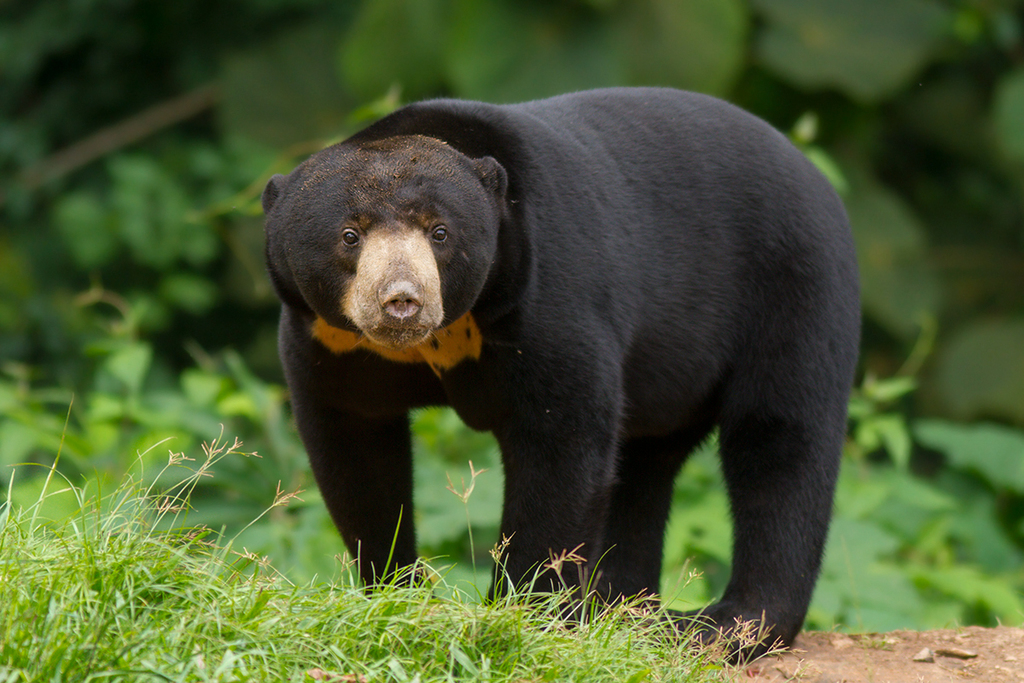
Sun Bear
Helarctos malayanus
The sun bear (Helarctos malayanus) is a bear species in the family Ursidae found in the tropical forests of Southeast Asia. It is the only species in the genus Helarctos and the smallest bear species, standing nearly 70 cm (28 in) at the shoulder and weighing 25–65 kg (55–143 lb). It is stockily built, with large paws, strongly curved claws, small, rounded ears and a short snout. The fur is generally short and jet black, but can vary from grey to red. The sun bear gets its name from its characteristic orange to cream-coloured chest patch.
The sun bear's unique morphology with inward-turned front feet, flattened chest, powerful forelimbs with large claws suggests adaptations for climbing, and it is an excellent climber and the most arboreal of all bears. It sunbathes or sleeps in trees 2 to 7 m (6 ft 7 in to 23 ft 0 in) above the ground. It is mainly active during the day, though nocturnality might be more common in areas frequented by humans. It tends to remain solitary, but sometimes occur in pairs such as a mother and her cub. It does not hibernate, possibly because food resources are available the whole year throughout its range. It is an omnivore, and its diet includes ants, bees, beetles, honey, termites, and plant material such as seeds and several kinds of fruits; vertebrates such as birds and deer are also eaten occasionally. It breeds throughout the year; individuals become sexually mature at two to four years of age. Litters comprise one or two cubs that remain with their mother for around three years.
From the article Sun bear on Wikipedia (CC BY-SA), quoted section by section
Description
The sun bear is named so for its characteristic orange- to cream-coloured, crescent-like chest patch. It is the smallest of all bear species. It is stockily built, with large paws, strongly curved claws, small rounded ears and a short snout. The head-and-body length is between 100 and 140 cm (39 and 55 in), and the shoulder height is nearly 70 cm (28 in). Males tend to be larger than females by roughly 10-20%. Adults weigh 25–65 kg (55–143 lb). The snout is grey, silver, or orange. The fur is generally jet black, but can vary from grey to red. The hair is silky and fine, and is the shortest of all bear species, suiting its hot tropical habitat. The characteristic chest patch, typically U-shaped, but sometimes circular or spotlike, varies from orange or ochre-yellow to buff or cream, or even white. Some individuals lack this patch. Sun bears can expose the patch while standing on their hind feet as a threat display against enemies. Infants are greyish black with a pale brown or white snout and the chest patch is dirty white; the coat of older juveniles may be dark brown. The underfur is particularly thick and black in adults, while the guard hairs are lighter. Two whorls occur on the shoulders, from whence the hair radiates in all directions. It has a crest on the sides of the neck and a whorl in the centre of the breast patch. …
Wikipedia: “Characteristics”
Range & habitat
H. annamiticus, described by Pierre Marie Heude in 1901 from Annam, is not considered a distinct species, but is subordinated as a junior synonym to H. m. malayanus. In 1906, Richard Lydekker proposed another subspecies by the name H. m. wardii for a sun bear skull, noting its similarities to a skull from Tibet with a thicker coat, but the Tibetan specimen was later found to be an Asian black bear (Ursus thibetanus). Genetic differences between the two subspecies are obscure and some consider the species monotypic.
Wikipedia: “Subspecies and distribution”
What it does
The sun bear leads a particularly arboreal lifestyle among bears. It is a capable climber; it sunbathes or sleeps in trees 2 to 7 m (6 ft 7 in to 23 ft 0 in) above the ground. Bedding sites consist mainly of fallen hollow logs, but they also rest in standing trees with cavities, underneath fallen logs or tree roots, and in tree branches high above the ground. It is also an efficient swimmer. The sun bear is solitary but is sometimes seen in pairs such as mothers and cubs. For a broad view of its surroundings or smell far-off objects, it stands on its hind feet; it tries to intimidate its enemies by displaying its chest patch if threatened. Its vocalisations includes grunts and snuffles while foraging for insects, and roars similar to those of a male orangutan during the breeding season; less commonly, it gives out short barks when surprised. It does not hibernate, possibly because food resources are available the whole year throughout the range. The sun bear is mainly active during the day, although nocturnality might be more common in areas frequented by humans. It is noted for its intelligence; a captive bear observed sugar being stored in a cupboard locked by a key, and later used its claw to open the lock. …
Wikipedia: “Ecology and behaviour”
In human culture
The generic name Helarctos comes from two Greek words: ήλιος (hēlios, related to the sun) and αρκτος (arctos, bear). Another name is "honey bear", beruang madu in Malay and Indonesian, in reference to its habit of feeding on honey from honeycombs.
Wikipedia: “Etymology”
Listen
Looking for field recordings…
Where it lives
Recorded sightings
—
geo-referenced records in GBIF, from museums, herbaria and field observers.
Drag the globe to turn it. Dots are where records exist, not a range map; darker means more records.
In the stacks
Searching the stacks…
Every page naming Helarctos malayanus in the Biodiversity Heritage Library →
This page is assembled live from iNaturalist, GBIF, Wikipedia, the Source Library and the Internet Archive. It is not yet part of the hand-edited codex. iNaturalist taxon 41655.