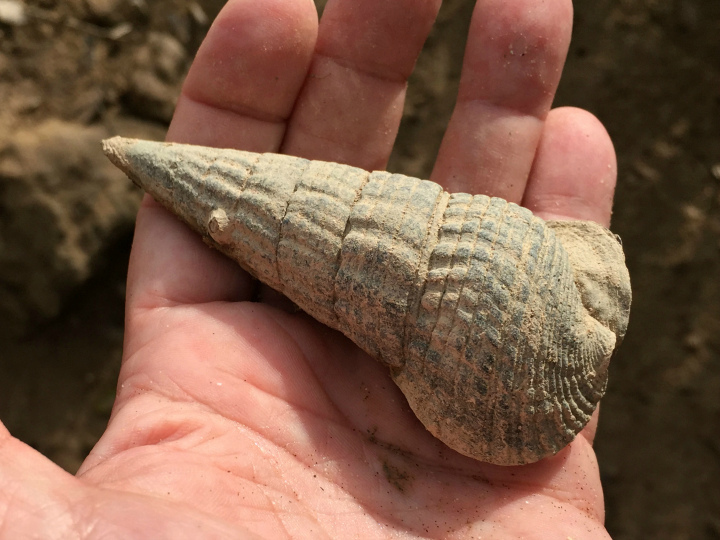
Giant Mangrove Whelk
Terebralia palustris
Terebralia palustris, common name the giant mangrove whelk, is a species of brackish-water snail, a gastropod mollusk in the family Potamididae. This tropical species which inhabits mangrove environments of the Indo-West Pacific region, has the widest geographic distribution amongst the potamidids extending from eastern Africa to northern Australia. Terebralia palustris is the largest mangrove gastropod, with a maximum shell length of 190 mm recorded from Arnhem Land, Australia.
From the article Terebralia palustris on Wikipedia (CC BY-SA), quoted section by section
Description
The head and foot are typically dark brown while the snout and tips of the cephalic tentacles are black. In females, a ciliated groove on the right side of the foot leads to a large, bulbous white ovipositor which is situated internally near the base of the foot. The hemocyanin of this species was analyzed by Lieb et al. in 2010. Its mega-hemocyanin have unusually high oxygen affinities.
Wikipedia: “Anatomy”
Range & habitat
This species has the widest distribution range of any Terebralia species. Its Western Pacific distribution extends south from the Ryukyus to the Philippines and across Borneo, New Guinea and tropical Australia. Eastwards, T. palustris is found as far as Palau as well the New Hebrides and New Caledonia.
The Indian Ocean occurrence of Terebralia palustris includes mangrove habitats throughout Indonesia and regions of South East Asia including India and Ceylon. The species has also been reported from the Andaman Islands, Nicobar, the Maldives, Mauritius, the Seychelles, the Amirantes and Madagascar. Terebralia palustris also occurs along the tropical and subtropical East African coastline including Kenya, Tanzania and Mozambique. The southern global distribution limit for this species is along the eastern subtropical coastline of South Africa. The northward extension of the African distribution is as far as the Red Sea.
Wikipedia: “Distribution”
What it does
It lives in the mud in mangrove forests. Terebralia palustris is a predominantly mangrove-associated species.
Wikipedia: “Ecology”
Where it lives
Recorded sightings
—
geo-referenced records in GBIF, from museums, herbaria and field observers.
Drag the globe to turn it. Dots are where records exist, not a range map; darker means more records.
In the stacks
Searching the stacks…
Every page naming Terebralia palustris in the Biodiversity Heritage Library →
This page is assembled live from iNaturalist, GBIF, Wikipedia, the Source Library and the Internet Archive. It is not yet part of the hand-edited codex. iNaturalist taxon 416328.