- Animals
- ›Chordates
- ›Vertebrates
- ›Mammals
- ›Therians
- ›Placental Mammals
- ›Ungulates, Carnivorans, and Allies
- ›Carnivorans
- ›Euplerids
- ›Civet-like Euplerids
- ›Cryptoprocta
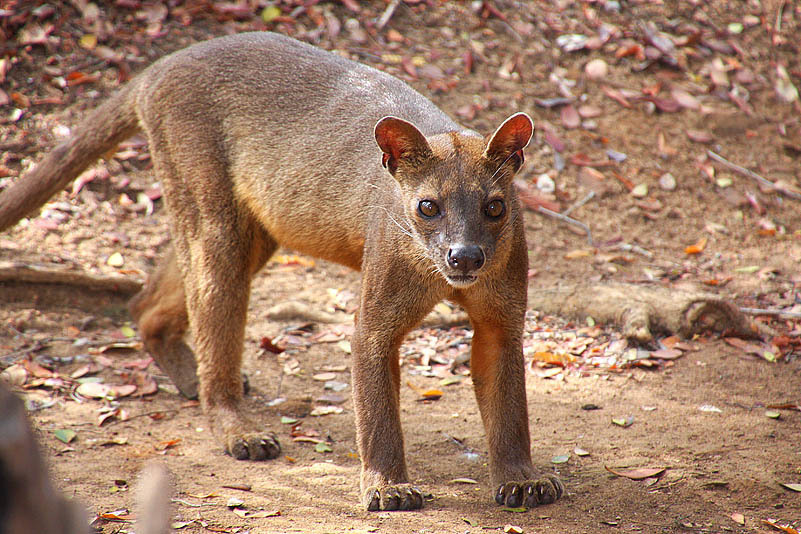
Fossa
Cryptoprocta ferox
The fossa (Cryptoprocta ferox; FOSS-ə or FOO-sə; Malagasy: [ˈfusə̥]) is a slender, long-tailed, cat-like mammal that is endemic to Madagascar. It is a member of the carnivoran family Eupleridae.
The fossa is the largest mammalian carnivore on Madagascar and has been compared to a small cougar, as it has convergently evolved many cat-like features. Adults have a head-body length of 70–80 cm (28–31 in) and weigh between 5.5 and 8.6 kg (12 and 19 lb), with the males larger than the females. It has semi-retractable claws (meaning it can extend but not retract its claws fully) and flexible ankles that allow it to climb up and down trees head-first, and also support jumping from tree to tree. Two larger extinct relatives of the species are known, Cryptoprocta spelea and Cryptoprocta bevatabe, with the former probably becoming extinct before 1400.
From the article Fossa (animal) on Wikipedia (CC BY-SA), quoted section by section
Description
The fossa appears as a diminutive form of a large felid, such as a cougar, but with a slender body and muscular limbs, and a tail nearly as long as the rest of the body. It has a mongoose-like head, relatively longer than that of a cat, although with a muzzle that is broad and short, and with large but rounded ears. It has medium brown eyes set relatively wide apart with pupils that contract to slits. Like many carnivorans that hunt at night, its eyes reflect light; the reflected light is orange in hue. Its head-body length is 70–80 cm (28–31 in) and its tail is 65–70 cm (26–28 in) long. There is some sexual dimorphism, with adult males (weighing 6.2–8.6 kg or 14–19 lb) being larger than females (5.5–6.8 kg or 12–15 lb). Smaller individuals are typically found north and east on Madagascar, larger ones to the south and west. Unusually large individuals weighing up to 20 kg (44 lb) have been reported, but there is some doubt as to the reliability of the measurements. The fossa can smell, hear, and see well. It is a robust animal and illnesses are rare in captive fossas.
Both males and females have short, straight fur that is relatively dense and without spots or patterns. Both sexes are generally a reddish-brown dorsally and colored a dirty cream ventrally. …
Range & habitat
The fossa has the most widespread geographical range of the Malagasy carnivores, and is generally found in low numbers throughout the island in remaining tracts of forest, preferring pristine undisturbed forest habitat. It is also encountered in some degraded forests, but in lower numbers. Although the fossa is found in all known forest habitats throughout Madagascar, including the western dry deciduous forests, the eastern rainforests, and the southern spiny forests, it is seen more frequently in humid than in dry forests. This may be because the reduced canopy in dry forests provides less shade, and also because the fossa seems to travel more easily in humid forests. It is absent from areas with the heaviest habitat disturbance and, like most of Madagascar's fauna, from the central high plateau of the country. The fossa has been found across several different elevational gradients in undisturbed portions of protected areas throughout Madagascar. In the Réserve Naturelle Intégrale d'Andringitra, evidence of the fossa has been reported at four different sites ranging from 810 to 1,625 m (2,657 to 5,331 ft). Its highest known occurrence was reported at 2,000 m (6,600 ft); its presence high on the Andringitra Massif was subsequently confirmed in 1996. …
Wikipedia: “Habitat and distribution”
What it does
The fossa is active during both the day and the night and is considered cathemeral; activity peaks may occur early in the morning, late in the afternoon, and late in the night. The animal generally does not reuse sleeping sites, but females with young do return to the same den. The home ranges of male fossas in Kirindy Forest are up to 26 km2 (10 sq mi) large, compared to 13 km2 (5.0 sq mi) for females. These ranges overlap—by about 30 percent according to data from the eastern forests—but females usually have separated ranges. Home ranges grow during the dry season, perhaps because less food and water is available. In general, radio-collared fossas travel between 2 and 5 kilometres (1.2 and 3.1 mi) per day, although in one reported case a fossa was observed moving a straight-line distance of 7 km (4.3 mi) in 16 hours. The animal's population density appears to be low: in Kirindy Forest, where it is thought to be common, its density has been estimated at one animal per 4 km2 (1.5 sq mi) in 1998. Another study in the same forest between 1994 and 1996 using the mark and recapture method indicated a population density of one animal per 3.8 km2 (1.5 sq mi) and one adult per 5.6 km2 (2.2 sq mi). Except for mothers with young and occasional observations of pairs of males, animals are usually found alone, so that the species is considered solitary. …
Wikipedia: “Behavior”
In human culture
The generic name Cryptoprocta refers to how the animal's anus is hidden by its anal pouch, from the Ancient Greek words crypto- "hidden", and procta "anus". The species name ferox is the Latin adjective "fierce" or "wild". Its common name comes from the word fosa Malagasy pronunciation: [ˈfusə̥] in Malagasy, an Austronesian language, and some authors have adopted the Malagasy spelling in English. The word is similar to posa (meaning "cat") in the Iban language (another Austronesian language) from Borneo, and both terms may derive from trade languages from the 1600s. However, an alternative etymology suggests a link to another word that comes from Malay: pusa refers to the Malayan weasel (Mustela nudipes). The Malay word pusa could have become posa for cats in Borneo, while in Madagascar the word could have become fosa to refer to the fossa.
Wikipedia: “Etymology”
Listen
Looking for field recordings…
Where it lives
Recorded sightings
—
geo-referenced records in GBIF, from museums, herbaria and field observers.
Drag the globe to turn it. Dots are where records exist, not a range map; darker means more records.
In the stacks
Searching the stacks…
Every page naming Cryptoprocta ferox in the Biodiversity Heritage Library →
This page is assembled live from iNaturalist, GBIF, Wikipedia, the Source Library and the Internet Archive. It is not yet part of the hand-edited codex. iNaturalist taxon 41578.