- Animals
- ›Cnidarians
- ›Sea Anemones and Corals
- ›Hexacorallians
- ›Sea Anemones
- ›Enthemonae
- ›Actinioidea
- ›Actiniid Sea Anemones
- ›Bunodosoma
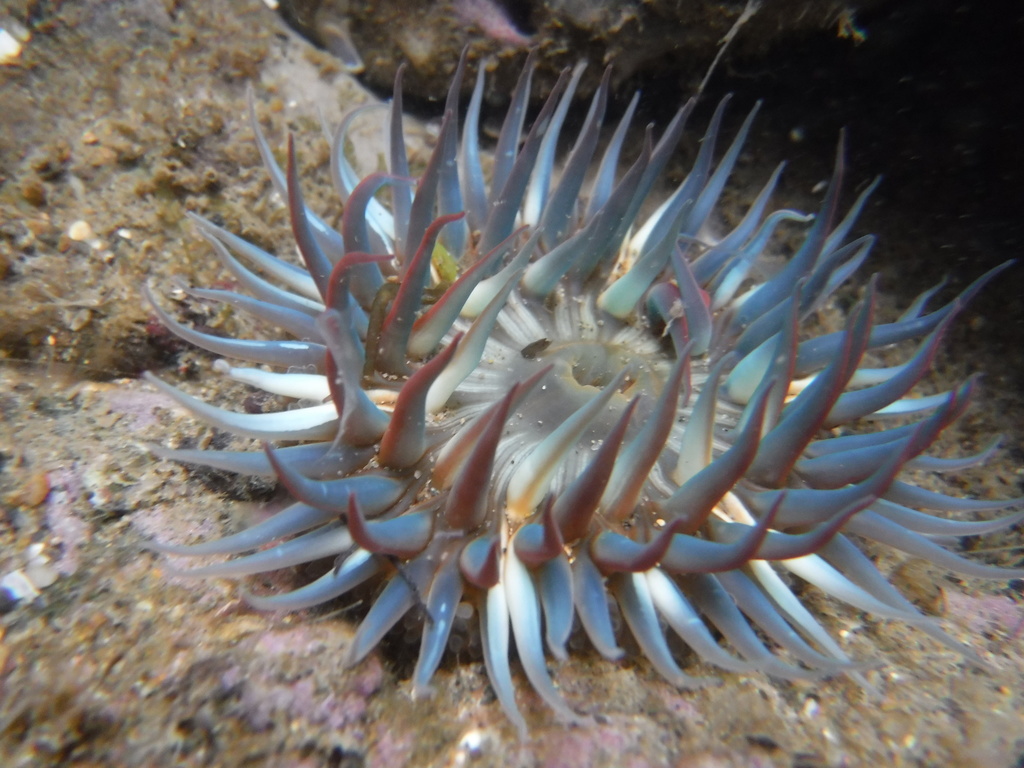
Warty Sea Anemone
Bunodosoma cavernatum
Bunodosoma cavernatum, commonly known as the warty sea anemone or the American warty anemone, is a species of sea anemone in the family Actiniidae. It occurs in the tropical and subtropical western Atlantic Ocean and the Caribbean Sea. It was first described in 1802 by the French naturalist Louis Augustin Guillaume Bosc, one of fourteen marine invertebrates described and named by him.
From the article Bunodosoma cavernatum on Wikipedia (CC BY-SA), quoted section by section
Description
Bunodosoma cavernatum is a robust species with a muscular trunk covered with 96 vertical rows of small, rounded, wart-like vesicles. The oral disc is smooth and the approximately 96 tentacles are arranged in five cycles. Each tentacle is of moderate length, smooth and tapering, the inner tentacles being longer than the outer ones. At their base are about 48 rounded lobular projections called acrorhagi which are armed with stinging cells. The colour of the trunk varies, being some shade of olive green, orange, red or brown. The tentacles are olive green, pale orange or reddish, with the oral disc being yellowish-brown, reddish-brown or olive green, sometimes with faint pale radial striping. When fully extended this sea anemone can reach 15 mm (0.6 in) in height, and the tentacles and oral disc when extended can reach 40 mm (1.6 in) in diameter.
Range & habitat
Bunodosoma cavernatum is native to the tropical and subtropical western Atlantic Ocean and the Caribbean Sea, its range extending from North Carolina to Texas, including Florida and the West Indies. It occurs in the lower part of the intertidal zone on rocks and jetties, and on other hard substrates underlying gravelly or sandy bottoms.
Wikipedia: “Distribution and habitat”
What it does
Bunodosoma cavernatum is nocturnal; during the night it expands and spreads out its tentacles to feed but during the day, it contracts into a reddish gelatinous blob. It feeds on small fish and any invertebrates that are encountered by its tentacles. The remains of a scorched mussel (Brachidontes exustus) have been found inside one individual.
== References ==
Wikipedia: “Ecology”
Where it lives
Recorded sightings
—
geo-referenced records in GBIF, from museums, herbaria and field observers.
Drag the globe to turn it. Dots are where records exist, not a range map; darker means more records.
In the stacks
Searching the stacks…
Every page naming Bunodosoma cavernatum in the Biodiversity Heritage Library →
This page is assembled live from iNaturalist, GBIF, Wikipedia, the Source Library and the Internet Archive. It is not yet part of the hand-edited codex. iNaturalist taxon 415301.