On eBird ↗
White-faced Storm-Petrel
Live sightings near you, the range map, bar charts of when it is seen, and Macaulay Library photos and recordings.
White-faced Storm-Petrel
Pelagodroma marina
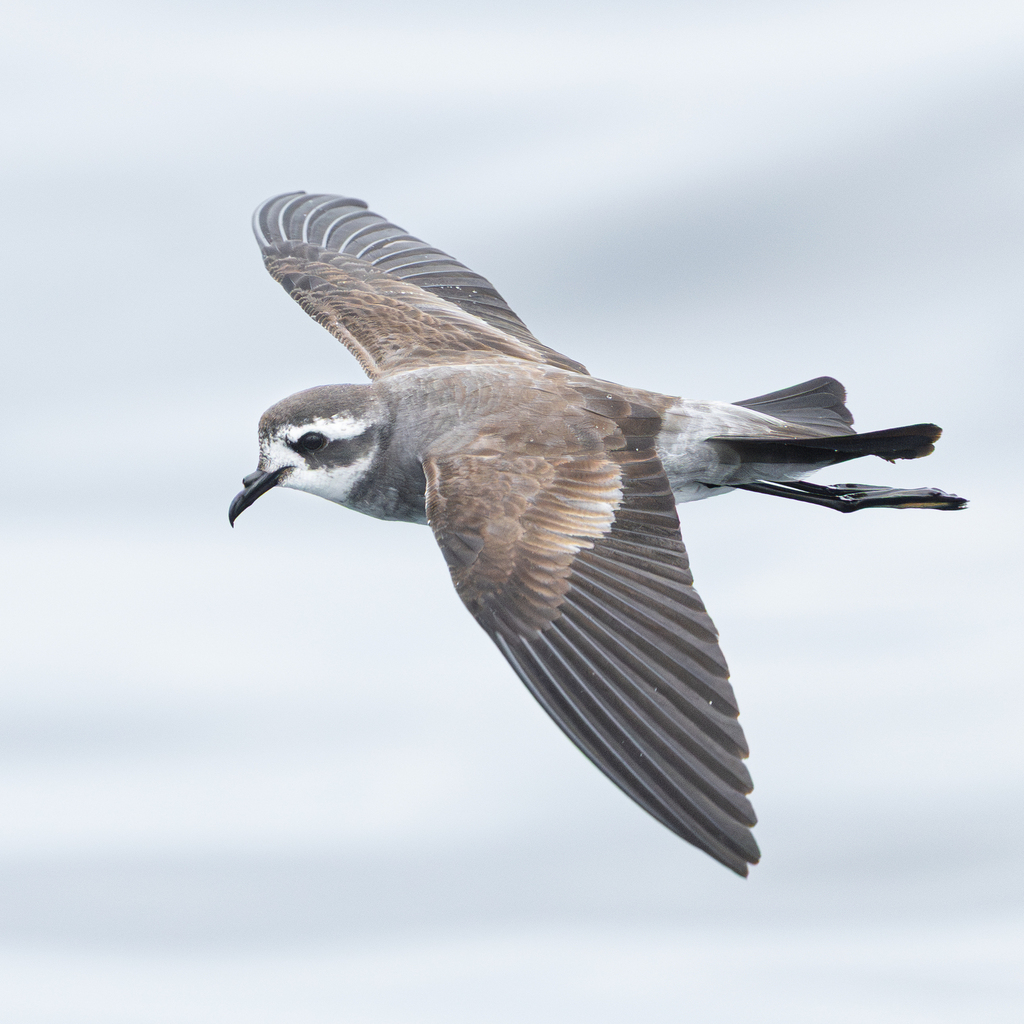
The white-faced storm petrel (Pelagodroma marina), (Māori: takahikare) also known as white-faced petrel or frigate petrel, is a small seabird of the austral storm petrel family Oceanitidae. It is the only member of the monotypic genus Pelagodroma. It is widely distributed across the northern and southern hemisphere, especially around the coastal and open ocean waters of southern Australia, New Zealand, Tristan da Cunha, Cabo Verde, the Canary islands and the Selvagens islands.
From the article White-faced storm petrel on Wikipedia (CC BY-SA), quoted section by section
Description
Commonly, the white-faced storm petrel is 19 to 21 centimetres (7.5 to 8.3 in) in length with a 41 to 44 centimetres (16 to 17 in) wingspan and 40 to 70 grams body mass. The key characteristics of this species include dark bill, tarsi, toes and claws. It has a pale brown to grey back, rump and wings with black flight feathers. It is white below, unlike other north Atlantic petrels, and has a white face with a black eye mask like a phalarope. Its distinctive grey-brown dorsal side plumage makes it one of the easier petrels to identify at sea from a distance. Both sexes of this frigate petrel have similar plumage with no seasonal variation. However, they have slight differences with females are larger than males in tarsus, wing and tail lengths by around 1–3%. On the other hand, males have a larger bill depth than females by about 1.7%.
While the juvenile and adult are similar, the juvenile's fresh plumage tends to have larger light fringes and tips to upperparts feathers, and depending on the moult, it may seem grey or brown. The juvenile's tail fork is also often shallower than the adult's, at least in the case of the subspecies in New Zealand, P. m. maoriana.
Certain subspecies exhibit subtle differences such as a subspecies on the Kermedec Islands, P. m. albiclunis is similar to P. m. dulciae but notable for its white rump and shorter, square tail, setting it apart from P. …
Range & habitat
Here are six recognised subspecies, breeding in island colonies through subtropical to subantarctic regions of the Atlantic, Indian and south-western Pacific Oceans in both hemisphere:
P. m. albiclunis Murphy & Irving, 1951 – Kermadec Islands P. m. dulciae Mathews, 1912 – islands off southern Australia, Houtman Abrolhos in Western Australia, east to the Broughton Islands in New South Wales and Tasmania. P. m. eadesi or eadoserum Bourne, 1953– Cape Verde Islands, within the North Atlantic. P. m. hypoleuca (Webb, Berthelot & Moquin-Tandon, 1842)– Savage Islands (Selvages Islands) in the North-east Atlantic being the host the majority of the world's population of this subspecies with only 50 pairs of breeding elsewhere. An estimate from 1996 suggested a total of 61,000 breeding pairs in the Selvagens Archipelago with 36,000 counted on Selvagem Grande alone. Other breeding spots which are Canary Islands such as Montaña Clara and Alegranza. P. m. maoriana Mathews, 1912 – islands around New Zealand, including the Chatham, Auckland Islands and Whero Island. P. m. marina (Latham, 1790) – Nightingale Islands, Tristan da Cunha, Inaccessible and Gough Island (Nominate subspecies).
Wikipedia: “Subspecies and their distributions”
What it does
The white-faced storm petrel is strictly pelagic outside the breeding season, and this, together with its often-remote breeding sites, makes this petrel a difficult bird to see from land. Only in severe storms might this species be pushed into headlands. It is highly gregarious, but does not follow ships. This seabird burrows on both rocky slopes and flat sandy areas, favoring isolated islets for its nests. Like most petrels, its walking ability is limited to a short shuffle to the burrow.
Breeding. The white-faced storm petrel breeds on remote islands in the south Atlantic, such as Tristan da Cunha and also Australia and New Zealand. There are also north Atlantic colonies on the Cape Verde Islands, Canary Islands and Savage Islands. It nests in dense colonies close to the sea in rock crevices and lays a single white egg. The burrows are very dense especially in forested areas where vegetation such as hollyhock and grasses help stabilize the soil, reducing the potential of burrows to collapse. It spends the rest of the year at sea and strictly nocturnal at the breeding sites to avoid predation by gulls and skuas, and will even avoid coming to land on clear moonlit nights. …
Wikipedia: “Behaviour”
Listen
Looking for field recordings…
Where it lives
Recorded sightings
—
geo-referenced records in GBIF, from museums, herbaria and field observers.
Drag the globe to turn it. Dots are where records exist, not a range map; darker means more records.
In the stacks
Searching the stacks…
Every page naming Pelagodroma marina in the Biodiversity Heritage Library →
This page is assembled live from iNaturalist, GBIF, Wikipedia, the Source Library and the Internet Archive. It is not yet part of the hand-edited codex. iNaturalist taxon 4153.