- Animals
- ›Chordates
- ›Vertebrates
- ›Mammals
- ›Therians
- ›Placental Mammals
- ›Ungulates, Carnivorans, and Allies
- ›Bats
- ›Yangochiroptera
- ›Sheath-tailed and Slit-faced Bats
- ›Sheath-tailed Bats
- ›Tomb and Pouched Bats
- ›Saccolaimus
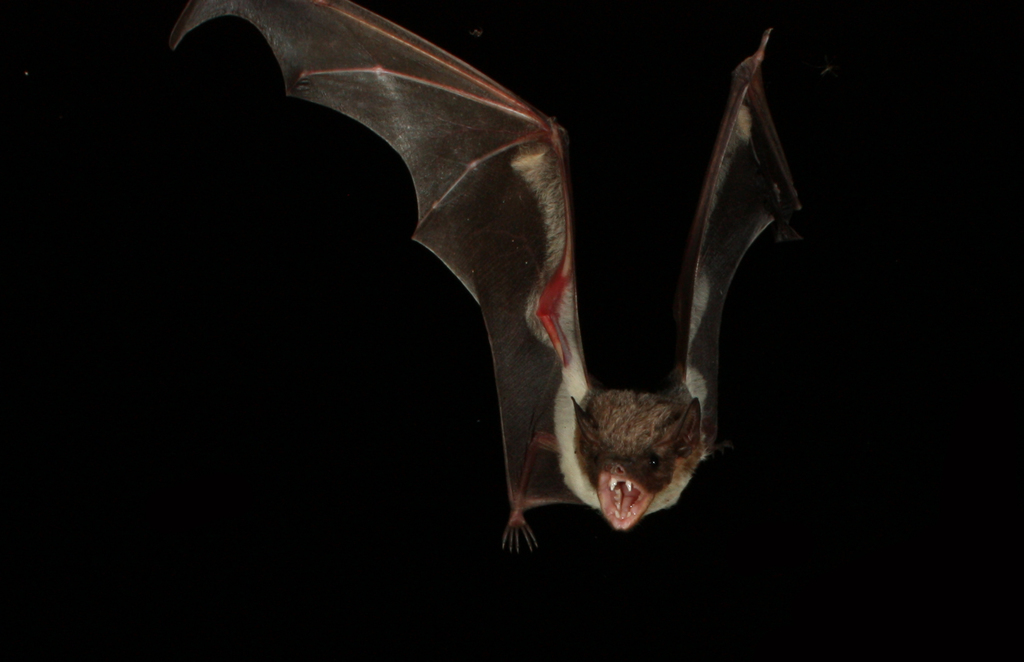
Papuan Pouched Bat
Saccolaimus mixtus
The Papuan sheath-tailed bat (Saccolaimus mixtus) is a species of bat in the family Emballonuridae which occurs at the Cape York Peninsula and New Guinea. The poorly known species hunts in open forests for night flying insects.
From the article Papuan sheath-tailed bat on Wikipedia (CC BY-SA), quoted section by section
Description
A species of Saccolaimus with dark hoary grey fur for across the back, the colour is darkest at the head and shoulder, the ventral side is pale buff-grey. The range of measurements of the forearm are 62 to 68 millimetres, the total length of head and body is 72 to 77 mm. It weighs around 24 grams. The ears are around 18 mm from the notch at the head to the tip, the bare skin of these, along with the muzzle and other parts of the face, is a dark brown colour. The pouch at the wing, a feature of related species, has a lining of whitish hairs. A throat pouch is also found on the species. this is quite prominent in males and presented as a bare patch of skin in females. The first harmonic of the call of the S. Mixtus is audible, their signals are recorded at 9 kilohertz, distinguishable in visual analysis from Saccolaimus flaviventris (yellow-bellied) and closely resembling S. saccolaimus (naked-rumped pouched bat). Their rapid wing beats, small size and ventral colour allows them to be distinguished in flight from known species by workers spotting with torchlight. They resemble another species also found in Australia S. flaviventris, which is discernible by its greater size, darker pelage and the presence of a developed throat pouch in the female.
Range & habitat
The distribution range extends from northern Australia to the southwest of Papua New Guinea. The occurrence at Cape York is only recorded at a few locations, seven collected at Weipa and several more at Brown's Creek near the Pascoe River at the north of the Cape York district. S. mixtus is associated with forest of western Queensland dominated by the stringybark Eucalyptus tetrodonta, and is recorded in small groups occupying dead specimens of that tree. The little information on their life history and habitat is derived from observations in New Guinea, where it is associated with roosts limestone caves and forages over the canopy of the forest. Their daytime roosts in Australia are tree hollows. They appear to favour hunting over the canopy and at open flight paths over streams and clearings. Surveys undertaken in Australia have suggested evidence of a greater range than was previously established, extending the area it may occur to southern parts and western regions of Cape York and at islands to the north. The species has been reported at Pormpuraaw, Queensland.
Wikipedia: “Distribution and habitat”
Listen
Looking for field recordings…
Where it lives
Recorded sightings
—
geo-referenced records in GBIF, from museums, herbaria and field observers.
Drag the globe to turn it. Dots are where records exist, not a range map; darker means more records.
In the stacks
Searching the stacks…
Every page naming Saccolaimus mixtus in the Biodiversity Heritage Library →
This page is assembled live from iNaturalist, GBIF, Wikipedia, the Source Library and the Internet Archive. It is not yet part of the hand-edited codex. iNaturalist taxon 41341.