- Animals
- ›Chordates
- ›Vertebrates
- ›Mammals
- ›Therians
- ›Placental Mammals
- ›Ungulates, Carnivorans, and Allies
- ›Bats
- ›Yangochiroptera
- ›Sheath-tailed and Slit-faced Bats
- ›Sucker-footed Bats
- ›Myzopoda
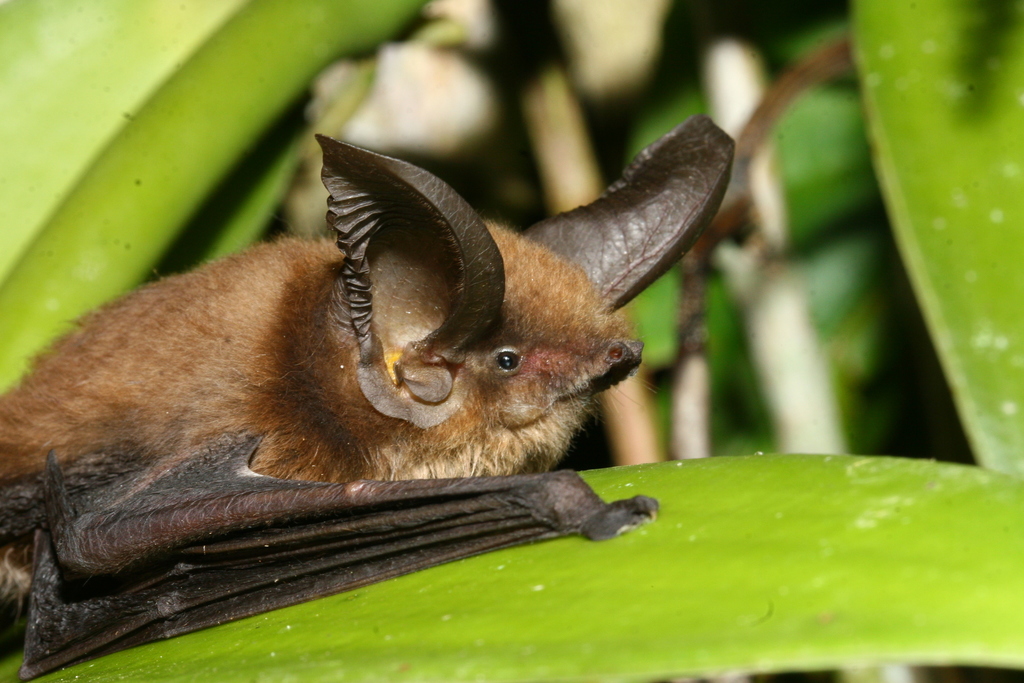
Eastern Sucker-footed Bat
Myzopoda aurita
The Madagascar sucker-footed bat, Old World sucker-footed bat, or simply sucker-footed bat (Myzopoda aurita) is a species of bat in the family Myzopodidae endemic to Madagascar, especially in the eastern part of the forests. The genus was thought to be monospecific until a second species, Myzopoda schliemanni, was discovered in the central western lowlands. It was classified as Vulnerable in the 1996 IUCN Red List of Threatened Species but is now known to be more abundant and was reclassified in 2008 as of "Least Concern".
The bat is named for the presence of small cups on its wrists and ankles. They roost inside the rolled leaves of the traveller's tree, using their suckers to attach themselves to the smooth surface. Despite the name, it is now known that the bats do not use suction to attach themselves to roost sites, but instead use a form of wet adhesion by secreting a body fluid at their pads. The ankle and wrist pads of the bat are controlled by muscle contraction and allow the bat to separate the pads to reduce the adhesive effect. This allows the bats to climb with ease and to remove themselves from surfaces after sticking. Due to this property the Madagascar sucker-footed bat is one of the few bat species that roosts with its head up rather than upside down. This is so the bat does not accidentally lose control of the adhesive pads while it is sleeping due to the muscle tension associated with roosting upside down.
Listen
Looking for field recordings…
Where it lives
Recorded sightings
—
geo-referenced records in GBIF, from museums, herbaria and field observers.
Drag the globe to turn it. Dots are where records exist, not a range map; darker means more records.
In the stacks
Searching the stacks…
Every page naming Myzopoda aurita in the Biodiversity Heritage Library →
This page is assembled live from iNaturalist, GBIF, Wikipedia, the Source Library and the Internet Archive. It is not yet part of the hand-edited codex. iNaturalist taxon 41210.