- Animals
- ›Chordates
- ›Vertebrates
- ›Mammals
- ›Therians
- ›Placental Mammals
- ›Ungulates, Carnivorans, and Allies
- ›Bats
- ›Yangochiroptera
- ›Noctilionoid Bats
- ›New World Leaf-nosed Bats
- ›Stenodermatine Bats
- ›Stenodermatini
- ›Uroderma
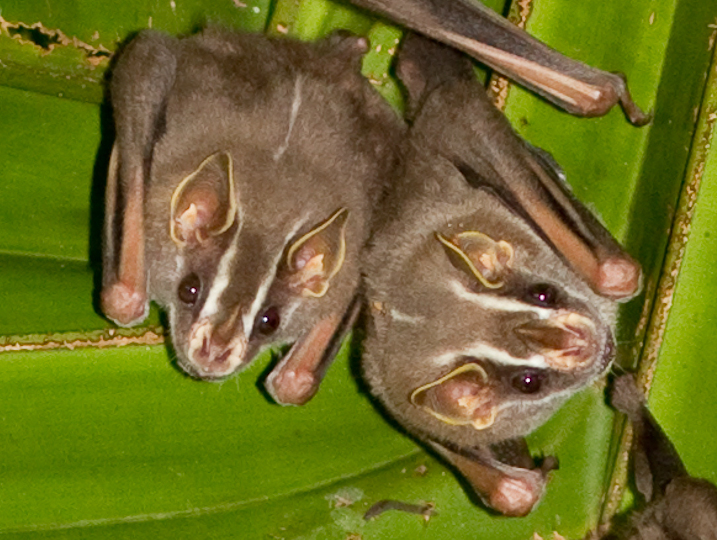
Common tent-making Bat
Uroderma bilobatum
The tent-making bat (Uroderma bilobatum) is an American leaf-nosed bat (Phyllostomidae) found in lowland forests of Central and South America. This medium-sized bat has a gray coat with a pale white stripe running down the middle of the back. Its face is characterized by a fleshy nose-leaf and four white stripes. Primarily a frugivore, it may supplement its diet with insects, flower parts, pollen, and nectar. Its common name comes from its behavior of constructing tents out of large, fan-shaped leaves. These roosts provide excellent protection from the tropical rains, and a single tent roost may house several bats at once. This bat's conservation status is listed as Least Concern, as it is quite common in its geographic range.
From the article Tent-making bat on Wikipedia (CC BY-SA), quoted section by section
Description
Uroderma bilobatum is medium in size, weighing between 13 and 20 g with a body length of 59–69 mm. Typically, the females are slightly larger than the males. Their pelage ranges in color from dark gray to grayish brown, with their belly slightly lighter in color than their back. The individual hairs of their coat are bicolor, being lighter in color at the base than at the top. A thin, white stripe runs down the middle of the back from behind the head to the rump. The face has two striking symmetrical pairs of white stripes. One pair goes over the head, between and to the back of the ears. The other pair lies just below the eye. This facemask may serve a camouflage purpose by making their eyes less obvious to would-be predators. Their brown noseleaf and ears are rimmed with yellow or white. They have a U-shaped tail membrane that is practically hairless and measures 14–16 mm in length. A dorsal view of their skull reveals a depression between the frontal bone and their snout. Their dental formula is i 2/2, c 1/1, p 2/2, m 3/3, which gives them a total of 32 teeth. They also possess a calcar and a slightly pigmented, permanently open dactylopatagium minus.
Range & habitat
These bats are found in Central America from Oaxaca and Veracruz, Mexico to Peru, Bolivia, and southeastern Brazil. They also live on the island of Trinidad. Most specimens have been collected at elevations below 600 m, but some have been found as high as 1500 m above sea level.
Wikipedia: “Geographic distribution”
What it does
Uroderma bilobatum lives in low-elevation evergreen and deciduous forests, second-growth forests, and fruit groves. They are primarily frugivores and have been observed carrying small, unripe figs in their mouths. They will also feed on the pericarp of small palm fruits and occasionally common guavas. At times they may supplement their diet with insects, flower parts, nectar, or pollen.
Wikipedia: “Habitat and diet”
In human culture
The genus name Uroderma is said to be derived from the Greek words uro for "tail" and derma for "skin", thus meaning "tail of skin". This describes their tail membrane, which is made entirely of skin, lacking tail vertebrae. The proper word for "tail" in ancient Greek is however oura (οὐρά). The species name bilobatum is said to be derived from the Greek and Latin roots bi for "two" and lobat for "lobed" in reference to their first upper incisors, which have two lobes.
Wikipedia: “Etymology”
Listen
Looking for field recordings…
Where it lives
Recorded sightings
—
geo-referenced records in GBIF, from museums, herbaria and field observers.
Drag the globe to turn it. Dots are where records exist, not a range map; darker means more records.
In the stacks
Searching the stacks…
Every page naming Uroderma bilobatum in the Biodiversity Heritage Library →
This page is assembled live from iNaturalist, GBIF, Wikipedia, the Source Library and the Internet Archive. It is not yet part of the hand-edited codex. iNaturalist taxon 41153.