- Animals
- ›Chordates
- ›Vertebrates
- ›Mammals
- ›Therians
- ›Placental Mammals
- ›Ungulates, Carnivorans, and Allies
- ›Bats
- ›Yangochiroptera
- ›Noctilionoid Bats
- ›New World Leaf-nosed Bats
- ›Nectar Bats and Allies
- ›Lonchophyllini
- ›Platalina
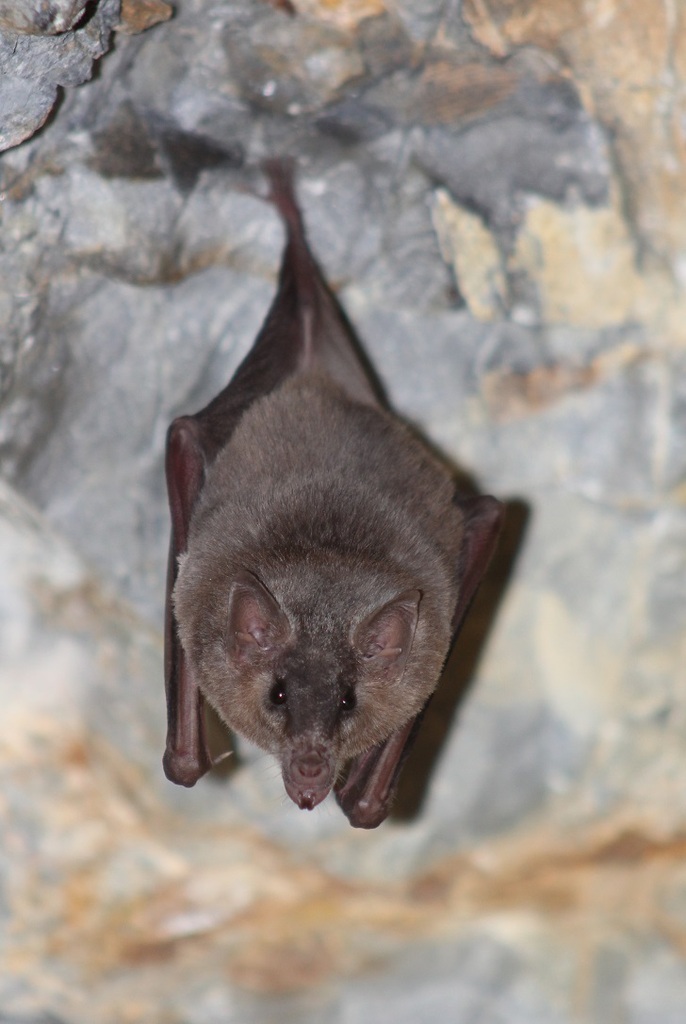
long-snouted bat
Platalina genovensium
The long-snouted bat (Platalina genovensium) is a species of bat in the family Phyllostomidae. It is the only species within the genus Platalina. It is endemic to northern Peru and northern Chile. It feeds almost exclusively on the nectar and fruit of the columnar cactus. The species is rare, but has a wide distribution with at least 25 populations, and is listed as near-threatened due to habitat loss causing the removal of their primary food source.
From the article Long-snouted bat on Wikipedia (CC BY-SA), quoted section by section
Description
Captured long-snouted bats range in length from 7.2 to 8.9 cm with a tail length of 0.5 to 1.1 cm and forearm length of 12.8 to 26.5 cm. Weights range from 12.8 to 26.5 g with the upper weight range including a pregnant female. More typical measurements are total length around 81 mm, wing extension of 341 mm, and weights of 19.5 to 19.9 grams. Wing area is the largest of any known glossophagine with wing loading the lowest. This may be due to the high altitude. It is the largest bat within the family Lonchophyllinae. This size could be an adaptation for night temperatures approaching 0c. The bat is known for its extremely elongated muzzle which could indicate increased specialization. In addition, the tongue is long, extendable and covered in papillae. The upper incisors are broad and spoon shaped with a diamond-shaped nose-leaf. The interfemoral membrane is long and sparsely haired with the tail extending 1/3 of the way into the membrane. The body is pale brown with the base of each hair being lighter than the tip. The underside is also lighter than the back.
Range & habitat
On the western slopes of the Andes, this species ranges from Piura in the North to Tacna in the south. Most research has centered on Arequipa. On the eastern slopes, there is only one known population near Huánuco. Elevations range from sea level to 2500 m although no individual has been collected below 2200 m. Populations are strongly associated with desert habitats dominated by columnar cactus. This range is hypothesized to change with precipitation events as populations move to more moist areas during El Niño events.
Wikipedia: “Range”
What it does
The long-snouted bat has an obligate mutualistic relationship with the W. weberbaueri and as a result, this species is the primary pollinator and seed disperser for this species. This species of cactus produces fruit year around, even after 17 months without rain which allows minimal bat populations to persist. Platalina genovensium increases the successful fruit production from 40% to 77%, significantly increasing available food available in the ecosystem for rodents and birds. During and following drought, two species of hummingbird (Patagona gigas and Rhodopis vesper) also play a role in pollination. The bats supplement their diet with small coleopterans found within the flower but the primary component of their diet is cactus pollen. Carbon isotope analysis has determined that the long-snouted bat feeds almost exclusively on CAM plants or insects that feed on CAM plants. Other species which may play a role in their diet to an unknown degree include Browningia candelaris, Neoraimondia arequipensis, Coryocactus brevistylus, Echinopsis chiloensis, Armatocereus procerus, and Weberbauerocereus rauhii. Carrying capacity can range from 5 bats per ha during rainy years to .5 bats in drought years. Activity peaked around 8 pm.
Wikipedia: “Diet”
Listen
Looking for field recordings…
Where it lives
Recorded sightings
—
geo-referenced records in GBIF, from museums, herbaria and field observers.
Drag the globe to turn it. Dots are where records exist, not a range map; darker means more records.
In the stacks
Searching the stacks…
Every page naming Platalina genovensium in the Biodiversity Heritage Library →
This page is assembled live from iNaturalist, GBIF, Wikipedia, the Source Library and the Internet Archive. It is not yet part of the hand-edited codex. iNaturalist taxon 41133.