- Animals
- ›Chordates
- ›Vertebrates
- ›Mammals
- ›Therians
- ›Placental Mammals
- ›Ungulates, Carnivorans, and Allies
- ›Bats
- ›Yangochiroptera
- ›Noctilionoid Bats
- ›New World Leaf-nosed Bats
- ›Flower Bats
- ›Phyllonycteris
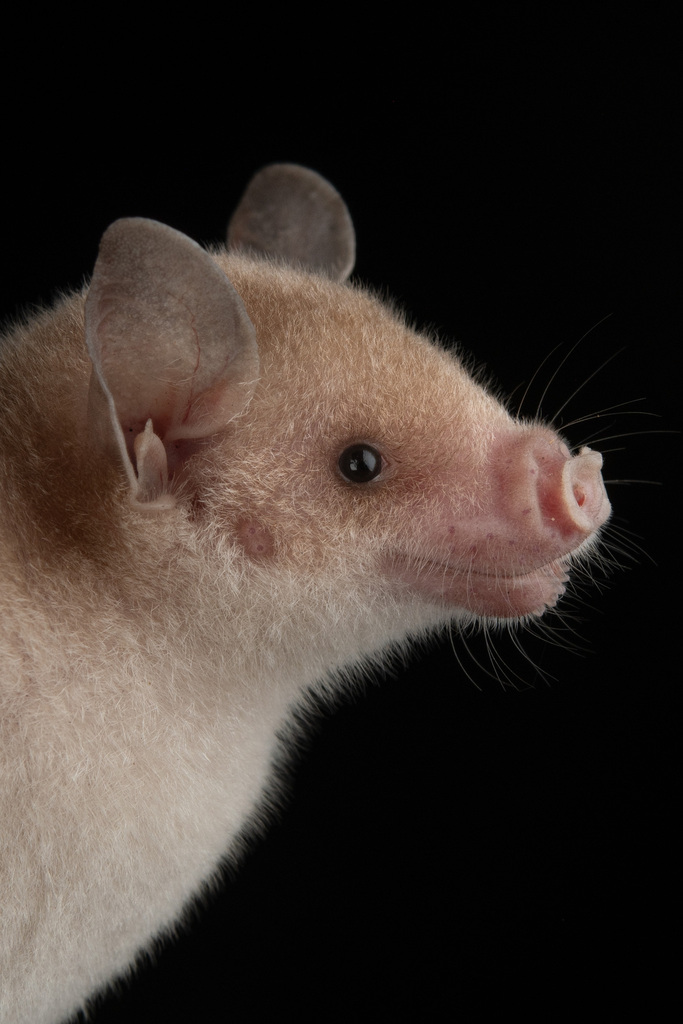
Jamaican flower bat
Phyllonycteris aphylla
The Jamaican flower bat (Phyllonycteris aphylla) is a critically endangered species of bat in the family Phyllostomidae. It is endemic to Jamaica.
From the article Jamaican flower bat on Wikipedia (CC BY-SA), quoted section by section
Description
It weighs 14–18 g (0.49–0.63 oz). Its total body length is 88 mm (3.5 in). Its forearm is 48 mm (1.9 in) long. On the dorsal side of the forearm, its skin is pink. Its ears are 16 mm (0.63 in) long and 12 mm (0.47 in) wide. The tragus is 8 mm (0.31 in). It has a disc-shaped, basic nose-leaf at the end of its snout. The fur is short, with individual hairs approximately 6 mm (0.24 in) long on its back and 4 mm (0.16 in) long on its belly. Its feet are very large in relation to its body, at 17 mm (0.67 in), and the uropatagium lacks a calcar. Like other members of the Glossophaginae subfamily, it has a long tongue tipped with lingual papillae. Its skull is larger and more robust than most other Glossophagines, though. Fur is silky in texture. Dorsal fur is blond or light gold, while ventral fur is almost white. Its flight membranes are dark brown or almost black in color.
Range & habitat
It is only found on Jamaica. It is currently only known to roost in four caves: Marta Tick Cave, Green Grotto Caves, Rock Spring Caverns and the largest population at Stony Hill Cave. Previously, a "sizeable colony"–the only one known for this species–roosted in St. Clair Cave, although the Jamaican flower bat is no longer found there. Per McFarlane 1986, Goodwin 1970 stated that the bat could be found in three caves: St. Clair Cave, Riverhead Cave, and Mt. Plenty Cave. Goodwin also stated that fossilized remains of the species had been found in Wallingford and Runaway Bay Caves.
Wikipedia: “Range and habitat”
In human culture
It was described by American zoologist Gerrit Smith Miller Jr. in 1898. He initially placed it in the genus Reithronycteris, which is now synonymous with Phyllonycteris. The specimen that he described was collected in Jamaica; the date of collection and the exact location are unknown. The type specimen used to describe the species has since been lost. Its species name aphylla was derived from the Ancient Greek word áphullos, meaning "leafless." This is likely in reference to its small nose-leaf.
Wikipedia: “Taxonomy and etymology”
Listen
Looking for field recordings…
Where it lives
Recorded sightings
—
geo-referenced records in GBIF, from museums, herbaria and field observers.
Drag the globe to turn it. Dots are where records exist, not a range map; darker means more records.
In the stacks
Searching the stacks…
Every page naming Phyllonycteris aphylla in the Biodiversity Heritage Library →
This page is assembled live from iNaturalist, GBIF, Wikipedia, the Source Library and the Internet Archive. It is not yet part of the hand-edited codex. iNaturalist taxon 41130.