- Fungi Including Lichens
- ›Basidiomycete Fungi
- ›Higher Basidiomycetes
- ›Mushrooms, Bracket Fungi, Puffballs, and Allies
- ›Agaricomycetidae
- ›Common Gilled Mushrooms and Allies
- ›Marasmiineae
- ›Mycenaceae
- ›Roridomyces
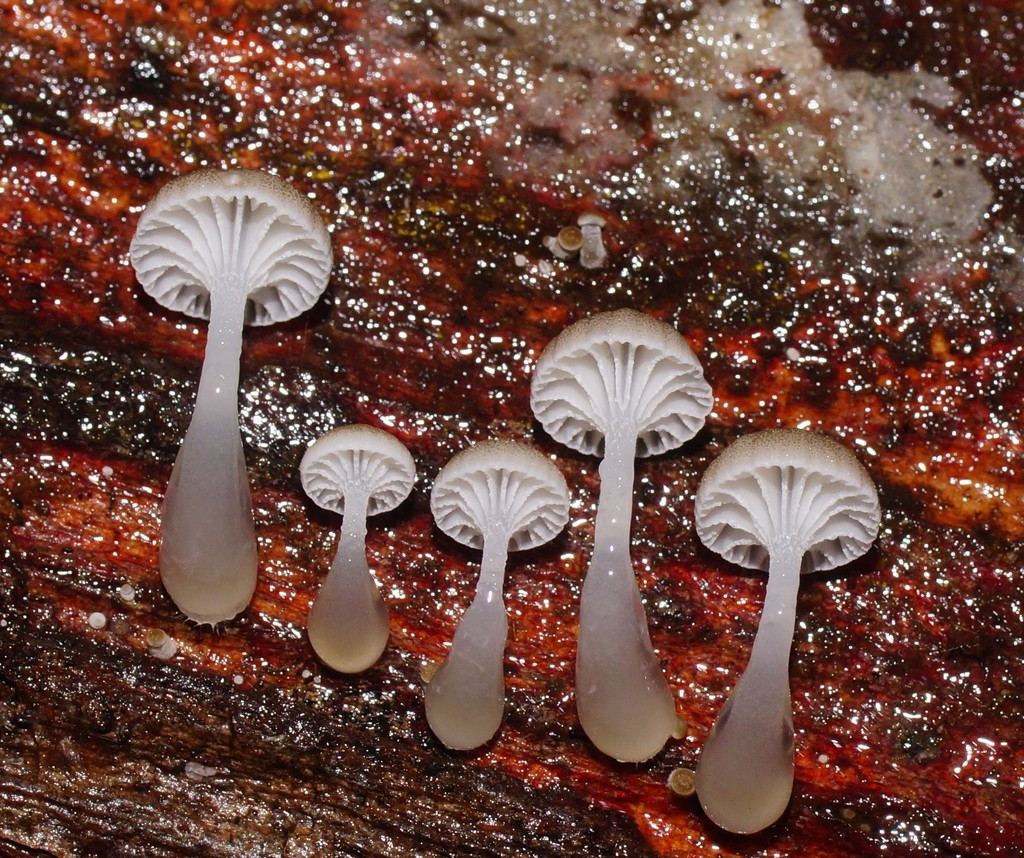
Austral Dripping Bonnet
Roridomyces austrororidus
Roridomyces austrororidus, commonly known as the austro dripping bonnet, is a species of agaric fungus in the family Mycenaceae. Described as new to science in 1962 by American mycologist Rolf Singer, it is found in South America, New Zealand, and Australia, where it grows on rotting wood.
The fruit bodies (mushrooms) have several distinguishing characteristics that facilitate identification, including thick, white, mucilaginous stipes, and white to pale cream, convex caps that measure 1–2 cm (0.4–0.8 in). The gills are white, widely spaced, and have a fused or decurrent attachment to the stipe. Spores are smooth, ellipsoid, and measure about 9–15 by 6–9 micrometres. The smooth and white stipes are 4–6 cm (1.6–2.4 in) long and 0.1–0.2 cm (0.04–0.08 in) thick, and covered with a thick coating of gluten.
From the article Roridomyces austrororidus on Wikipedia (CC BY-SA), quoted section by section
Description
The cap is shallowly convex to convex or irregularly convex, and with or without a shallow umbo, measuring up to 16 mm (0.63 in) in diameter and up to 5 mm (0.2 in) high. The cap margin is curved downward, sometimes slightly flared, and sometimes has translucent radial striations marking the positions of the gills underneath. The white flesh—thickest at the center of the cap—tapers gradually to the margin. The gills are broadly adnate (fused) to decurrent (running down the length of the stipe). The gill edges are either smooth and even, or may have minute teeth. The gills are well-spaced, with 16 to 24 gills extending fully from the cap margin to the stipe, and two or three tiers of interspersed lamellulae (short gills that do not extend fully from the cap margin to the stipe). The smooth, cylindrical stipe is up to 27 mm (1.1 in) long, and up to 2.5 mm (0.1 in) in diameter at the base, narrowing towards the top. It is hollow, silky to shiny, and mucilaginous—usually with thick slime at the base. Sometimes, there are short white hairs at the bottom of the stipe, although their presence is variable. The mushroom has no distinctive odor. Spores are roughly ellipsoidal in shape with a Q ratio (the fraction of length/width) of 1.6, and dimensions of 9.4–15.4 by 6.2–9.0 μm. …
Range & habitat
Like all members of its genus, Roridomyces austrororidus grows as a saprophyte on rotting wood. In Australia, the fungus fruits in clusters or groups on rainforest trees, decayed logs, fallen Eucalyptus branches, Bedfordia salicina logs and branches, and Nothofagus cunninghamii logs. Fruiting usually occurs after rainy periods from April to June, although the mushroom has also been collected in August. New Zealand collections have been reported to grow on Pinus, Leptospermum, and Ripogonum. A study of fungal succession in a wet eucalypt forest in Tasmania demonstrated that R. austrororidus prefers mature forests (with at least 70 years of growth since the last wildfire), and fruits on small diameter wood—typically twigs with a width less than 15 mm (0.6 in). Roridomyces austrororidus occurs in Argentina, Chile, New Zealand, and Australia. Its Australian distribution includes Queensland, New South Wales, Victoria, Tasmania and Western Australia. Australian mycologist Tony Young suggests that the geographical distribution of the fungus indicates that its ancestor may have originated from the ancient continent Gondwana.
Wikipedia: “Habitat and distribution”
Where it lives
Recorded sightings
—
geo-referenced records in GBIF, from museums, herbaria and field observers.
Drag the globe to turn it. Dots are where records exist, not a range map; darker means more records.
In the stacks
Searching the stacks…
Every page naming Roridomyces austrororidus in the Biodiversity Heritage Library →
This page is assembled live from iNaturalist, GBIF, Wikipedia, the Source Library and the Internet Archive. It is not yet part of the hand-edited codex. iNaturalist taxon 411067.