- Animals
- ›Arthropods
- ›Crustaceans
- ›Typical Crustaceans
- ›Barnacles and Copepods
- ›Barnacles and Allies
- ›Barnacles
- ›Normal Barnacles
- ›Thoracican Barnacles
- ›Symmetrical Sessile Barnacles
- ›Chthamaloidea
- ›Chthamalid Barnacles
- ›Chamaesipho
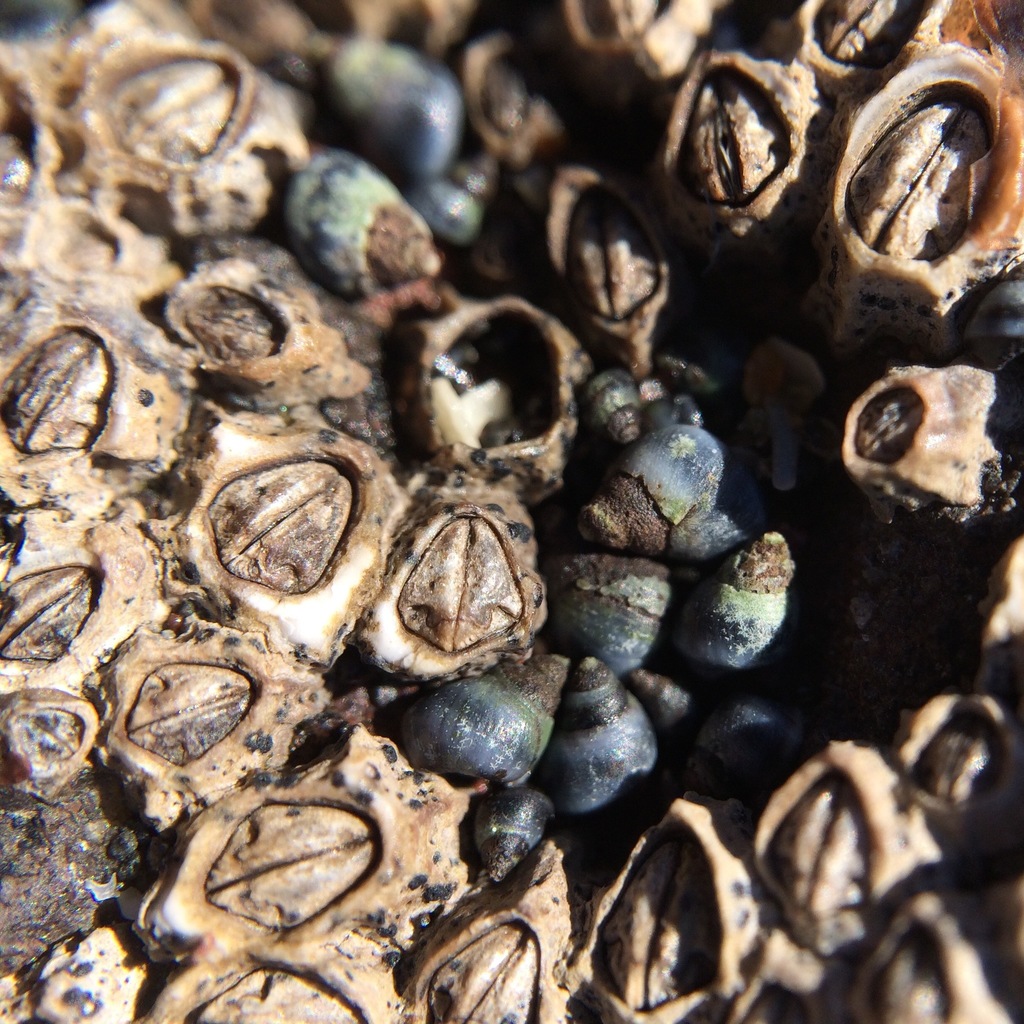
Column Barnacles
Chamaesipho columna
Chamaesipho columna is the type species for the barnacle genus Chamaesipho. Originally, species concept, as refined by Darwin472 consisted of C. columna. Spengler's 1790 description included specimens from "Otaheite" (Tahiti), which were far larger than any of the three described species. As Chamaesipho is restricted to Australia and New Zealand, and Spengler's Tahiti material lacked opercular plates, it is no longer included as Chamaesipho. Spengler's written description agrees with Chamaesipho.472 Spengler's Tahiti material is thought to be New Zealand Epopella, mislabeled.
Later authors recognized Chamaesipho columna populations really represented three species. Moore, 1944, recognized a second New Zealand population with sufficient anatomical differences to warrant description as Chamaesipho brunnea. The two species substantially overlap, and are sympatric. Australian Chamaesipho' specimens were seen to represent a third species, which was proposed as Chamaesipho tasmanica. Neither New Zealand species occurs naturally in Australia.
From the article Chamaesipho columna on Wikipedia (CC BY-SA), quoted section by section
Description
Adult shells are very small, rostrocarinal diameter of not more than 9 mm in solitary specimens, 4 mm in columnar growth individuals. Height of crowded individuals reaches to 16 mm, 6 mm in solitary specimens. The shell is whitish, and erodes to show pitting. Juvenile shell wall of 6 plates, becoming four plated by diameter of .5mm, and sutures fuse together, cannot be seen in adult, even when etched with acid. Basis is membraneous. Opercular plates are deeply interlocked with sinuous articulation, and subject to considerable environmental wear, making large variations in individual appearance and shape.471 Articulation is not nearly as deep as in Chamaesipho brunnea. Interior of scutum shows a wide shallow adductor pit, and small lateral depressor pit. There is a distinct low rounded scutal adductor ridge, in contrast to that of C. brunnea, which has at best poorly developed ridge. Scutal articular ridge, which in chthamaloids is large central lobe on tergal margin, is rounded. In C. brunnea, this lobe is very large and rectangular. The tergum is much narrower than in C. brunnea, with articular margin bearing two rounded relatively shallow re-entrants. Chamaesipho brunnea shows a single very deep re-entrant. Tergal depressor crests are prominent in both species, with fewer (to about four) in C. columna, versus up to seven in C. brunnea. …
Wikipedia: “Description and Discussion”
Where it lives
Recorded sightings
—
geo-referenced records in GBIF, from museums, herbaria and field observers.
Drag the globe to turn it. Dots are where records exist, not a range map; darker means more records.
In the stacks
Searching the stacks…
Every page naming Chamaesipho columna in the Biodiversity Heritage Library →
This page is assembled live from iNaturalist, GBIF, Wikipedia, the Source Library and the Internet Archive. It is not yet part of the hand-edited codex. iNaturalist taxon 410718.