- Animals
- ›Arthropods
- ›Crustaceans
- ›Typical Crustaceans
- ›Malacostracans
- ›Decapods, Isopods, and allies
- ›Decapods and Krill
- ›Decapods
- ›Crabs, Lobsters, Shrimps, and Allies
- ›True Crabs
- ›Eubrachyuran Crabs
- ›Heterotrematan Crabs
- ›Rock and Horse Crabs
- ›Rock Crabs
- ›Metacarcinus
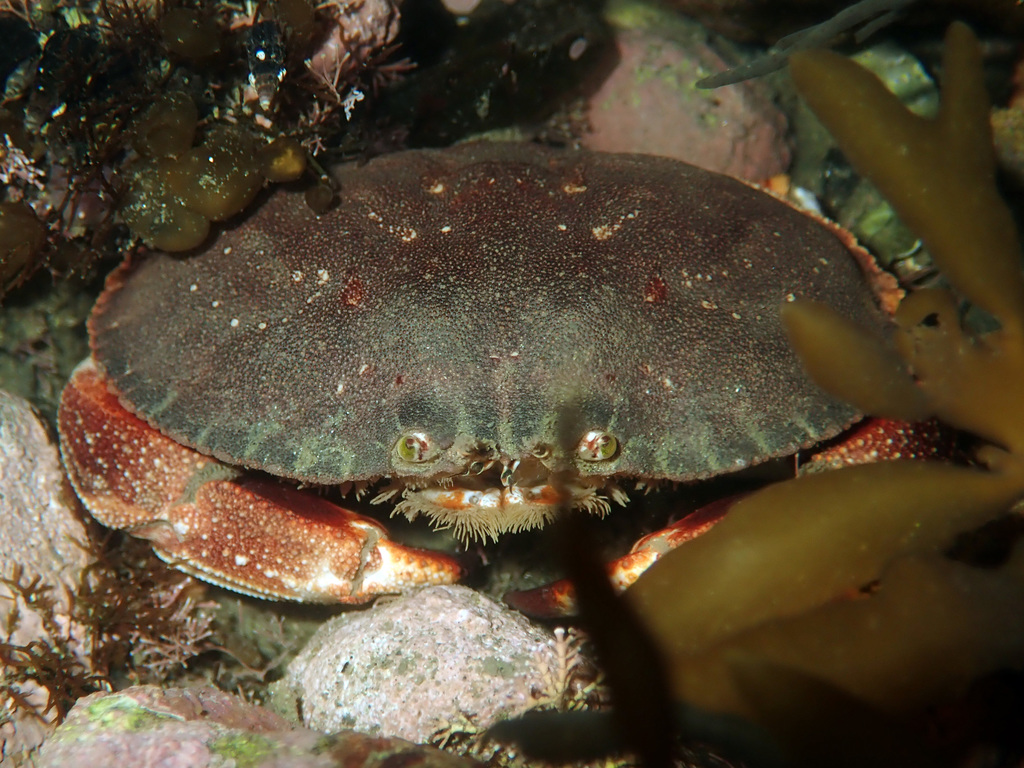
Pie Crust Crab
Metacarcinus novaezelandiae
The pie crust crab (Metacarcinus novaezelandiae, formerly Cancer novaezelandiae), is a species of crab found around New Zealand and south-eastern Australia.
From the article Pie crust crab on Wikipedia (CC BY-SA), quoted section by section
What it does
In larval form Metacarcinus novaezelandieae consumes mostly tiny plankton. Once fully grown though they are primarily carnivorous, hunting nocturnally and preying on a variety of organisms. Molluscs (bivalves, gastropods and cephalopods) make up approximately one third of its diet and are its main food source; followed by crustaceans (amphipods, isopods, crabs and shrimp) which make up about 20% of its diet. Other food sources include small fish, sea anemones, sea sponges and algae. M. novaezelandieae hunts by using its powerful chelae to catch, kill, crush and access its prey, then feeds using its mouthparts. Its claws are capable of breaking open the tough shells of molluscs allowing the crab to reach the soft mollusc body inside and feed on it. Its claws allow it to effectively kill other forms of prey such as crustaceans as well.
Wikipedia: “Diet and foraging”
At the table
New Zealand Maori have historically eaten crabs as part of their kai moana (food from the ocean) diet. Crabs were an easy resource to gather as they are often found in coastal shallows, making them easily accessible sea food. M. novaezelandieae is most likely among the many species of crabs the Maori ate, as it grows to a size large enough to be considered for eating, as well as being found throughout New Zealand. Sea food including M. novaezelandieae are still claimed by Maori today as a cultural food resource.
Wikipedia: “Cultural uses”
Where it lives
Recorded sightings
—
geo-referenced records in GBIF, from museums, herbaria and field observers.
Drag the globe to turn it. Dots are where records exist, not a range map; darker means more records.
In the stacks
Searching the stacks…
Every page naming Metacarcinus novaezelandiae in the Biodiversity Heritage Library →
This page is assembled live from iNaturalist, GBIF, Wikipedia, the Source Library and the Internet Archive. It is not yet part of the hand-edited codex. iNaturalist taxon 410433.