- Animals
- ›Molluscs
- ›Bivalves
- ›Autobranchia
- ›Heteroconchia
- ›Euheterodonta
- ›Imparidentia
- ›Venerids
- ›Veneroidea
- ›Venus Clams
- ›Venerinae
- ›Austrovenus
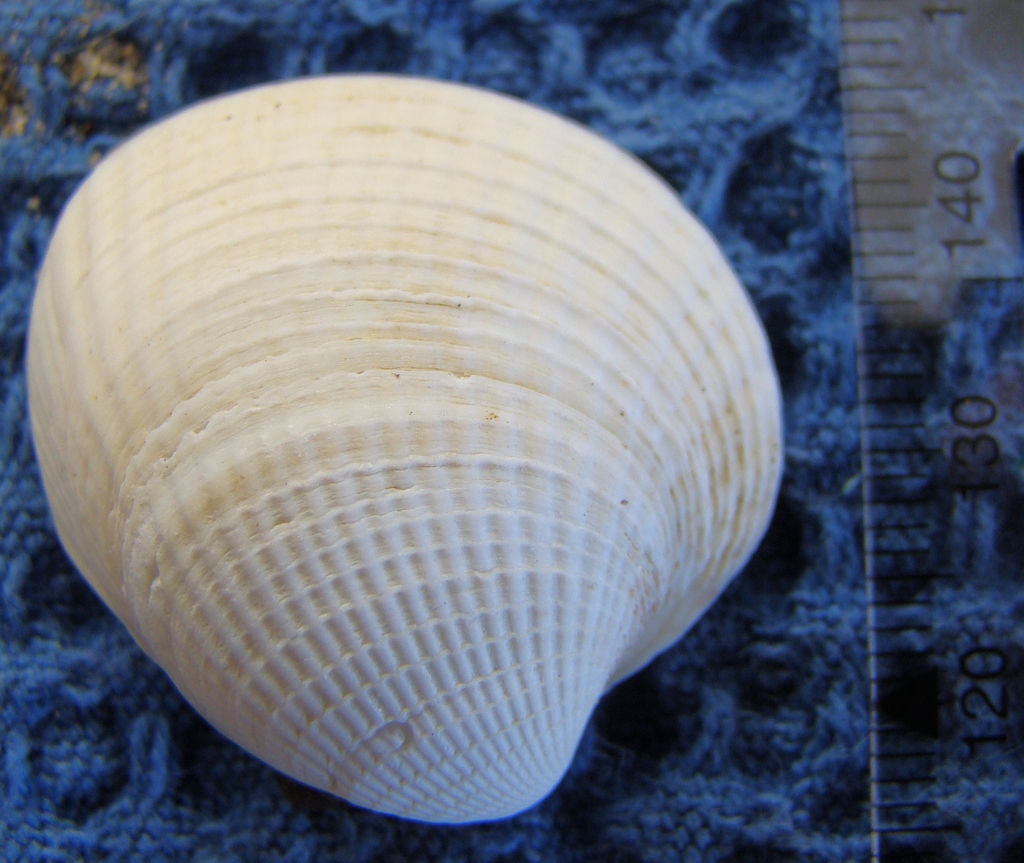
New Zealand Cockle
Austrovenus stutchburyi
Austrovenus stutchburyi, commonly known as the New Zealand cockle or New Zealand little neck clam, is a marine bivalve in the family Veneridae that occurs only in New Zealand. Its Māori name is tuangi in the North Island or tuaki in the South Island. The shell is between 15 to 65 mm (0.59 to 2.56 in) in length, but may reach up to 90 mm (3.5 in). The outside is dirty white; the inside is porcelain white and often has purple stains. A. stutchburyi is widespread throughout the coasts of New Zealand, including the Chatham Islands and subantarctic Auckland Islands. It is found in the intertidal-to-low-tide zone in muddy and fine sands. A. stutchburyi feeds via suspension feeding, where food particles are filtered out of the water. The species is often harvested for food, active commercial harvesting occurring in the Dunedin and Tasman regions. It is a traditional food source for Māori people, who have an archaeological history of harvesting A. stutchburyi and have customary fishing rights to harvest it in areas of cultural significance.
Spawning occurs in spring and summer; the larvae (juvenile stage) attach to a surface within twenty days. The rate at which A. stutchburyi grows depends heavily on environmental conditions such as salinity, food availability and temperature. A. stutchburyi may support primary production (the conversion of inorganic carbon to organic compounds) by releasing ammonium ions within ecosystems. Its predators include crabs, wading birds, large whelks (carnivorous shellfish) and stingrays.
From the article Austrovenus stutchburyi on Wikipedia (CC BY-SA), quoted section by section
Description
The A. stutchburyi shell has two valves, essentially two halves of a single shell, joined by an elastic material (the ligament), as is typical for bivalves. The hinge line, where the two valves meet, is rather wide. Each valve is 15 to 65 mm (0.59 to 2.56 in) long, but can occasionally exceed 90 mm (3.5 in). The shell's overall size can vary slightly throughout New Zealand, being slightly larger in the southern parts of the country. The shell's outer surface has a dirty white colour, at times with rust-coloured stains. The shell's interior is porcelain white and frequently stained purple towards one end of the shell. Occasionally, most of the interior is purple. The shell's interior presents circular scars impressed into the surface where the adductor muscles (which close the shell) attach to it. The outer surface has distinctive ribs running down and across the shell; those running down the shell become less prevalent towards the margin. After veliger larvae settle on substrate, they are at least 180 μm in length. The hinge joining the two larval shells has a projection on the right shell that opposes two projections on the left. There are also ridges on the margins of the left shell that slot into the right shell. Overall, the veliger larvae have an appearance typical of Veneridae larvae.
Range & habitat
A. stutchburyi is endemic to (only found in) New Zealand and occurs throughout the two mainland islands, as well as Stewart Island (just south of the South Island), the Chatham Islands 800 km (500 mi) east of the mainland and the subantarctic Auckland Islands 465 km (289 mi) south of the mainland. It lives along the shoreline in sheltered areas with muddy sediment and fine sands, such as in estuaries and harbours. It typically occurs from upper mid-intertidal zones to just below the lowest tide level reached during spring tides. In these habitats, A. stutchburyi can be extremely abundant with population density varying between sites. At Akaroa Harbour in Canterbury, the species was estimated to have a population density of 1,200 per m2 at one study site and 500 per m2 at another nearby study site. A. stutchburyi are usually buried just below the sediment surface or protrude slightly. They rarely burrow more than 50–100 mm (2.0–3.9 in) below the surface. In palaeontological assessments, fossils of A. stutchburyi can be used to infer the historical presence of a brackish sheltered environment, although water currents can move shells away from these environments.
Population genetics. In one study of A. stutchburyi population genetics, the haplotypes (groups of genetic variants) of the cytochrome oxidase I (COI) gene from 29 estuaries were sequenced. …
Wikipedia: “Distribution and habitat”
What it does
The excretions of A. stutchburyi are a source of ammonium ions, which support primary production (the conversion of inorganic carbon to organic compounds) in the water by photosynthetic microbes when production is limited by nitrogen abundance. It has also been proposed that these photosynthetic microbes promote oxygen uptake by the sediment. There is a correlation between density of A. stutchburyi and seagrass (Zostera muelleri) density. It has been proposed that the two species benefit from shared space, the seagrass providing shelter to A. stutchburyi, thus reducing mortality, while A. stutchburyi releases ammonium ions, which supports growth of the seagrass. However, abundant populations of each can also occur without the other. Mats of seaweed sometimes overlap in habitat with A. stutchburyi. In laboratory conditions, mats of the red algae Gracilaria chilensis and green algae Ulva lowered the concentration of dissolved oxygen in the sediment by preventing microbes from photosynthesising. As a result, A. stutchburyi buried itself at a shallower depth. In experiments where the dissolved oxygen in the sediment was artificially lowered to mimic these conditions, A. stutchburyi tended to move to the surface, and died after about eleven days. This suggests that seaweed mats have a negative effect on populations of A. stutchburyi.
Diet. A. …
Wikipedia: “Ecology and behaviour”
Toxicity
Like other species of shellfish, A. stutchburyi is capable of causing neurotoxic shellfish poisoning in humans after exposure to red tides, which release toxins into the water that are subsequently absorbed by A. stutchburyi. Following a shellfish poisoning outbreak in 1993, two brevetoxins (naturally occurring toxins harmful to the nervous tissue), brevetoxin B1 (BTX-B1) and brevetoxin B5 (BTX-B5), were isolated from A. stutchburyi. The latter was also found in the bivalves Perna canaliculus and Crassostrea gigas. In a laboratory study, A. stutchburyi broke down brevetoxins PbTx-2 to PbTx-3, BTX-B5 and BTX-B1. The study proposed that PbTx-3 and BTX-B5 may be effective markers for monitoring hazardous shellfish since these toxins persisted in A. stutchburyi the longest, thus being easier to detect.
Wikipedia: “Shellfish poisoning”
In human culture
A. stutchburyi is a traditional food source for Māori people. Middens (old dump sites for domestic waste) dating back to pre-European contact often contained shells of A. stutchburyi. The shells in middens can be used to make inferences about historical Māori activity and changes in the species' populations. In the Bay of Islands, middens are rich in remains of A. stutchburyi, suggesting that in was a dietary staple in the area. The shells are also notably larger than in current day, indicating that the modern populations are being hindered by increased sedimentation and reduced resistance to parasites. In another study, the growth rates of A. stutchburyi from six midden sites around New Zealand were all found to have decreased from AD 1300 to present day. Like in the Bay of Islands, it was suggested that this was due to increased sedimentation. Since 1998, Māori often have customary fishing rights to harvest A. stutchburyi in some areas of cultural significance.
Wikipedia: “In Māori culture”
Where it lives
Recorded sightings
—
geo-referenced records in GBIF, from museums, herbaria and field observers.
Drag the globe to turn it. Dots are where records exist, not a range map; darker means more records.
In the stacks
Searching the stacks…
Every page naming Austrovenus stutchburyi in the Biodiversity Heritage Library →
This page is assembled live from iNaturalist, GBIF, Wikipedia, the Source Library and the Internet Archive. It is not yet part of the hand-edited codex. iNaturalist taxon 409698.