- Animals
- ›Chordates
- ›Vertebrates
- ›Mammals
- ›Therians
- ›Placental Mammals
- ›Ungulates, Carnivorans, and Allies
- ›Bats
- ›Yinpterochiroptera
- ›Pteropodoidea
- ›Old World Fruit Bats
- ›Flying-foxes, Monkey-faced Bats and allies
- ›Flying-foxes and allies
- ›Styloctenium
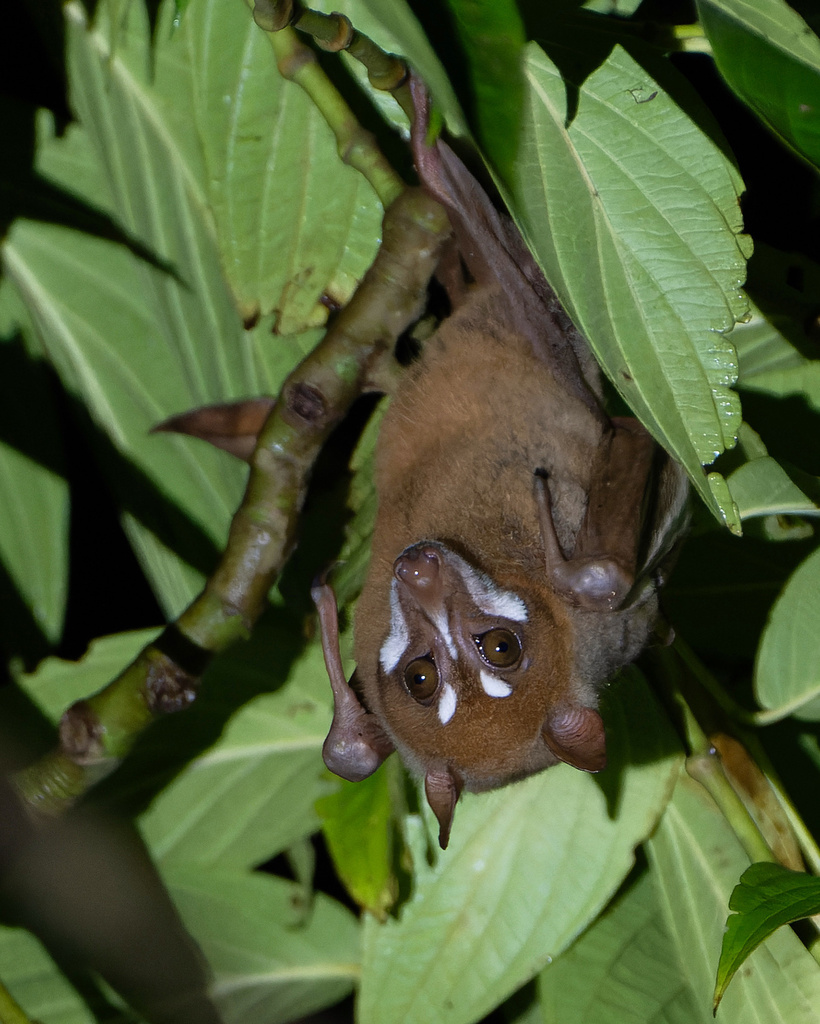
Wallace's Stripe-faced Fruit Bat
Styloctenium wallacei
The Wallace's or Sulawesi stripe-faced fruit bat (Styloctenium wallacei) is a species of megabat in the family Pteropodidae. It is endemic to Sulawesi and the nearby Togian Islands of Indonesia. Cave paintings resembling these bats have been found in Australia, where bats of this kind are not otherwise known.
From the article Sulawesi stripe-faced fruit bat on Wikipedia (CC BY-SA), quoted section by section
Description
The Sulawesi stripe-faced fruit bat is a typical fruit bat with long, naked ears, forearms modified for flight and short hind legs with claws. There are white facial markings, each with a dark brown margin; a streak on the rostrum, a spot on the cheek, another at the angle of the jaw, a patch over the eye, a band across the upper lip and a patch on the chin. The only other known species of the genus Styloctenium, S. mindorensis, is differentiated by its multicusped lower and upper canine teeth.
Range & habitat
The Sulawesi stripe-faced fruit bat is native to the island of Sulawesi in the Greater Sunda Islands and the Togian Islands in the Gulf of Tomini . It inhabits primary forest at altitudes of up to about 1,100 m (3,600 ft) but sometimes occurs in secondary forest where the understorey has been cleared to make way for cultivation of coffee or cocoa. When it is occasionally seen in more open areas, it is probably moving between fragmented patches of forest. Cave paintings of megabats, found near Kimberley in Australia, are unlike any bats living on that continent today; they more resemble the Sulawesi stripe-faced fruit bat than any other species. A fossilised wasp nest overlaying cave paintings of a similar type has been tested as being 17,500 years old, making the rock art older and maybe dating to the last ice age, some twenty to twenty-five thousand years ago.
Wikipedia: “Distribution and habitat”
Listen
Looking for field recordings…
Where it lives
Recorded sightings
—
geo-referenced records in GBIF, from museums, herbaria and field observers.
Drag the globe to turn it. Dots are where records exist, not a range map; darker means more records.
In the stacks
Searching the stacks…
Every page naming Styloctenium wallacei in the Biodiversity Heritage Library →
This page is assembled live from iNaturalist, GBIF, Wikipedia, the Source Library and the Internet Archive. It is not yet part of the hand-edited codex. iNaturalist taxon 40953.