- Fungi Including Lichens
- ›Ascomycete Fungi
- ›Sac Fungi and Lichens
- ›Common Lichens
- ›Shield Lichens, Sunburst Lichens, Rosette Lichens, and Allies
- ›shield lichens, rim lichens, and allies
- ›bushy lichens, sea-fog lichens, and allies
- ›Ramalina
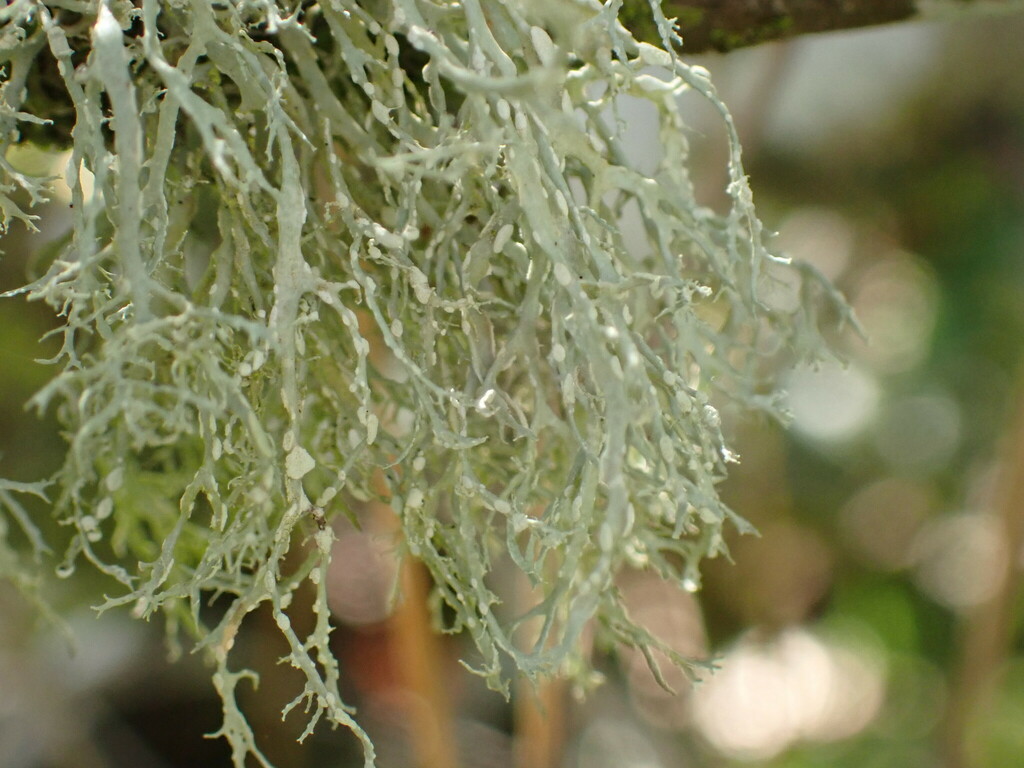
Ramalina erumpens
Ramalina erumpens is a species of corticolous lichen (bark-dwelling) in the family Ramalinaceae. Originally thought to be specimens of Ramalina pacifica, the species was identified as being distinct in 1996 by Dan Blanchon, John E. Braggins and Alison Stewart. It is found in New Zealand, and on Tasmania and Macquarie Island in Australia.
From the article Ramalina erumpens on Wikipedia (CC BY-SA), quoted section by section
Description
Ramalina erumpens is yellow-green in colour, and has erect flat branches typically measuring between 1–4.5 cm (0.39–1.77 in) in length, with a width of between 0.5–2 mm (0.020–0.079 in). The species had forked apices and marginal soralia, which are rimmed, round to ellipsoid, and produce fibrils.
Range & habitat
The species is found in the South Island of New Zealand, between Banks Peninsula and western Southland, typically in native forest remnants in coastal areas up to 400 m (1,300 ft) above sea level. In 2002, the species was found on Bird Island in the Foveaux Strait. Var. norstictica is found on the Otago Peninsula, where var. erumpens can also be found. In Australia, the species has been found on Tasmania and Macquarie Island.
Wikipedia: “Distribution and habitat”
What it does
The species is corticolous, found primarily on the bark of Dacrycarpus dacrydioides, but can also be found on other trees and shrubs.
Wikipedia: “Ecology”
Where it lives
Recorded sightings
—
geo-referenced records in GBIF, from museums, herbaria and field observers.
Drag the globe to turn it. Dots are where records exist, not a range map; darker means more records.
In the stacks
Searching the stacks…
Every page naming Ramalina erumpens in the Biodiversity Heritage Library →
This page is assembled live from iNaturalist, GBIF, Wikipedia, the Source Library and the Internet Archive. It is not yet part of the hand-edited codex. iNaturalist taxon 409517.