- Animals
- ›Chordates
- ›Vertebrates
- ›Mammals
- ›Therians
- ›Placental Mammals
- ›Ungulates, Carnivorans, and Allies
- ›Bats
- ›Yinpterochiroptera
- ›Pteropodoidea
- ›Old World Fruit Bats
- ›Flying-foxes, Monkey-faced Bats and allies
- ›Flying-foxes and allies
- ›Pteropus
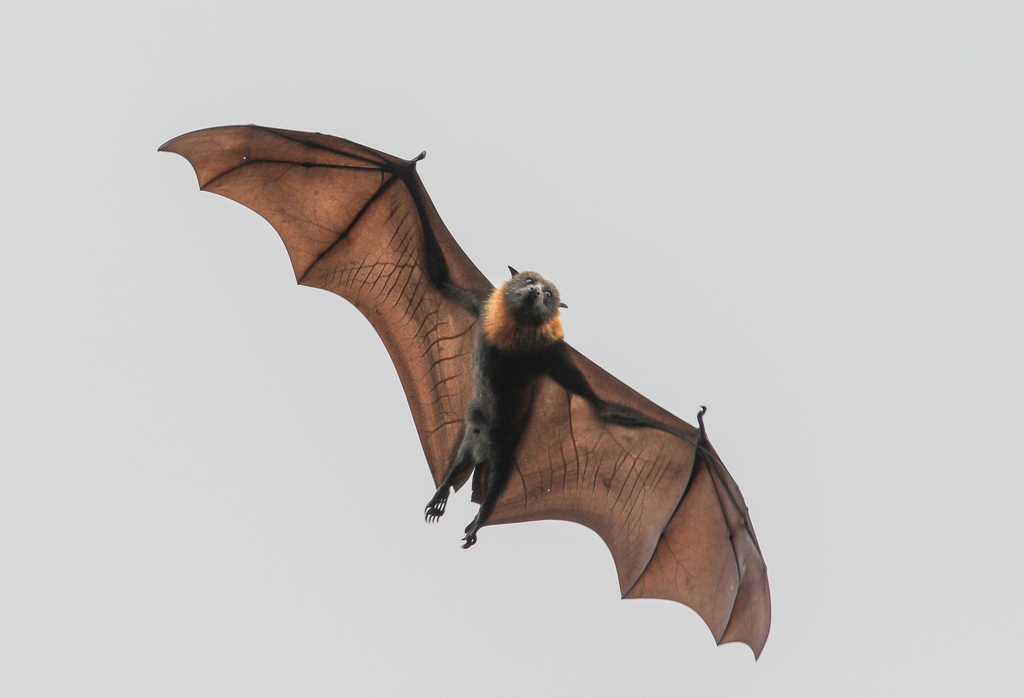
Grey-headed Flying-fox
Pteropus poliocephalus
The grey-headed flying fox (Pteropus poliocephalus) is a megabat native to Australia. The species shares mainland Australia with three other members of the genus Pteropus: the little red P. scapulatus, spectacled P. conspicillatus, and the black P. alecto. The grey-headed flying fox is the largest bat in Australia.
The grey-headed flying fox is endemic to the south-eastern forested areas of Australia, principally east of the Great Dividing Range. Its range extends approximately from Bundaberg in Queensland to Geelong in Victoria, with outlying colonies in Ingham and Finch Hatton in the north, and in Adelaide in the south. In the southern parts of its range it occupies more extreme latitudes than any other Pteropus species.
From the article Grey-headed flying fox on Wikipedia (CC BY-SA), quoted section by section
Description
The grey-headed flying fox is the largest bat in Australia, with the adult wingspan reaching up to 1 m (3 ft 3 in) in length and weighing up to 1 kg (2.2 lb). Weight generally varies between 600 and 1,000 g (21 and 35 oz), with an average of 700 g (25 oz). The combined length of the head and body is from 230 to 290 mm. The forearm length is a range from 138 to 180 mm. The length of the ear from the tip to base is 30 to 37 mm. The overall colour of the pelage is a dark-grey body with a light-grey head, separated by a reddish-brown collar. The fur on the body is long and streaked with grey, the broad and well defined collar completely encircles the neck with hair that is golden orange in tone. A unique characteristic among bats of the genus Pteropus is fur on the legs that extends all the way to the ankle. Like many megachiropterans, the species lacks a tail. All of these bats possess claws on its first and second digits. The head is simple in form, with the characteristic 'dog-like' appearance of the genus. Since it does not echolocate, it lacks the tragus or leaf ornamentation found in many species of Microchiroptera. It relies on smell and, predominately, sight to locate its food (nectar, pollen and native fruits) and thus has relatively large eyes for a bat. The voice of P. poliocephalus consists of a complex series of squeals and screechings. …
Range & habitat
The distribution range is at the eastern regions of the Australian continent, mostly within 200 kilometres of the coast, from Gladstone in Queensland through to the southern Gippsland region and populations around the city of Melbourne. The breeding range has been recorded as progressing southward, the temperate climate of Melbourne and Geelong and no further north than Maryborough, Queensland. Urbanisation may displace the species, or provide habitat that accommodates their feeding or roosting preferences. The city of Brisbane has many roosts occupied by the species; a famous colony at the Indooroopilly Island is noted for the evening departure of the bats across the local river. Within the central business district of Sydney, they can be seen travelling along city streets to feed at Moreton Bay fig trees at Hyde Park. The species was recorded as an occasional visitor to the national capital Canberra, although the flowering eucalypts at Commonwealth Park have seen more permanent camps established close to the city. The species was surveyed during the 1920s by Francis Ratcliffe, who recorded the populations in estimates of quarter, half, or one million in camps, generally located around 40 kilometres apart. These numbers have greatly declined since this first survey.
Wikipedia: “Distribution”
What it does
Around dusk, grey-headed flying foxes leave the roost and travel up to 50 km a night to feed on pollen, nectar and fruit. The species consumes fruit flowers and pollens of around 187 plant species. These include eucalypt, particularly Corymbia gummifera, Eucalyptus muelleriana, E. globoidea and E. botryoides, and fruits from a wide range of rainforest trees, including members of the genus Ficus. These bats are considered sequential specialists, since they feed on a variety of foods. Grey-headed flying foxes, along with the three other Australian flying fox species, fulfill a very important ecological role by dispersing the pollen and seeds of a wide range of native Australian plants. The grey-headed flying fox is the only mammalian nectarivore and frugivore to occupy substantial areas of subtropical rainforests, so is of key importance to those forests. The teeth, tongue and palate of the pteropodid bats are able to extract plant juices from food, only swallowing smaller seeds of the meal. Incisors hold items such as fruit, and the fibrous material is ejected from the mouth after it is masticated and the juice is swallowed; larger seeds may be held in the mouth and dispersed several kilometres from the tree. The need for the elaborate intestinal tract of most herbivores is consequently removed. Some fruiting plants produce food for flying-foxes, and P. …
Wikipedia: “Diet and foraging”
Toxicity
The urbanised camps of cities were noted as succumbing to poisoning during the 1970s to 1980s, identified as the lead in petrol that would accumulate on the fur and enter the body when grooming. The mortality rate from toxic levels of lead in the environment dropped with the introduction of unleaded fuel in 1985. An introduced plant, the cocos palm Syagrus romanzoffiana, now banned by some local councils, bears fruit that is toxic to this species and has resulted in their death; the Chinese elm Ulmus parvifolia and privet present this same hazard.
Wikipedia: “Poisoning”
Listen
Looking for field recordings…
Where it lives
Recorded sightings
—
geo-referenced records in GBIF, from museums, herbaria and field observers.
Drag the globe to turn it. Dots are where records exist, not a range map; darker means more records.
In the stacks
Searching the stacks…
Every page naming Pteropus poliocephalus in the Biodiversity Heritage Library →
This page is assembled live from iNaturalist, GBIF, Wikipedia, the Source Library and the Internet Archive. It is not yet part of the hand-edited codex. iNaturalist taxon 40905.