- Animals
- ›Chordates
- ›Vertebrates
- ›Mammals
- ›Therians
- ›Placental Mammals
- ›Ungulates, Carnivorans, and Allies
- ›Bats
- ›Yinpterochiroptera
- ›Pteropodoidea
- ›Old World Fruit Bats
- ›Flying-foxes, Monkey-faced Bats and allies
- ›Flying-foxes and allies
- ›Acerodon
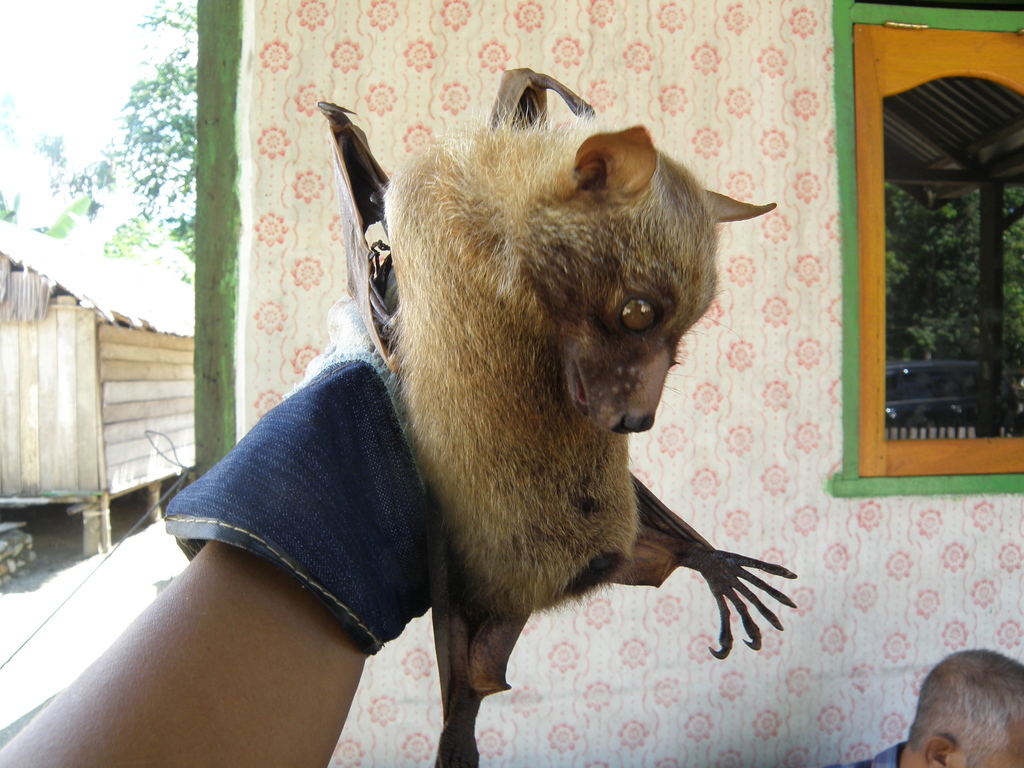
Sulawesi Fruit Bat
Acerodon celebensis
The Sulawesi flying fox or Sulawesi fruit bat (Acerodon celebensis) is a species of megabat endemic to Indonesia. It is classified as "Vulnerable" by the IUCN due to unsustainable levels of hunting.
From the article Sulawesi flying fox on Wikipedia (CC BY-SA), quoted section by section
Range & habitat
The species is endemic to the Sulawesi, Buton, and several smaller Indonesian islands (Mangole, Sanana, Siau, Sangihe, Selayar). It prefers lowland habitats with an elevation of up to 1,500 m asl.
Wikipedia: “Distribution and habitat”
What it does
The Sulawesi flying fox is a frugivore, feeding preferentially on coconuts and breadfruits. The species roosts in trees—often in mangrove forests—and is somewhat sensitive to human disturbance. Roosting sites may be shared with the black flying fox, which occupies the lower branches while the Sulawesi flying fox keeps to the higher ones. Pups are born between February and March. Flying fox serve as pollinators and seed dispersers for the plants of their area. They can carry large amounts of pollen on their fur and carry it to other plants great distances away, this is particularly important for plants which rely on cross-pollination. Flying fox disperse seeds by dropping the seeds as they eat fruit, or through their feces. It takes 12–34 minutes for food to pass through the digestive tract of the species.
Wikipedia: “Ecology”
In human culture
Following birth, the baby flying fox, called a pup, develops a strong bond with its mother. Aside from nursing the young, the mother carries her pup out of camp each night in search of food. While flying, the pup holds onto the nipple with its adapted, curved teeth and grabs onto the mother's waist with their feet. This persists for up to five weeks, or whenever the offspring becomes too heavy for their mother to support. For the next three to five weeks, the pup is left in a tree either in or just outside of their camp while the mother forages until dawn. This stage in a pup's life ends when the pup learns how to fly and can search for their own food, which generally occurs eight to ten weeks after birth. While their diets consist mainly of fruit, these bats' favorite food is the pollen and nectar of eucalyptus blossoms; however, due to a shortage of these and other preferred blossoms, flying fruit foxes are forced to feed on the less favorable exotic and cultivated fruit in Sulawesi. They also serve a major role in pollination and seed dispersal in the forest. By congregating in large numbers following the blooming of various plants and thanks to their large size, they are able to spread seeds (either through digestion or from pollen stuck to their fur) in greater quantities at greater distances than birds and insects. These bats live in colonies, also called camps. …
Wikipedia: “Life history”
Listen
Looking for field recordings…
Where it lives
Recorded sightings
—
geo-referenced records in GBIF, from museums, herbaria and field observers.
Drag the globe to turn it. Dots are where records exist, not a range map; darker means more records.
In the stacks
Searching the stacks…
Every page naming Acerodon celebensis in the Biodiversity Heritage Library →
This page is assembled live from iNaturalist, GBIF, Wikipedia, the Source Library and the Internet Archive. It is not yet part of the hand-edited codex. iNaturalist taxon 40835.