- Fungi Including Lichens
- ›Basidiomycete Fungi
- ›Higher Basidiomycetes
- ›Mushrooms, Bracket Fungi, Puffballs, and Allies
- ›Cantharellales
- ›Hydnaceae
- ›Sistotrema
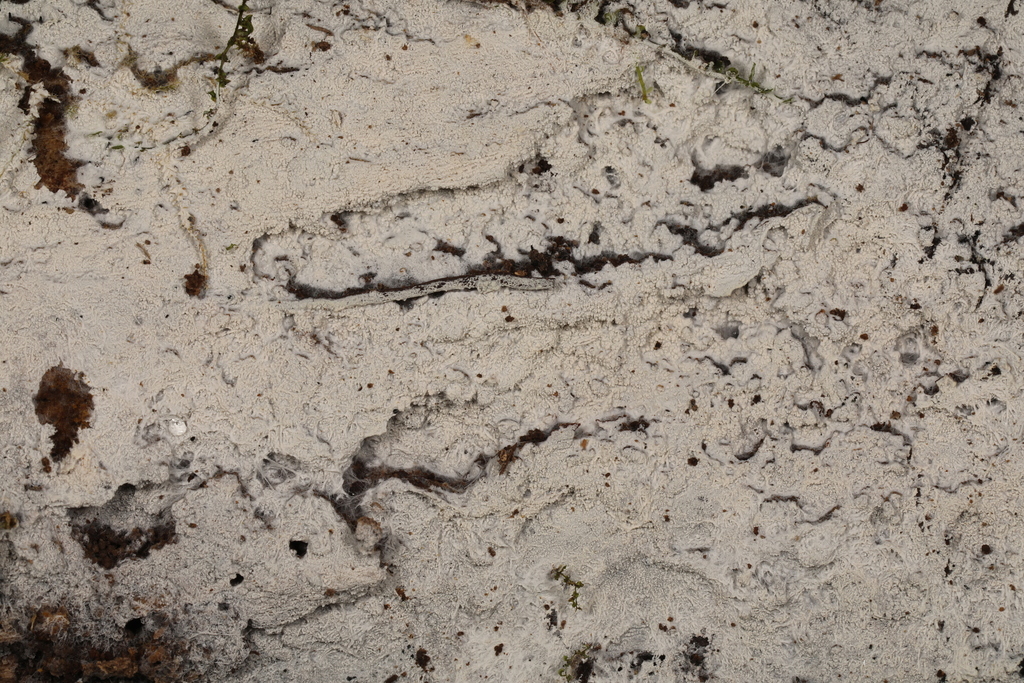
Sistotrema brinkmannii
Sistotrema brinkmannii, a resupinate wood-rotting basidiomycete, is a fungus found in soil, moss, debris, rotten woods as well as woods including seedling roots of Pinus banksiana Lamb. and ectomycorrhizae. No health issues caused by this fungus in human and animals have been reported although it is causative of brown rot. This fungus grows rapidly on malt extract agar (MEA), forming white mats with a faint sweet odour. It is commonly called "chain chlamydospore fungus" because bulbils are formed by chains of its cells that resemble chlamydospores. The basidia of this fungus are urniform and usually possess 6-8 sterigmata, and the spores are smooth and slightly curved.
From the article Sistotrema brinkmannii on Wikipedia (CC BY-SA), quoted section by section
Range & habitat
Both outdoor and indoor airs may contain Sistotrema brinkmannii. It was found that this fungus can contaminate washing machines in houses, but it is not a causative agent of human diseases or formation of malodour. The number of spores in dwellings increases as a result of surface disturbance such as vacuum cleaning of floors. This fungus may contaminate biofilms called endobronchial stents as well, which are used as an antibiotic treatment for airway complications such as lung transplantation. However, this contamination does not cause any serious issues in human health while some other fungi, including Scedosporium, which possibly contaminate the biofilms are known to be opportunistic pathogens in human. This fungus can reproduce sexually by both breeding and self-breeding which systems are called heterothallism and homothallism, respectively. There are three different incompatibility groups identified based on the reproductive mechanisms: bipolar heterothallic forms, tetrapolar heterothallic forms, and homothallic forms. These reproductive forms are dependent on its genetics. It was believed that homothallic forms are intersterile while both bipolar and tetrapolar heterothallic forms are capable of mating. In 1969, Lemke recognized that bipolar heterothallic forms and tetrapolar heterothallic forms also have intersterility as well as homothallic forms. …
Wikipedia: “Habitat and reproduction”
In human culture
Sistotrema brinkmannii possessed several synonyms in the early twentieth century including Corticium coronilla and Corticium octosporum, named by v. Höhnel & Litschauer and Schroeter ex v. Hohnel & Litschauer in 1906 respectively, and (Bres.) J. Erikss. named it Sistotrema brinkmannii in 1948. This fungus has been known as a cotton root rot pathogen, and it was thought to be an outdoor airborne fungus as there had been no reports suggesting its presence in indoor air. However, studies in Scotland found that 56% of indoor air samples from 51% of homes contained Sistotrema brinkmannii, indicating that wood rot observed in houses can be caused by this fungus. The basidia of Sistotrema brinkmannii usually range 10-20 × 5-8 μm and spores are 4-5 × 2-2.5 μm in size. This fungus was believed to be one of the different life stages of Phymatotrichum omnivorum. However, they are distinguished from each other based on the feature of their hyphae; hyphae of Sistotrema brinkmannii have dolipore septum while Phymatotrichum omnivorum possesses the simple type. Phylogenetic analyses sequencing genes such as mtSSU and RPB2 can strongly support the monophyly of this fungus, sorting it into the same monophyletic group as Clavulina-Membranomyces.
Wikipedia: “History and taxonomy”
Where it lives
Recorded sightings
—
geo-referenced records in GBIF, from museums, herbaria and field observers.
Drag the globe to turn it. Dots are where records exist, not a range map; darker means more records.
In the stacks
Searching the stacks…
Every page naming Sistotrema brinkmannii in the Biodiversity Heritage Library →
This page is assembled live from iNaturalist, GBIF, Wikipedia, the Source Library and the Internet Archive. It is not yet part of the hand-edited codex. iNaturalist taxon 408249.