- Animals
- ›Chordates
- ›Vertebrates
- ›Mammals
- ›Therians
- ›Placental Mammals
- ›Ungulates, Carnivorans, and Allies
- ›Bats
- ›Yinpterochiroptera
- ›Rhinolophoid Bats
- ›Horseshoe Bats
- ›Rhinolophus
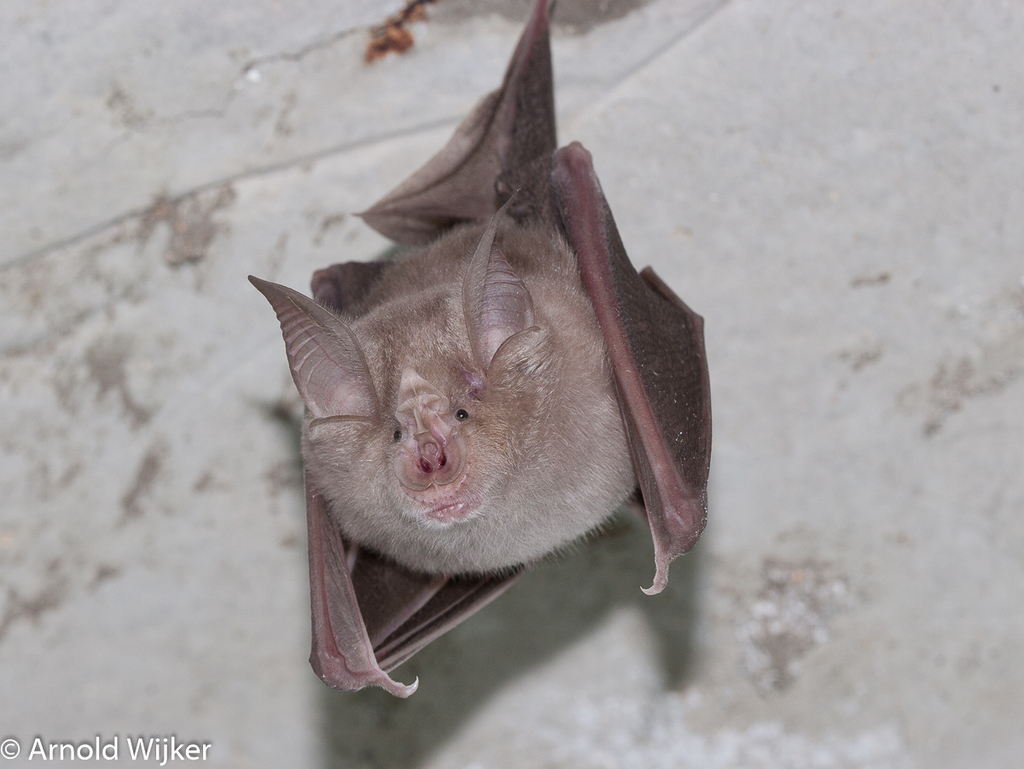
Greater Horseshoe Bat
Rhinolophus ferrumequinum
The greater horseshoe bat (Rhinolophus ferrumequinum) is an insectivorous bat of the genus Rhinolophus. Its distribution covers Europe, Northern Africa, Central Asia and Eastern Asia. It is the largest of the horseshoe bats in Europe and is thus easily distinguished from other species. The species is sedentary, typically travelling up to 30 kilometres (19 mi) between the winter and summer roosts, with the longest recorded movement being 180 km (110 mi). The frequencies used by this bat species for echolocation lie between 69–83 kHz, have most energy at 81 kHz and have an average duration of 37.4 ms.
From the article Greater horseshoe bat on Wikipedia (CC BY-SA), quoted section by section
Range & habitat
The greater horseshoe bat ranges from North Africa and southern Europe through south-west Asia, the Caucasus, Iran, Afghanistan, Pakistan and the Himalayas to south-eastern China, Korea, and Japan. The northernmost occurrence is in Wales. Reaches to the southern parts of the Netherlands, Germany, Poland and Ukraine. Generally the bats live below 800 m asl (above sea level), but it also lives, depending on roost availability and humidity, 3,000 m asl in the Caucasus.
Wikipedia: “Distribution”
What it does
The species feeds preferentially on lepidopterans (moths), making up around 41% of the diet - in particular the noctuid species. For example, the species preys on the lesser wax moth by identifying the moth's high frequency mating call. Coleopterans (beetles) constitute around 33% of the diet, of which dung beetles and cockchafers are often taken. Aphodius rufipes is one such dung beetle forming an especially important part of its diet. (Cow pats are part of its life cycle, acting as a food source and habitat for the larvae. Up to 100 larvae can be found in a single cow pat; while the adult beetle is most abundant in August when the young bats begin their first feeding flights.) The remainder of the diet consists of species of Hymenoptera and Diptera, as well as cave spiders. The feeding area from the maternity roost is typically of radius 4 km, as neither the lactating females or young can travel far. In late August and September the bats feed on cranefly, to fatten up before hibernation. Breeding females depend on beetles from April until June, and moths from June to August. The greater horseshoe bat leaves its roost at dusk. Its flying is made up of slow, fluttering travel with short glides, normally between 0.3 and 6 metres above the ground. Little hunting is done during wet and windy weather. …
Wikipedia: “Diet and hunting”
Listen
Looking for field recordings…
Where it lives
Recorded sightings
—
geo-referenced records in GBIF, from museums, herbaria and field observers.
Drag the globe to turn it. Dots are where records exist, not a range map; darker means more records.
In the stacks
Searching the stacks…
Every page naming Rhinolophus ferrumequinum in the Biodiversity Heritage Library →
This page is assembled live from iNaturalist, GBIF, Wikipedia, the Source Library and the Internet Archive. It is not yet part of the hand-edited codex. iNaturalist taxon 40645.