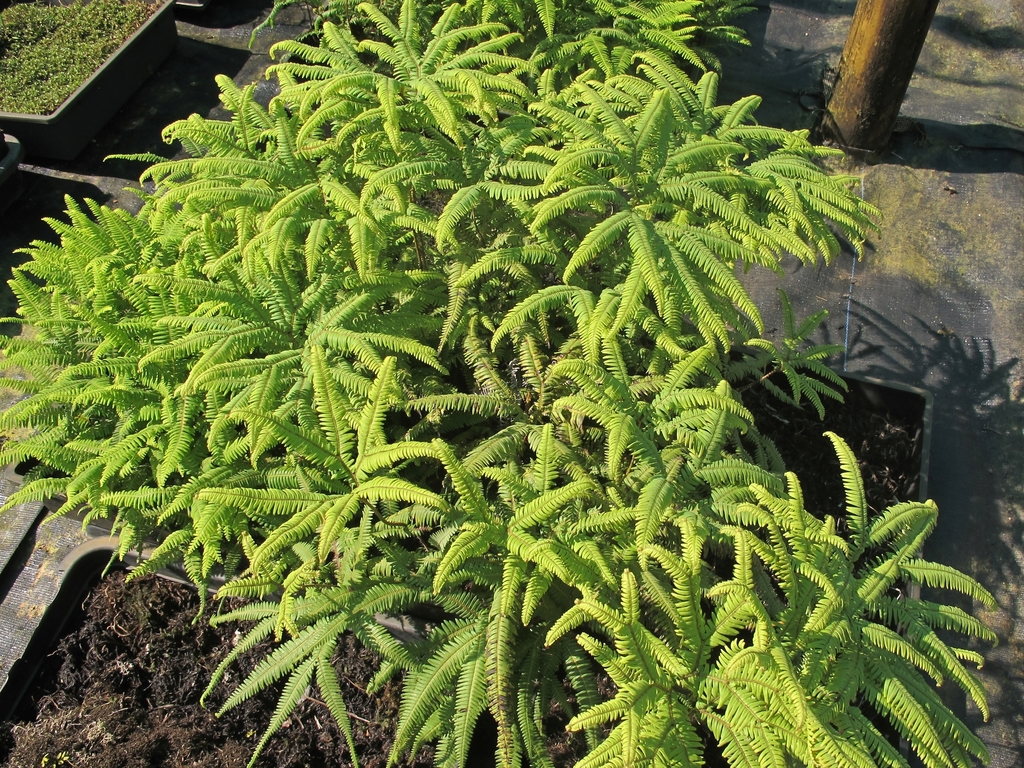
Silky Fan-fern
Sticherus tener
Sticherus tener, also known as silky fan-fern, is a common native ground-fern in the family Gleicheniaceae. It occurs growing along watercourses and drainage lines in rainforest that are dominated by Nothofagus cunninghamii. In Australia, it occurs in the states of Tasmania and Victoria. In New Zealand, it is known from two disjoint regions on the South Island. Like in other members of this genus, Sticherus tener have bright green fronds with repeatedly forking branches, branches bearing linear-shaped segments at almost right angles to the axis and form umbrella-like bush colony.
From the article Sticherus tener on Wikipedia (CC BY-SA), quoted section by section
Description
Sticherus tener are stout ground-fern that grow more than 2 m tall and form bushy colonies. Rhizomes are dark brown covered with brown scaly hairs, long and creeping, and are 4 mm thick and can reach 2 m in length. Fronds are yellow green or green, 200 – 380 mm tall that are dichotomously and repeatedly divided till pinnate laminas. Stipes arise from nearly 50 mm apart along rhizomes, are stiff and erect that are 12-90 cm in length, black and covered in scaly hairs at base that gradually change from reddish brown to green and glabrous at upper section. Pinnae are fan-shaped, 90-190 mm long and 45-260 mm wide, with a pair of primary branches at the stipe apex, which pseudodichotomously branched up to 4 times and ending in resulting 21-43 pairs of ultimate segments. Minor rachises are light to dark brown on ventral surfaces and sparsely covered with brown and narrow scaly hairs. Rachis buds are situated at the apex of stipe and between the primary branches and are covered with light or reddish-brown ciliates; and dormant buds (which rarely develops) are situated at apex of each axis. Segments on the primary branches are of uniform size and coverage, and narrowly oblong, 10-22 mm long, 1.5-3 mm wide and arising from axis at near right angles (75-90°). …
Range & habitat
Sticherus tener is found in the states of Tasmania and Victoria in Australia, and in the South Island of New Zealand. In Tasmania, Sticherus tener is widespread and common throughout the state, but more abundant in the western region compared to the east. In Victoria, it is more restricted to the Otways and Powelltown regions and less common in other region of the state. There are additional records of Stecherus tener along the coastal regions of New South Wales and a single record near Townsville in Queensland, but these records require further proper and authenticated information sources. In New Zealand, Sticherus tener is found in two disjunct regions on the South Island. These two regions comprise Stockton and Denniston Plateaus near Westport and on Resolution and Anchor Islands and Mt. Hodges in Fiordland. Sticherus tener are found growing in abundance in permanently damp soils along water courses and drainage lines within rainforest in Tasmania, which is mostly dominated by Nothofagus cunningghamii. In New Zealand, Sticherus tener are found growing in sandstone overhangs and on steep banks with low woody vegetation on Stockton and Denniston Plateaus and on poor soils of scrub, low or mixed forest that extend to tall beech or podocarp forest on Resolution and Anchor Islands and Mt Hodges.
== References ==
Wikipedia: “Distribution and habitat”
Where it lives
Recorded sightings
—
geo-referenced records in GBIF, from museums, herbaria and field observers.
Drag the globe to turn it. Dots are where records exist, not a range map; darker means more records.
In the stacks
Searching the stacks…
Every page naming Sticherus tener in the Biodiversity Heritage Library →
This page is assembled live from iNaturalist, GBIF, Wikipedia, the Source Library and the Internet Archive. It is not yet part of the hand-edited codex. iNaturalist taxon 406204.