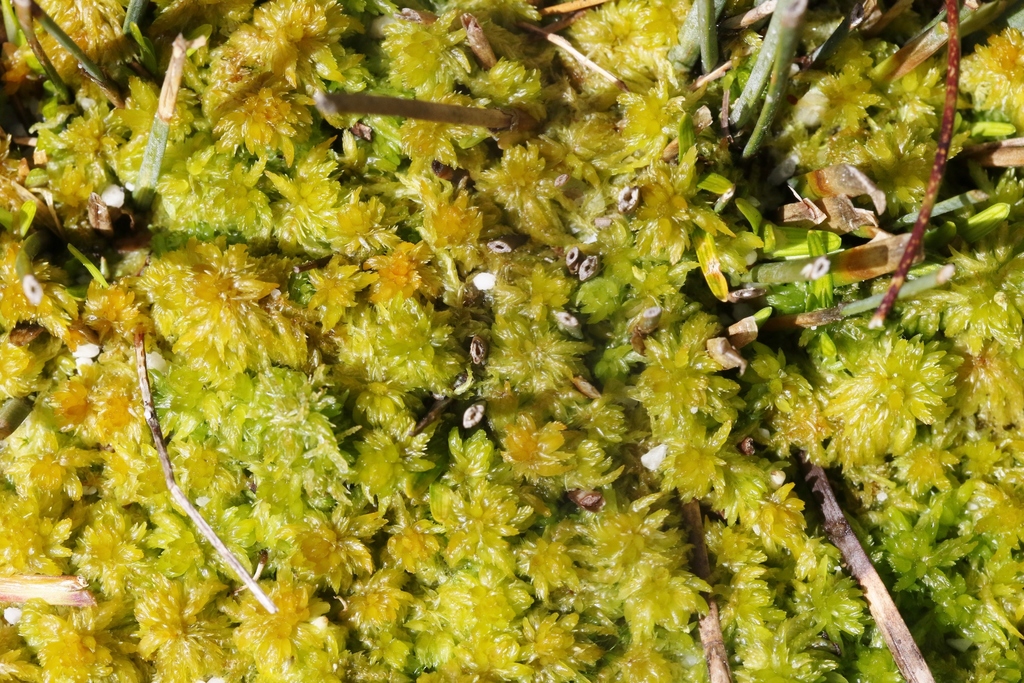
Sphagnum australe
Sphagnum australe is a species of Sphagnum found in southeastern Australia.
S. australe is very hard to differentiate from other species of sphagnum moss, particularly S. compactum (some forms with short internodes particularly) however the distance along the stems between the fascicles (the bundles of structures) on branches are very variable.
From the article Sphagnum australe on Wikipedia (CC BY-SA), quoted section by section
Range & habitat
Sphagnum australe is a moss found in Australia with known locations from New South Wales, Australian Capital Territory, Victoria through to Tasmania. S. australe grows in wet soil, forming extensive mounds in areas of shaded water seepage or of swampy ground. Sphagnum australe grows at an elevation of 0–1,239 m (0–4,065 ft). This species of is predominantly found on extensive colonies of alpine or sub-alpine bogs. Some can be found at much lower altitude occasionally in places almost down at sea level but these are much smaller areas.
Wikipedia: “Habitat”
What it does
Reproduction of Sphagnum australe is exhibited through the typical alternation of generations found in other mosses. Because they have a haploid (single set of chromosomes in cells) gametophyte, their gametes are relatively large and long-lived and noticeable on the plant (compared to the smaller and shorter lived diploid sphorophytes that are produced on the gametophytes. These sphorophytes produce spores and then is shed from gametophyte. The gametophyte is the sexual phase of the life cycle of plants and algae. Sex organs are produced on this structure that then produce gametes and haploid sex cells participating in fertilisation and then forming a diploid zygote which has the double set of chromosomes. Typically on moss it is a separate structure on the plant. In S. australe, dark brown circular sporophytes can be seen.
Wikipedia: “Reproduction”
In human culture
Sphagnum in Latin means moss (sphagnos) with the first known use in 1741. "australe" originates from austral, a Meridionale (Southern Italy) word meaning southern or south or southerner.
Wikipedia: “Etymology”
Where it lives
Recorded sightings
—
geo-referenced records in GBIF, from museums, herbaria and field observers.
Drag the globe to turn it. Dots are where records exist, not a range map; darker means more records.
In the stacks
Searching the stacks…
Every page naming Sphagnum australe in the Biodiversity Heritage Library →
This page is assembled live from iNaturalist, GBIF, Wikipedia, the Source Library and the Internet Archive. It is not yet part of the hand-edited codex. iNaturalist taxon 406129.