- Animals
- ›Chordates
- ›Vertebrates
- ›Mammals
- ›Therians
- ›Placental Mammals
- ›Ungulates, Carnivorans, and Allies
- ›Bats
- ›Yangochiroptera
- ›Vespertilionoid Bats
- ›Evening Bats
- ›Vesper Bats
- ›Plecotini
- ›Barbastella
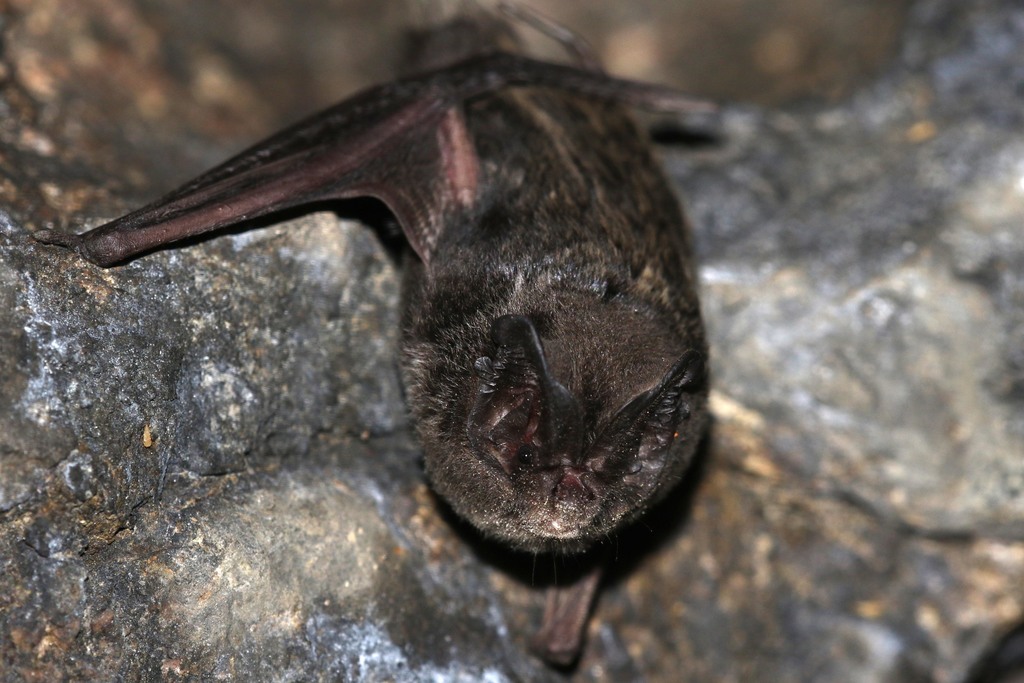
Western Barbastelle
Barbastella barbastellus
The western barbastelle (Barbastella barbastellus), also known as the barbastelle or barbastelle bat, is a European bat in the genus Barbastella. This species is found from Portugal to Azerbaijan and from Sweden to Canary Islands, where a sub-species was identified. It has a short nose, small eyes and wide ears. The conservation status of B. barbastellus is assessed as "near threatened", "vulnerable", "critically endangered" or "extinct" in various parts of its range.
From the article Western barbastelle on Wikipedia (CC BY-SA), quoted section by section
Description
The barbastelle is a medium-sized bat, with a characteristic pug-shaped nose. The ears are broad, joined across its head by skin, and covered in gingery-brown fur on the rear surface. The tragus is triangular – broad at the base but with a nearly parallel tip which starts about halfway along its length. Head and body length is between 40 and 55 mm and wingspan is between 26 and 29 cm (10 and 11 in). Forearm length is 3.5 to 4.5 cm (1.4 to 1.8 in) and body mass is 6 to 13 g (0.21 to 0.46 oz).
Range & habitat
Barbastelles roost in splits or behind loose bark of trees all year, generally in mature deciduous forests, as well as rock crevices and within human buildings. In central Italy, tall dead beech in unmanaged woodland were found to be preferred as roost trees. While barbastelles typically remain within a single roosting area, they move between individual roosts with great frequency. Barbastelles migrate to underground roosting sites over the winter, although they may stay within arboreal roosts in the beginning of the season. Winter roosting sites include natural caves and human structures such as basements, mines and bunkers. Barbastelles are relatively resistant to cold conditions, and are typically found hibernating in cold sites and in exposed positions.
Wikipedia: “Habitat”
What it does
Barbastelles feed chiefly on moths, as well as on flies. Research from Switzerland showed that the biologically most productive parts of the forest are exploited in priority by this species while hunting and that ca. 99% of prey by volume consisted of Lepidoptera. More recent studies confirmed this predominance of Lepidoptera, underlining that medium-sized and larger specimens are targeted in priority by the barbastelles. However, seasonal diet changes were recorded during autumn due to potential interspecific competition with Plecotus austriacus and strong decrease of flying larger moths. The diet of the barbastelles appears to be one of the narrowest among European bats. This specialization in foraging habits probably points to a higher vulnerability of this species to negative changes in the abundance of moth populations. This could explain its current rarity throughout most of its range. While foraging, barbastelles behave as typical aerial-hawking bat species despite the fact that they hunt exclusively just above the forest canopy. This peculiar foraging technique could be explained by the co-evolution with the defence system of its prey. Specimens can travel up to 20 km per night for foraging purposes and nonreproductive females forage at greater distances than reproductive females
Wikipedia: “Hunting and feeding”
Listen
Looking for field recordings…
Where it lives
Recorded sightings
—
geo-referenced records in GBIF, from museums, herbaria and field observers.
Drag the globe to turn it. Dots are where records exist, not a range map; darker means more records.
In the stacks
Searching the stacks…
Every page naming Barbastella barbastellus in the Biodiversity Heritage Library →
This page is assembled live from iNaturalist, GBIF, Wikipedia, the Source Library and the Internet Archive. It is not yet part of the hand-edited codex. iNaturalist taxon 40581.