- Animals
- ›Chordates
- ›Vertebrates
- ›Mammals
- ›Therians
- ›Placental Mammals
- ›Ungulates, Carnivorans, and Allies
- ›Bats
- ›Yangochiroptera
- ›Vespertilionoid Bats
- ›Evening Bats
- ›Vesper Bats
- ›Pipistrellini
- ›Nyctalus
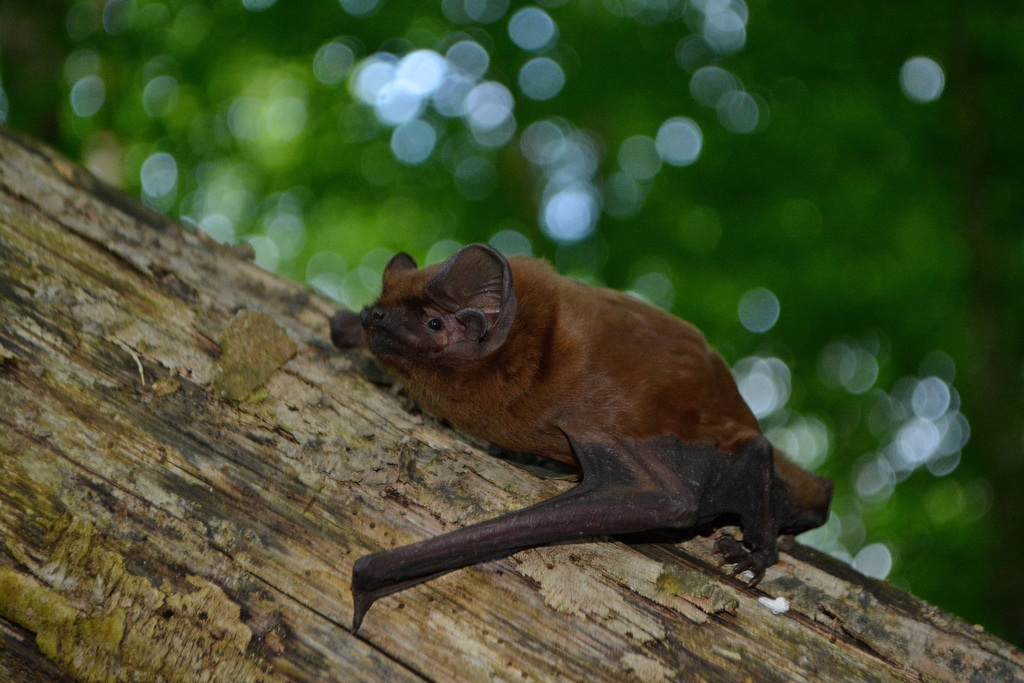
Giant Noctule
Nyctalus lasiopterus
The greater noctule bat (Nyctalus lasiopterus) is a rare carnivorous bat found in Europe, West Asia, and North Africa. It is the largest and least studied bat in Europe with a wingspan of up to 46 centimetres (18 in) and is one of the few bat species to feed on passerine birds. Greater noctule bats are the only bat species to hunt birds on the wing rather than when roosting. The greater noctule bat has wings adapted for open-air hunting and uses echolocation frequencies above the hearing range of birds.
From the article Greater noctule bat on Wikipedia (CC BY-SA), quoted section by section
Description
The greater noctule bat belongs to the suborder Yangochiroptera (family Vespertilionidae) and uses echolocation. Echolocation is a perceptual system where echoes are produced by emitting ultrasonic sounds. Echolocation allows bats to compare the outgoing pulse with returning echoes which produces detailed images of the bat's surroundings. With echolocation, bats are able to detect, locate and classify their prey in complete darkness. The greater noctule bat has been observed as only emerging from its roosts well after dusk when it is completely dark. The greater noctule bat has keen hearing and sense of smell, however its eyes are poorly developed. The wings of the greater noctule bat are thinner than those of birds, which allows it to manoeuvre quickly and accurately. While its wing is delicate and tears easily, it is able to regrow. The greater noctule is the largest bat in Europe, with a wingspan of 41–46 cm (16–18 in). Its head-and-body length is from 8.4 to 10.4 cm (3.3 to 4.1 in), its tail is from 5.5 to 6.6 cm (2.2 to 2.6 in) and its forearm ranges from 6.2 to 6.8 cm (2.4 to 2.7 in). The body mass of adults ranges from 41 to 76 g (1.4 to 2.7 oz). The greater noctule bat has been observed as a high altitude flier and a low altitude forager. The dorsal fur of the greater noctule bat is uniformly reddish-brown to dark brown. …
Range & habitat
The greater noctule bat is a tree-dwelling bat that roosts in trees all year round. It is found throughout the deciduous forests of Europe from the Iberian Peninsula to the Bosporus region of Turkey. The largest concentration of greater noctule bat is in the south western portion of Spain. The greater noctule bat is a tree-obligate species that prefers oak or beech trees that have a hollow space for day roosting. Greater noctule bats also roost in pine trees if there are no other options. Other studies have shown that this bat greatly prefers birch trees. The studies' differing results may suggest instead that the greater noctule bat does not prefer a specific tree, but perhaps looks for the physical condition of the tree. It has been noted in several studies of greater noctule bat roosting behaviour that different trees have different functions for the greater noctule bat, and that these tree-specific needs could affect roost selection for communities of greater noctule bats. Studies in Hungary (Ke´ kes peak, 1014 m a.s.l.) indicates that greater noctules prefer high roost locations. The study also suggests that older, decayed trees are preferred by the species.
Wikipedia: “Habitat”
What it does
While the majority of the world's carnivorous bats are insect eaters, greater noctule bats do regularly prey on birds. One study has shown that predation on birds accounts for over 80% of the greater noctule bat's diet during periods of the year when the birds are migrating. The greater noctule bat switches its prey type opportunistically depending on the time of year. In addition, with the possible exception of the Asian great evening bat, the greater noctule bat is the only bat that hunts birds on the wing rather than when roosting. The greater noctule is well adapted for hunting passerines in the air. It is large in size, has wings with a wingspan of up to 46 centimetres that are evolved for open-air hunting, and employs echolocation with frequencies beyond the hearing range of birds.
Wikipedia: “Diet”
Listen
Looking for field recordings…
Where it lives
Recorded sightings
—
geo-referenced records in GBIF, from museums, herbaria and field observers.
Drag the globe to turn it. Dots are where records exist, not a range map; darker means more records.
In the stacks
Searching the stacks…
Every page naming Nyctalus lasiopterus in the Biodiversity Heritage Library →
This page is assembled live from iNaturalist, GBIF, Wikipedia, the Source Library and the Internet Archive. It is not yet part of the hand-edited codex. iNaturalist taxon 40576.