On eBird ↗
Cape Verde Petrel
Live sightings near you, the range map, bar charts of when it is seen, and Macaulay Library photos and recordings.
Cape Verde petrel
Pterodroma feae
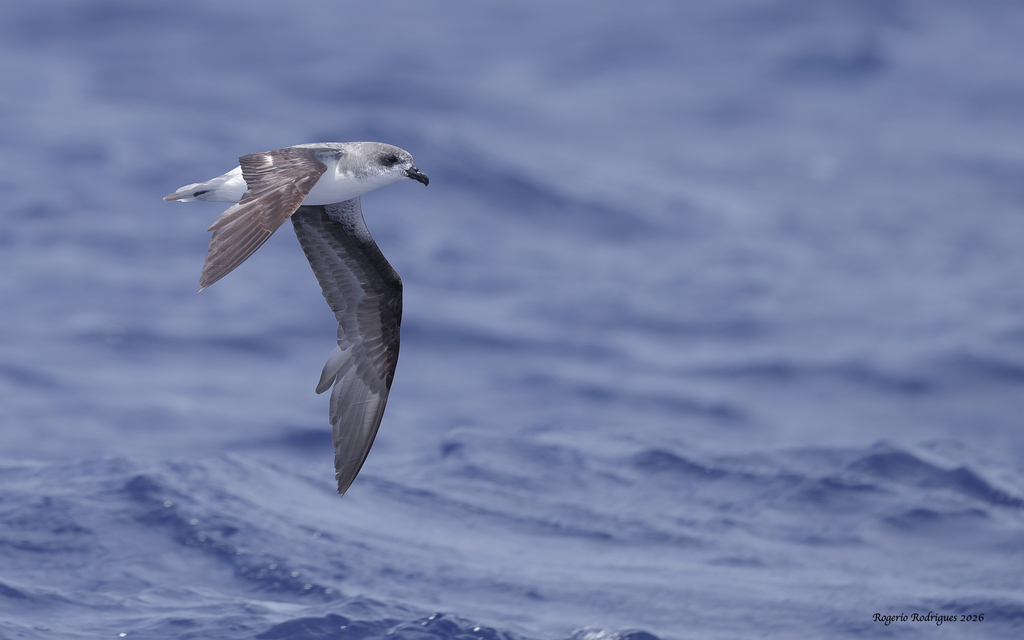
Fea's petrel or the Cape Verde petrel (Pterodroma feae) is a small seabird in the gadfly petrel genus, Pterodroma. It was previously considered to be a subspecies of the soft-plumaged petrel (P. mollis), but they are actually not closely related at all. However, P. feae is very closely related to Zino's petrel and the Desertas petrel, two other species recently split from P. mollis. The gadfly petrels are named for their speedy weaving flight, as if evading horseflies. The flight action is also reflected in the genus name Pterodroma, from Ancient Greek pteron, "wing" and dromos, " runner". This species is named after the Italian zoologist Leonardo Fea (1852-1903).
From the article Fea's petrel on Wikipedia (CC BY-SA), quoted section by section
Description
This long-winged petrel is 33–36 cm in length with an 86–94 cm wingspan. It has a grey back and wings, with a dark "W" marking across the wings. The undersides of the wings are dark and the belly is white. It has a fast impetuous flight. It picks planktonic food items from the ocean surface. This species is very similar to the Zino's petrel, but is larger and has a thicker black bill. As all three species in the Pterodroma feae/madeira/desertae complex were once believed to be subspecies of a single species: Pterodroma mollis, the extreme difficulty in telling them apart is easily understood. A summary of data from a morphological study sheds light on the issue:
In overall size feae is closer to deserta and both are bigger than madeira (wing length - f:262, d: 264, m: 248; tarsus - f:34.7, d: 35.2, m: 32.7). Bill length once again similar in feae and deserta and both larger than madeira (f:29.0, d: 28.6, m: 26.3). Bill depth by far biggest in deserta, lowest in madeira, and intermediate in feae (f:11.9, d: 12.9, m: 10.5). In terms of ratios:
(Bill length/wing length) (f:11.1%, d: 10.8%, m: 10.6%) is rather similar in the three taxa. (Bill length/bill depth) (f: 2.44, d: 2.22, m: 2.53) is lowest in deserta, and highest in madeira. In feae it is intermediate, but more than twice closer to madeira than to deserta.
Range & habitat
It breeds on four islands of Cape Verde in the eastern Atlantic Ocean: Fogo, Santo Antão, São Nicolau and Santiago.
Wikipedia: “Distribution and habitat”
Listen
Looking for field recordings…
Where it lives
Recorded sightings
—
geo-referenced records in GBIF, from museums, herbaria and field observers.
Drag the globe to turn it. Dots are where records exist, not a range map; darker means more records.
In the stacks
Searching the stacks…
Every page naming Pterodroma feae in the Biodiversity Heritage Library →
This page is assembled live from iNaturalist, GBIF, Wikipedia, the Source Library and the Internet Archive. It is not yet part of the hand-edited codex. iNaturalist taxon 4055.