- Fungi Including Lichens
- ›Ascomycete Fungi
- ›Sac Fungi and Lichens
- ›Common Lichens
- ›Shield Lichens, Sunburst Lichens, Rosette Lichens, and Allies
- ›Peltigerales
- ›Lobariaceae
- ›Pseudocyphellaria
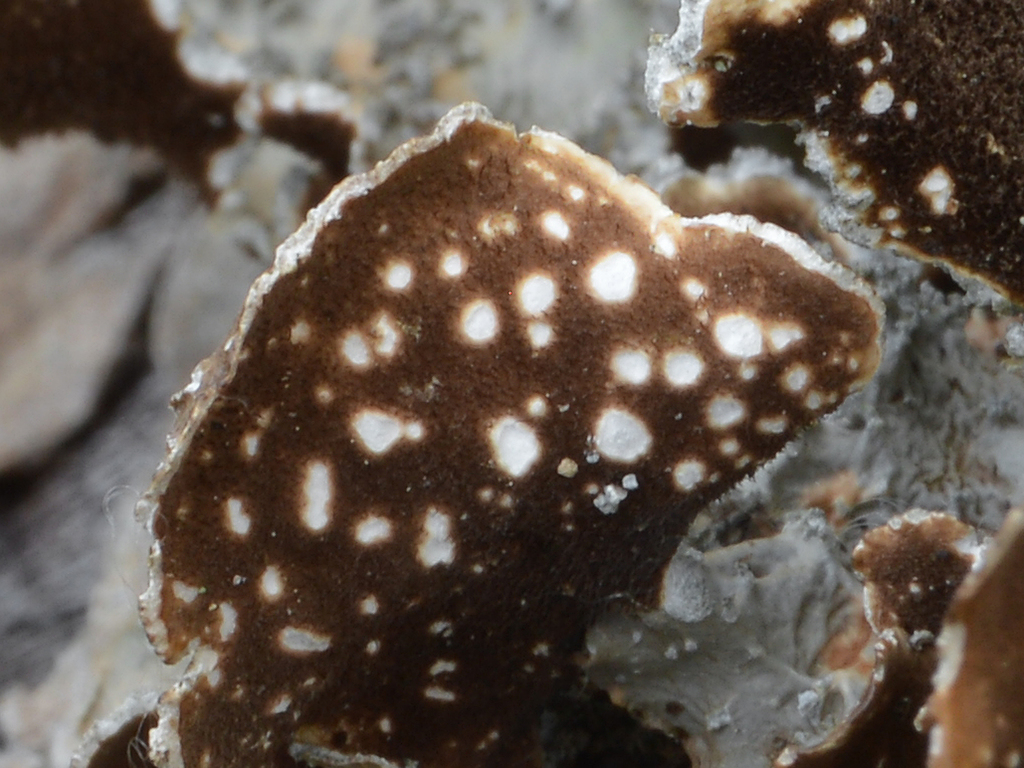
Pseudocyphellaria haywardiorum
Pseudocyphellaria haywardiorum is a species of corticolous (bark-dwelling), foliose lichen in the family Peltigeraceae. It is found in New Zealand, where it is considered "at risk" under the New Zealand Threat Classification System. Pseudocyphellaria haywardiorum has a more or less circular thallus measuring 30–80 mm in diameter, loosely attached from its edges to its centre, featuring rising wavy margins with rounded lobes that overlap in a complex pattern. The upper surface varies in colour from dark grey-blue to brown-black, becoming darker at the lobe tips when moist, and displays a spectrum of colours including dark olive-brown to pale yellowish with greyish edges when dry, while the underside is either bubbly or unevenly wrinkled with a tomentum ranging from red-brown to black-brown, and white pseudocyphellae especially noticeable in the central region.
From the article Pseudocyphellaria haywardiorum on Wikipedia (CC BY-SA), quoted section by section
Description
The thallus of Pseudocyphellaria haywardiorum is more or less circular, measuring 30–80 mm in diameter. This lichen loosely attaches from its edges to its centre. The edges of the thallus appear to rise slightly and display rounded lobes, spanning 2–20 mm in length and 4–25 mm in width. These lobes stand apart but touch each other and have a complex overlapping pattern. The lichen's margins are sinuous, rising weakly with an irregular formation ranging from finely to coarsely jagged. The underbelly of the lichen occasionally presents soredia – small reproductive propagules – and has a greyish-white, eroded appearance. The upper surface showcases a spectrum of colours from dark grey-blue to brown-black, particularly becoming darker at the lobe tips when moist. When dry, the central area can vary from dark olive-brown to a pale yellowish tint with greyish edges. The surface texture can be flat or slightly wavy, with the tips more wrinkled and the remainder distinctly dotted. Additionally, the upper surface is matte, ranging from smooth to minutely spiderweb-like in parts. Depending on its state, it feels either leathery to brittle when dry or soft and limp when wet. It is sorediate, and it lacks phyllidia or pseudocyphellae. Small, irregular light buff-coloured spots (maculae) can be seen, forming a mesh-like patterns towards the lobe tips. …
Range & habitat
On Raoul Island, it is known from fragmentary specimens collected from amongst the debris of Kermadec pōhutukawa that were toppled by a cyclone, suggesting that in that location it inhabits the upper tree canopy. In Kohimarama, where it is quite rare, it has been found growing on the trunks of cabbage trees and on fallen dead branches.
Wikipedia: “Habitat and distribution”
Where it lives
Recorded sightings
—
geo-referenced records in GBIF, from museums, herbaria and field observers.
Drag the globe to turn it. Dots are where records exist, not a range map; darker means more records.
In the stacks
This page is assembled live from iNaturalist, GBIF, Wikipedia, the Source Library and the Internet Archive. It is not yet part of the hand-edited codex. iNaturalist taxon 405298.