- Animals
- ›Chordates
- ›Vertebrates
- ›Mammals
- ›Therians
- ›Placental Mammals
- ›Ungulates, Carnivorans, and Allies
- ›Bats
- ›Yangochiroptera
- ›Vespertilionoid Bats
- ›Evening Bats
- ›Vesper Bats
- ›Hairy-tailed Bats
- ›Lasiurus
- ›Aeorestes
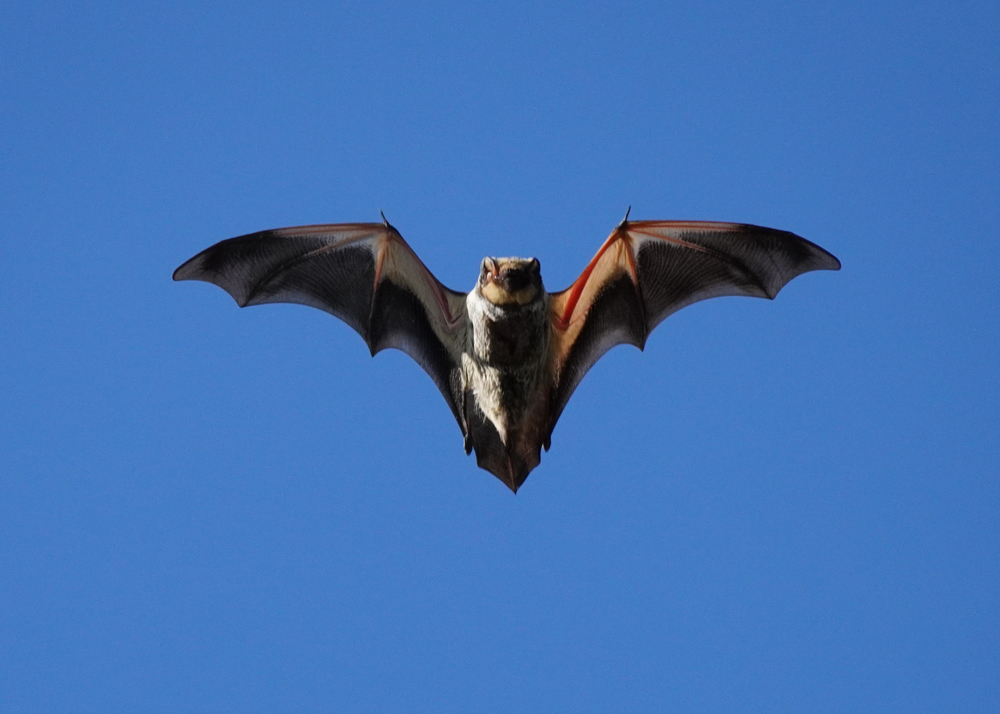
Northern Hoary Bat
Lasiurus cinereus
The hoary bat (Lasiurus cinereus) is a species of bat in the vesper bat family, Vespertilionidae. It occurs throughout most of North America and much of South America, with disjunct populations in the Galápagos Islands and Hawaii.
From the article Hoary bat on Wikipedia (CC BY-SA), quoted section by section
Description
The hoary bat averages 13 to 14.5 cm (5.1 to 5.7 in) long with a 40 cm (15.5 in) wingspan and a weight of 26 g (0.92 oz). It is the largest bat normally found in Canada. Its coat is dense and dark brown, with white tips to the hairs that give the species its 'hoary' appearance for which it is named. The body is covered in fur except for the undersides of the wings. Males and females are dimorphic in body mass, with females 40% heavier than males.
Range & habitat
It ranges throughout North America, from northern Canada south to Guatemala. Although the Hawaiian subspecies L. semotus was reclassified into a distinct species, studies in 2015 and 2017 found evidence supporting two different colonization events of Hawaii by Lasiurus species; one about 1.4 million years ago by the ancestors of L. semotus, but also a much more recent colonization by true L. cinereus. This would mean that L. cinereus also inhabits the Hawaiian islands, in cryptic sympatry with L. semotus. However, in contrast, a 2020 genetic study found no evidence of multiple bat species on Hawaii, finding the islands to only be inhabited by a single species, L. semotus, and attributed the previous results as a consequence of incomplete lineage sorting.
Wikipedia: “Distribution”
What it does
The bat normally roosts alone on trees, hidden in the foliage, but on occasion has been seen in caves with other bats. It prefers woodland, mainly coniferous forests, but hunts over open areas or lakes. It hunts alone and its main food source is moths. The bats can cover an impressive 39 km (24 mi) while foraging. Hoary bats are long-distance migrants, spending the winter in Central America and the southwestern United States and the spring and summer in more northern latitudes in the United States and Canada.
Wikipedia: “Behavior”
Listen
Looking for field recordings…
Where it lives
Recorded sightings
—
geo-referenced records in GBIF, from museums, herbaria and field observers.
Drag the globe to turn it. Dots are where records exist, not a range map; darker means more records.
In the stacks
Searching the stacks…
Every page naming Lasiurus cinereus in the Biodiversity Heritage Library →
This page is assembled live from iNaturalist, GBIF, Wikipedia, the Source Library and the Internet Archive. It is not yet part of the hand-edited codex. iNaturalist taxon 40523.