- Animals
- ›Chordates
- ›Vertebrates
- ›Mammals
- ›Therians
- ›Placental Mammals
- ›Ungulates, Carnivorans, and Allies
- ›Bats
- ›Yangochiroptera
- ›Vespertilionoid Bats
- ›Evening Bats
- ›Vesper Bats
- ›Eptesicini
- ›Eptesicus
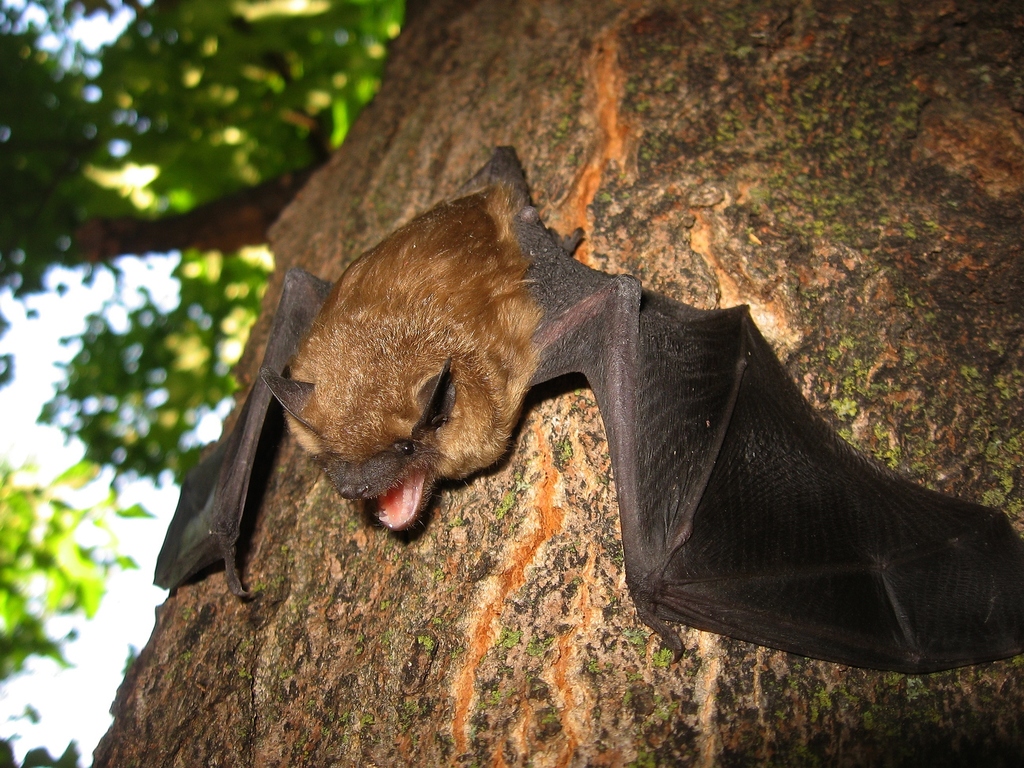
Big Brown Bat
Eptesicus fuscus
The big brown bat (Eptesicus fuscus) is a species of vesper bat distributed widely throughout North America, the Caribbean, and the northern portion of South America. It was first described as a species in 1796. Compared to other microbats, the big brown bat is relatively large, weighing 15–26 g (0.53–0.92 oz) and possessing a wingspan of 32.5–35 cm (12.8–13.8 in).
Big brown bats are insectivorous, consuming a diverse array of insects, particularly night-flying insects, but especially beetles. Some of the beetles it consumes are serious agricultural pests, including cucumber beetles. They are nocturnal, foraging for prey at night and roosting in sheltered areas during the day such as caves, tunnels, tree cavities, and human structures. Their breeding season is in the fall, shortly before their annual hibernation. After hibernation ends in the spring, females form maternity colonies for giving birth to young. Oftentimes only one offspring is produced per litter, though twins are common in the Eastern US. Lifespans of 6.5 years are considered average.
From the article Big brown bat on Wikipedia (CC BY-SA), quoted section by section
Description
It is a relatively large microbat, weighing 15–26 g (0.53–0.92 oz). Adult body length is 110–130 mm (4.3–5.1 in). Its forearm is usually longer than 48 mm (1.9 in). The tail is 47–52 millimetres (1.9–2.0 in) and the hind legs are 10 millimetres (0.39 in). Its wingspan is 32.5–35 cm (12.8–13.8 in). Its dorsal fur is reddish brown and glossy in appearance; its ventral fur is lighter brown. Its snout, uropatagium (flight membrane between the hind limbs), and wing membranes are black and hairless. Its ears (12–13 millimetres [0.47–0.51 in]) are also black; they are relatively short with rounded tips. The tragi (cartilage flaps in front of the ear canal) also have rounded tips. It has a robust skull; the greatest length of the skull is approximately 19.25 mm (0.758 in). The snout has a rounded and somewhat flattened appearance. The braincase has a breadth of approximately 8.6 mm (0.34 in) and the mandible (jawbone) has a length of approximately 14.5 mm (0.57 in). The upper incisors are large, with the inner pair more prominent than the outer pair. The inner pair of upper incisors also has a distinctive secondary cusp. The crowns of the lower incisors are trifid, or have three cusps. Its dental formula is 2.1.1.33.1.2.3, for a total of 32 teeth.
Range & habitat
The big brown bat is encountered widely throughout North America in present times. It is found from southern Canada and Alaska to as far south as Colombia and Venezuela. It has also been documented in the Caribbean in both the Greater and Lesser Antilles, including Cuba, Hispaniola, Dominica, Barbados, and the Bahamas. The big brown bat has been documented from 300–3,100 m (980–10,170 ft) above sea level. It is a generalist, capable of living in urban, suburban, or rural environments. It has been called "the most widespread Pleistocene bat in North America", as it is more represented in the fossil record of that time than any other bat species. Its extensive fossil record is known from more than thirty sites, including fourteen US states, Puerto Rico, Mexico, and the Bahamas.
Wikipedia: “Range and habitat”
What it does
Big brown bats are insectivorous, eating many kinds of insects including beetles, flies, stone flies, mayflies, true bugs, net-winged insects, scorpionflies, caddisflies, and cockroaches. It will forage in cities around street lamps. As the big brown bat is such a widespread species, it has regional variation in its diet, though it is generally considered a beetle specialist. Populations in Indiana and Illinois have particularly high consumption of scarab beetles, cucumber beetles, ground beetles and shield bugs. In Oregon, primary prey items include moths in addition to scarab beetles and ground beetles. In British Columbia, large proportions of caddisflies are consumed, with flies as a secondary prey source. A study in Ontario compared fecal samples of big brown bats with the abundance of insects collected in passive traps. The result was a strong preference for beetles as prey. Lepidoptera were the most common insect order collected but beetles were present in 99.2% of fecal samples. When being rehabilitated, big brown bats are often fed mealworms which have been supplemented with necessary vitamins and minerals. Big brown bats are significant predators of agricultural pests. …
Wikipedia: “Diet”
In human culture
The big brown bat was described in 1796 by French naturalist Palisot de Beauvois. Palisot described the species based on specimens in the Philadelphia Museum of Charles Willson Peale, an American naturalist, giving it the name Vespertila fuscus. The genus name, Eptesicus, is likely derived from the Greek words ptetikos ("able to fly") or petomai ("house flier"), and the species name "fuscus" is Latin in origin, meaning "brown". The big brown bat is the type species for the genus Eptesicus, which was established in 1820 by French-American naturalist Constantine Samuel Rafinesque. Though Rafinesque designated the type species as Eptesicus melanops, this was later determined to be a synonym of Eptesicus fuscus. The first use of the current name combination Eptesicus fuscus was in 1900 by Hungarian zoologist Lajos Méhelÿ. Recognized subspecies number eleven or twelve:
E. f. lynni has sometimes been considered a full species, though was listed as a subspecies by the American Society of Mammalogists and the Integrated Taxonomic Information System (ITIS) as of 2019. In the US state of Colorado where two subspecies were hypothesized to overlap (E. f. fuscus and E. f. pallidus), morphological features did not agree with genetic lineages, and thus were not reliable in distinguishing the two subspecies. …
Wikipedia: “Taxonomy and etymology”
Listen
Looking for field recordings…
Where it lives
Recorded sightings
—
geo-referenced records in GBIF, from museums, herbaria and field observers.
Drag the globe to turn it. Dots are where records exist, not a range map; darker means more records.
In the stacks
Searching the stacks…
Every page naming Eptesicus fuscus in the Biodiversity Heritage Library →
This page is assembled live from iNaturalist, GBIF, Wikipedia, the Source Library and the Internet Archive. It is not yet part of the hand-edited codex. iNaturalist taxon 40509.