- Animals
- ›Chordates
- ›Vertebrates
- ›Mammals
- ›Therians
- ›Placental Mammals
- ›Ungulates, Carnivorans, and Allies
- ›Bats
- ›Yangochiroptera
- ›Vespertilionoid Bats
- ›Evening Bats
- ›Vesper Bats
- ›Plecotini
- ›Plecotus
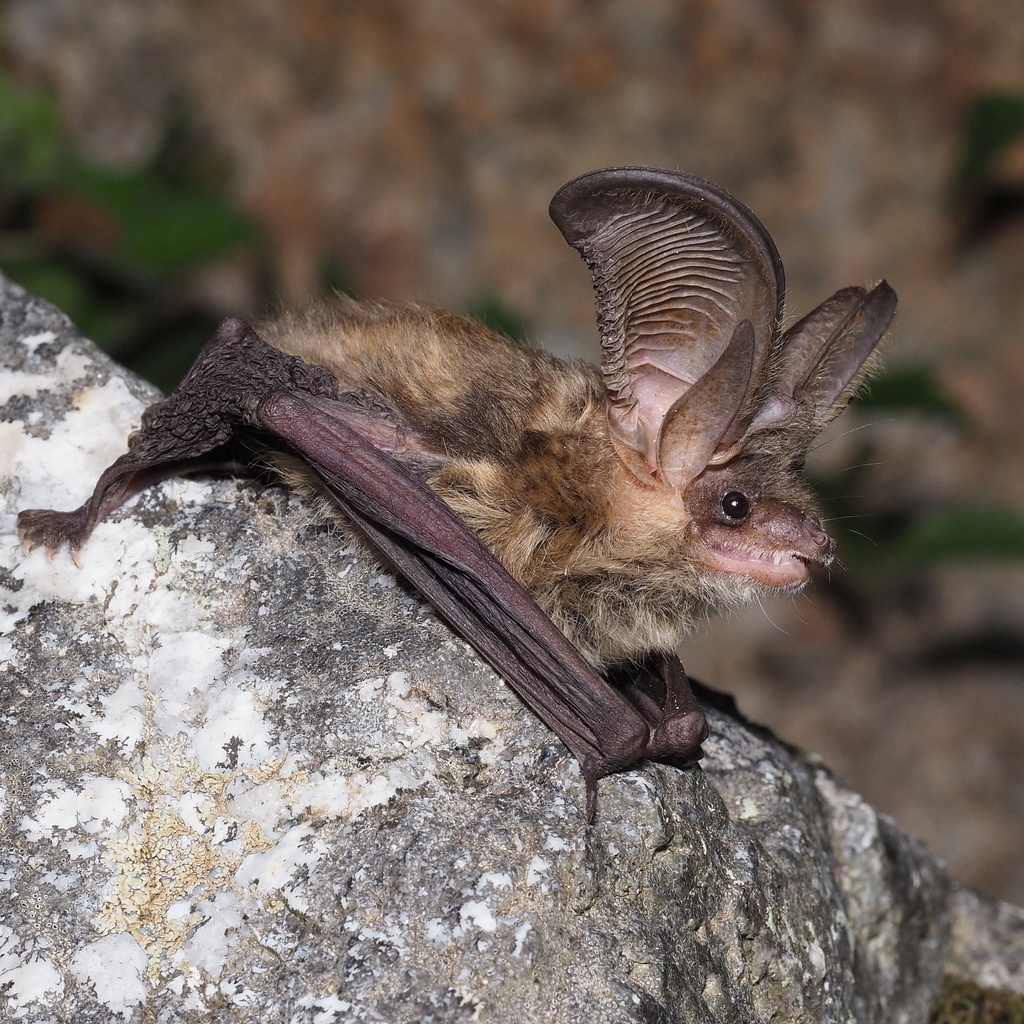
Grey Long-eared Bat
Plecotus austriacus
The grey long-eared bat (Plecotus austriacus) is a fairly large European bat. It has distinctive ears, long and with a distinctive fold. It hunts above woodland, often by day, and mostly for moths. In captivity, it has also been recorded to eat small lizards. It is extremely similar to the more common brown long-eared bat, and was only distinguished in the 1960s, but has a paler belly.
From the article Grey long-eared bat on Wikipedia (CC BY-SA), quoted section by section
Range & habitat
Distributed throughout all of Europe, except for the Scandinavian Peninsula. Although they are a near threatened species, they are more commonly found in Southern Europe. (To be more specific, woodlands and grasslands, as well as a few urban areas.)
Wikipedia: “Distribution”
What it does
Its main foraging habitats are lowland meadows and marshes. It locates its insect prey via echolocation. The frequencies used by this bat species for echolocation lie between 18 and 45 kHz, have most energy at 28 kHz and have an average duration of 5.8 ms.
Wikipedia: “Biology and ecology”
Listen
Looking for field recordings…
Where it lives
Recorded sightings
—
geo-referenced records in GBIF, from museums, herbaria and field observers.
Drag the globe to turn it. Dots are where records exist, not a range map; darker means more records.
In the stacks
Searching the stacks…
Every page naming Plecotus austriacus in the Biodiversity Heritage Library →
This page is assembled live from iNaturalist, GBIF, Wikipedia, the Source Library and the Internet Archive. It is not yet part of the hand-edited codex. iNaturalist taxon 40415.