On eBird ↗
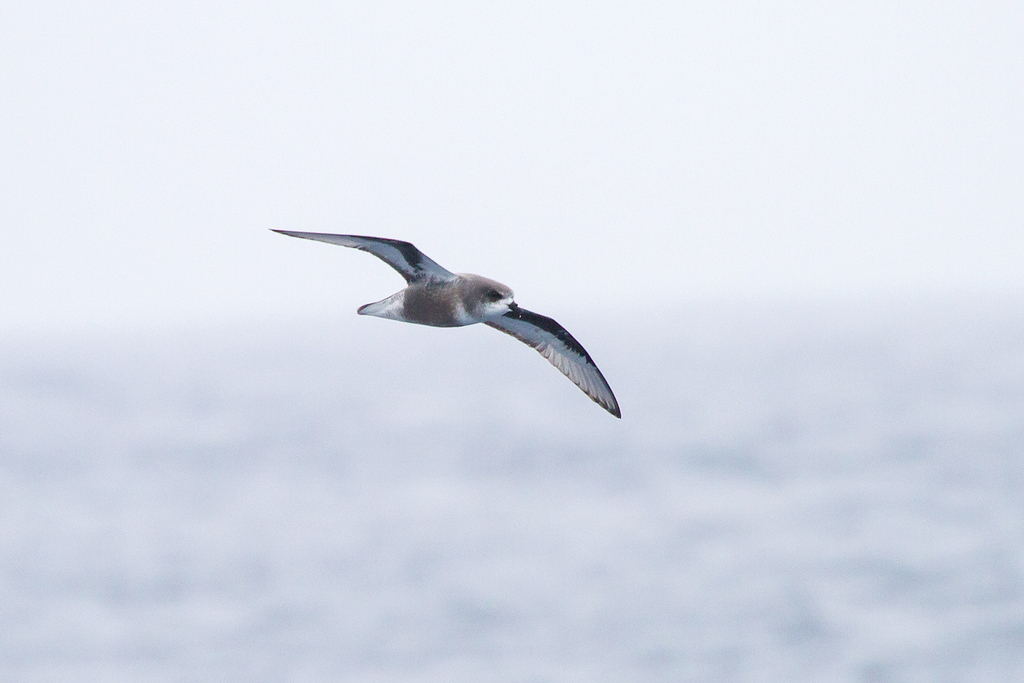
Mottled Petrel
Live sightings near you, the range map, bar charts of when it is seen, and Macaulay Library photos and recordings.
Mottled Petrel
Pterodroma inexpectata
The mottled petrel (Pterodroma inexpectata) or kōrure is a species of seabird and a member of the gadfly petrels. It usually attains 33 to 35 cm (13–14 in) in length with a 74 to 82 cm (29–32 in) wingspan.
This species is highly pelagic, rarely approaching land, except to nest and rear young. The mottled petrel feeds mostly on fish and squid, with some crustaceans taken. It is a transequatorial migrant, breeding in the islands of New Zealand, and migrating to the Bering Sea, concentrating in the Gulf of Alaska and the Aleutian Islands.
From the article Mottled petrel on Wikipedia (CC BY-SA), quoted section by section
What it does
P. inexpectata feast alone, not joining in with other species, and they feed at night. They eat fish, squid, and krill, and forage by surface seizing tactics. Mottled petrels cope with prey limitations better than other breeding procellariforms.
Mottled petrels have a high latitude foraging niche along the edge of the Antarctic pack ice during breeding season. They also tend to go on long foraging trips.
Wikipedia: “Foraging and Feeding”
Listen
Looking for field recordings…
Where it lives
Recorded sightings
—
geo-referenced records in GBIF, from museums, herbaria and field observers.
Drag the globe to turn it. Dots are where records exist, not a range map; darker means more records.
In the stacks
Searching the stacks…
Every page naming Pterodroma inexpectata in the Biodiversity Heritage Library →
This page is assembled live from iNaturalist, GBIF, Wikipedia, the Source Library and the Internet Archive. It is not yet part of the hand-edited codex. iNaturalist taxon 4037.