On eBird ↗
Gould's Petrel
Live sightings near you, the range map, bar charts of when it is seen, and Macaulay Library photos and recordings.
Gould's Petrel
Pterodroma leucoptera
Gould's petrel (Pterodroma leucoptera) is a species of seabird in the family Procellariidae. The common name commemorates the English ornithologist and bird artist John Gould (1804-1881).
From the article Gould's petrel on Wikipedia (CC BY-SA), quoted section by section
Description
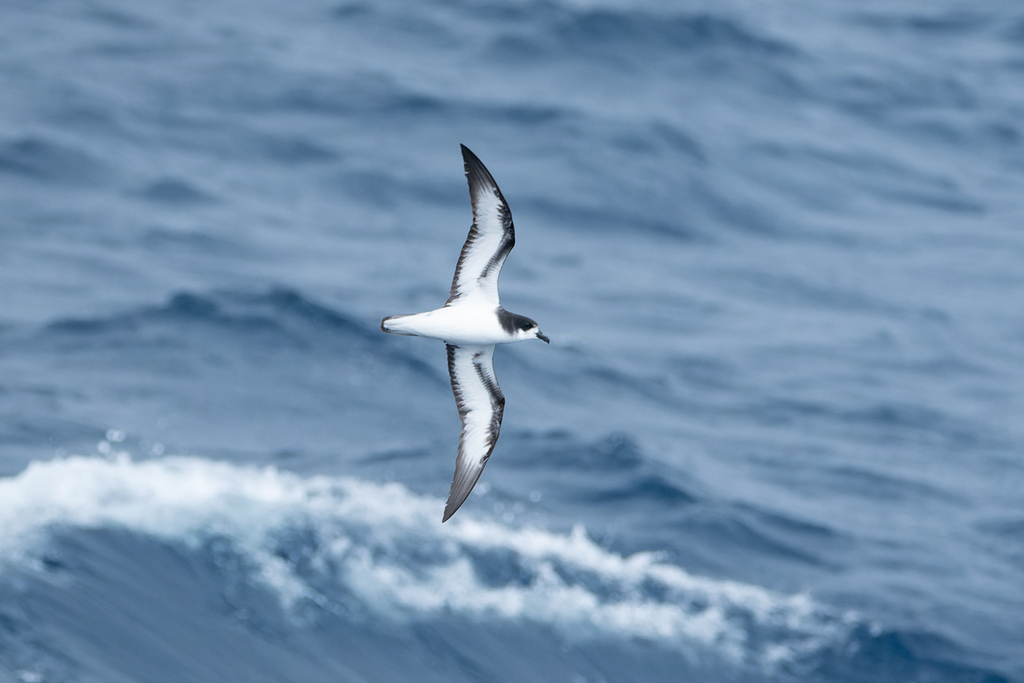
Gould's petrel is a small gadfly petrel, white below and dark brown and grey above. The species is classified within the subgenus Cookilaria, all members of which have a dark M pattern across the upper wings. Gould's petrel has long narrow wings, a short rounded tail and the head is noticeably dark, with a white forehead and face. Gould's petrel is 30 cm in length with a wingspan of 70 cm and weighs 180–200 g. Males are slightly larger than females.
Range & habitat
Gould's petrels spend most of their life at sea and come ashore only to breed. Prior to the 1990s, it was thought that the Australian subspecies of Gould's petrel bred only on Cabbage Tree Island off Port Stephens in New South Wales. After the discovery of breeding pairs on neighbouring Boondelbah Island, translocation of 200 chicks in 1999 and 2000 has established a small satellite colony which breeds in artificial nest boxes that were installed prior to the first translocation. In December 2009, just one month after it had been confirmed that rabbits had been eliminated from Cabbage Tree Island, one single Gould's petrel was found incubating an egg on another nearby island, Broughton Island. Today, the nominate subspecies breeds on at least five islands off New South Wales (Cabbage Tree Island, Boondelbah Island, Broughton Island, Little Broughton Island, and Montague Island). The New Caledonian subspecies breeds on New Caledonia in steep forested valleys on the central mountain chain, from 350 to 500 metres above sea level between Mountains Dzumac and Poya. There is also a small colony on Raivavae in French Polynesia. Both subspecies forage in the Tasman Sea during the breeding season and may venture as far west as the Indian Ocean south of south-western Western Australia before lying. After breeding, Gould's petrel migrates to the central (P. l. …
Wikipedia: “Distribution”
What it does
Little is known about the diet or feeding behaviour of Gould's petrels. We do know that they eat small cephalopods and fish, and that variation in foraging success is substantial. Procellariiforms go without food during often lengthy incubation shifts.
Wikipedia: “Diet”
In human culture
Gadfly petrels have relatively long breeding seasons. They are generally monogamous and form long-term pair bonds. While most petrels nest in burrows, as do the Gould's petrels on New Caledonia, the Australian subspecies of Gould's petrel does not. On Cabbage Tree Island, they nest amongst rocks and boulders, under fallen palm fronds, in hollow trunks of fallen palms and between buttresses of fig trees. On Cabbage Tree Island, birds arrive in mid-October to secure their nest site and reunite with their mate. In November, they return to sea for 2–3 weeks (the 'pre-laying exodus'). The single egg (which is not replaced if lost) is laid between 18 November and 10 December. Incubation is undertaken by both parents and takes 6–7 weeks. Males undertake the first shift, which can be as long as 17 days. Females then take over for a shorter shift. Finally, males take the final shift until the egg hatches, usually in January. The chick reaches a maximum body mass that is often more than 130% of adult body mass. The young fledge from April to May at 80–100 days of age and a body mass of 160–180 g. The age at which Gould's petrels commence breeding is unknown. The youngest bird of the Australian subspecies known to breed was 12 years of age. Young birds are thought to spend the first 5–6 years at sea before starting to breed. …
Wikipedia: “Life history”
Listen
Looking for field recordings…
Where it lives
Recorded sightings
—
geo-referenced records in GBIF, from museums, herbaria and field observers.
Drag the globe to turn it. Dots are where records exist, not a range map; darker means more records.
In the stacks
Searching the stacks…
Every page naming Pterodroma leucoptera in the Biodiversity Heritage Library →
This page is assembled live from iNaturalist, GBIF, Wikipedia, the Source Library and the Internet Archive. It is not yet part of the hand-edited codex. iNaturalist taxon 4035.