- Plants
- ›Vascular Plants
- ›Lycophytes
- ›clubmosses and firmosses
- ›Clubmosses and Firmosses
- ›Lycopodioideae
- ›Diphasium
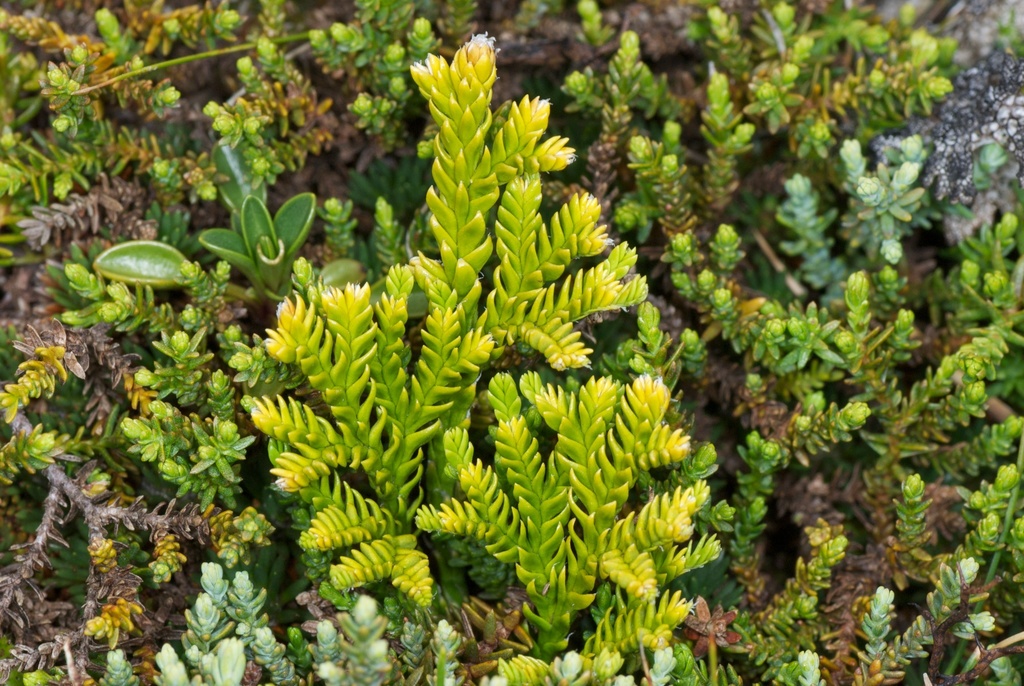
Creeping Clubmoss
Diphasium scariosum
Diphasium scariosum, synonym Lycopodium scariosum, commonly known as spreading clubmoss or creeping club moss, is a species in the club moss family Lycopodiaceae. The genus Diphasium is accepted in the Pteridophyte Phylogeny Group classification of 2016 (PPG I), but not in other classifications which submerge the genus in Lycopodium. D. scariosum is native to Australia, New Zealand, and Borneo.
From the article Diphasium scariosum on Wikipedia (CC BY-SA), quoted section by section
Description
Diphasium scariosum has main stems that lie flat along the ground and which spread to more than a meter long. The branchlets are 0.5 m tall, have two different surfaces and are very branched. The leaves are dimorphic and are yellowish green. The first leaf form occurs on the upper leaves of the plant, which are in two alternating rows and have been flattened into one plane. The upper leaves are 3–5 mm long, 1–1.5 mm wide and are oval. The second leaf form are the lower leaves which are in two rows but have not been flattened into one plane. These leaves are scale-like, are only 0.2 mm long and have translucent membranous dilated tips. D. scariosum has distinctive colouring with big fluorescent spots throughout. This is unusual for a club moss as not many club moss species have 5-O-glucosides of flavones, which cause these bright fluorescent spots. D. scariosum has solitary erect strobili which grow 1-3 cm long. The sporophylls overlap each other, are oval, straw-like, and have membranous tips. Genera of the Lycopodioideae subfamily, which includes D. scariosum, differs from the Lycopodielloideae sensu genera by the presence of pedunculate strobili with modified sporophylls in them.
Range & habitat
Diphasium scariosum occurs naturally in the Philippines, New Guinea, Borneo, Australia, New Zealand and the Subanatarctic islands. In New Zealand, Diphasium scariosum is found throughout the North Island but is less common in Northland. It is also found throughout the South Island.
Wikipedia: “Natural global range”
What it does
Diphasium scariosum is a pteridophyte. When the spores are released from the sporophyll and the strobili, they can take seven or more years to turn into a gametophyte which can then survive for 10 or more years. The lifecycle of a Lycopodium species can take up to 20 years to complete. D. scariosum reproduces sexually in unfavourable conditions or asexually in favourable conditions. When D. scariosum is not producing spores, it grows laterally along the ground.
Wikipedia: “Life cycle and phenology”
Where it lives
Recorded sightings
—
geo-referenced records in GBIF, from museums, herbaria and field observers.
Drag the globe to turn it. Dots are where records exist, not a range map; darker means more records.
In the stacks
Searching the stacks…
Every page naming Diphasium scariosum in the Biodiversity Heritage Library →
This page is assembled live from iNaturalist, GBIF, Wikipedia, the Source Library and the Internet Archive. It is not yet part of the hand-edited codex. iNaturalist taxon 401461.