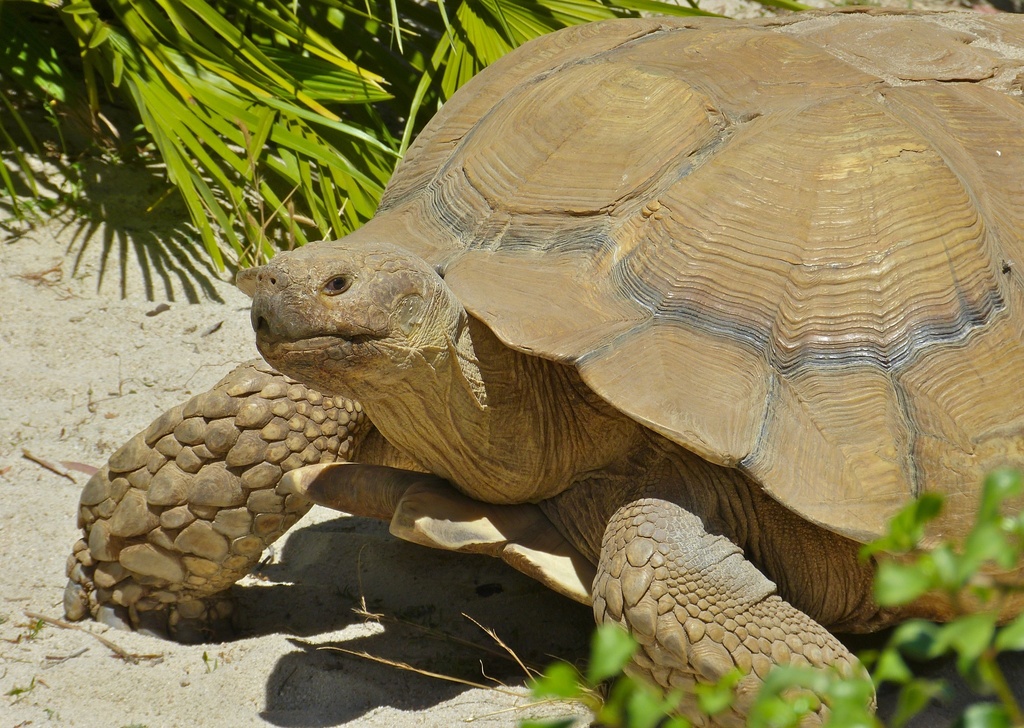
African Spurred Tortoise
Centrochelys sulcata
The African spurred tortoise (Centrochelys sulcata), also called the sulcata tortoise, is an endangered species of tortoise inhabiting the southern edge of the Sahara Desert and the Sahel. It is the largest mainland species of tortoise in Africa, and the third-largest in the world, after the Galapagos tortoise and Aldabra giant tortoise. It is the only living species in its genus, Centrochelys.
From the article African spurred tortoise on Wikipedia (CC BY-SA), quoted section by section
Range & habitat
The African spurred tortoise is native to the Sahara Desert and the Sahel, a transitional ecoregion of semiarid grasslands, savannas, and thorn shrublands found in the countries of Burkina Faso, the Central African Republic, Chad, Eritrea, Ethiopia, Mali, Mauritania, Nigeria, Senegal, Saudi Arabia, Sudan, Yemen and possibly in Somalia, Algeria, Benin, and Cameroon. It is possibly extirpated from Djibouti and Togo. They are found on hills, stable dunes, and flat areas with shrubs and high grass. They also like to settle in areas with interrupted streams or rivers. In these arid regions, the tortoise excavates burrows in the ground to get to areas with higher moisture levels, and spends the hottest part of the day in these burrows. This is known as aestivation. In the wild, they may burrow very deep, up to 15 m (49 ft) deep and 30 m (98 ft) long. Plants such as grasses and succulents grow around their burrows if kept moist, and in nature they continue to grow for the tortoise to eat if the soil is replenished with its feces. Sulcata tortoises found in the Sudanese part of their range may reach significantly greater size at maturity than those found in other regions.
Wikipedia: “Range and habitat”
What it does
Sulcata tortoises are mostly herbivores. Primarily, their diets consist of many types of grasses, plants (especially succulent plants), and hay. Flowers and other plants, including cactus pads, can be consumed. In the wild, they have been observed to also eat plants and algae off the surface of the water. African spurred tortoises are also capable of eating various vegetables such as endive, dandelion greens, and dark leafy greens. Despite being herbivores, they will occasionally eat the carcasses of dead animals. They mostly eat dead goats and zebras that have been pushed downstream during the wet season on the rivers and streams next to which tortoises settle. If a human settlement is nearby they will also feed on refuse. Their overall diet should be high in fiber and very low in protein. Too much protein will lead to the tortoise growing too fast, which can result in metabolic bone disease, a condition that is characterized by distortion of the skeleton and weakened bone structure and can lead to lameness, lower quality of life, and/or shortened lifespan.
Wikipedia: “Diet”
In human culture
In 1779 the English illustrator John Frederick Miller included a hand-coloured plate of the African spurred tortoise in his Icones animalium et plantarum and coined the binomial name Testudo sulcata. Its specific name sulcata is from the Latin word sulcus meaning "furrow" and refers to the furrows on the tortoise's scales. The species was subsequently given other binomial names. There are no recognized subspecies despite there being two separate populations, one in Western Africa and the other in Eastern Africa. There are also three different, yet similar, haplotypes. One haplotype is found in and closely around Sudan, another is found in the western portion of their range, and the last haplotype is found in Senegal, Mali, and Sudan.
Wikipedia: “Taxonomy and etymology”
Where it lives
Recorded sightings
—
geo-referenced records in GBIF, from museums, herbaria and field observers.
Drag the globe to turn it. Dots are where records exist, not a range map; darker means more records.
In the stacks
Searching the stacks…
Every page naming Centrochelys sulcata in the Biodiversity Heritage Library →
This page is assembled live from iNaturalist, GBIF, Wikipedia, the Source Library and the Internet Archive. It is not yet part of the hand-edited codex. iNaturalist taxon 40089.