- Fungi Including Lichens
- ›Ascomycete Fungi
- ›Sac Fungi and Lichens
- ›Common Lichens
- ›Shield Lichens, Sunburst Lichens, Rosette Lichens, and Allies
- ›shield lichens, rim lichens, and allies
- ›spindles and structured lichens
- ›Cladia
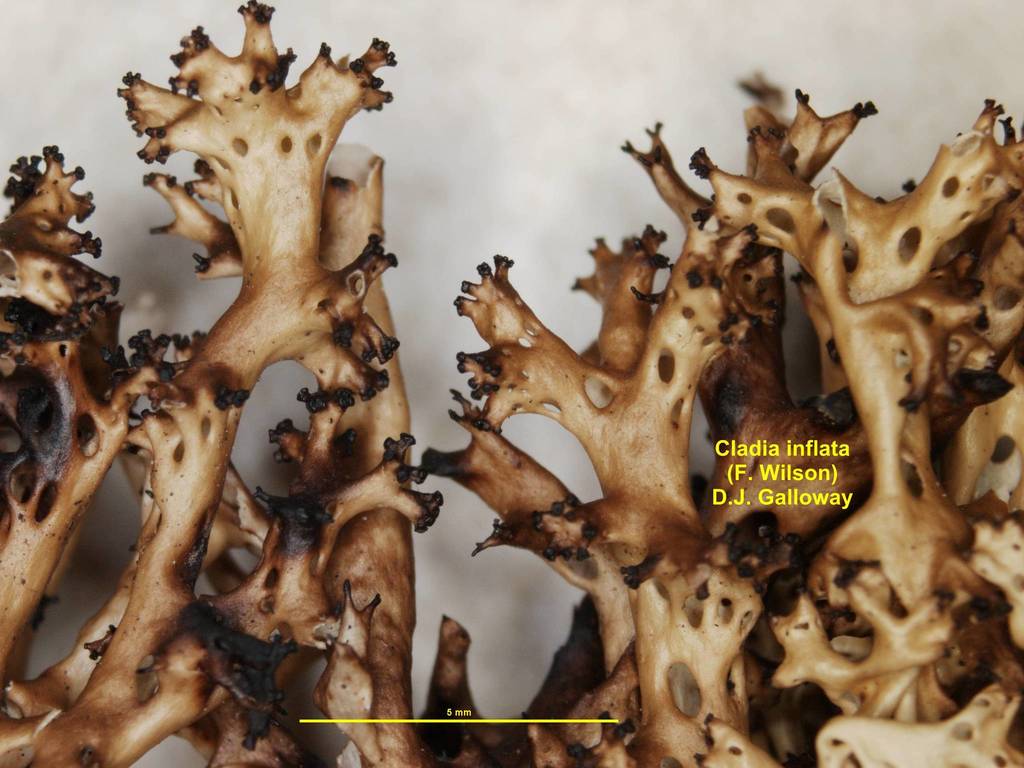
Cladia inflata
Cladia inflata is a species of fruticose lichen in the family Cladoniaceae. This lichen forms densely interwoven, spreading mats up to 5 centimetres high, with swollen, glossy branches that vary from pale yellow-brown to olive-brown in colour. It grows on peaty or sandy soil in high-rainfall areas, typically in areas exceeding 3000 millimetres of annual precipitation, and is found across Tasmania, south-eastern mainland Australia, and New Zealand. The species is characterized by its inflated branches that are broader at the forks, a feature that distinguishes it from closely related species in the Cladia aggregata complex.
From the article Cladia inflata on Wikipedia (CC BY-SA), quoted section by section
Description
Cladia inflata forms densely interwoven, spreading clumps or mats that are decumbent at the base, typically reaching 50 mm high and 4–6 mm wide. The thallus shows repeated dichotomous branching with branches tapering rather abruptly at their tips. The surface is texture is glossy to faintly wavy (undulate), and wrinkled or dimpled. It varies in colour from pale yellow-brown to olive-brown or reddish brown, and takes on a pale greenish colouration in deep shade. The angles where branches fork (axils) lack holes and are not pinched or narrowed, with branches typically diverging smoothly rather than at sharp angles, especially on the upper surface. Perforations, when present, are round to oval and measure 0.2–2 mm wide. The medullary cavity is white and tomentose throughout. Reproductive stalks (fertile pseudopodetia) are rare and grow horizontally along the ground (decumbent). They are nearly identical to non-reproductive stalks but have slightly more branching and develop small holes near their tips. Apothecia develop apically on short branchlets and are mostly solitary or occur in groups of 2–3. They measure up to 0.2 mm wide and usually proliferate in 2–3 compressed tiers. Ascospores measure 8–10 × 3–4 micrometres (μm). …
Range & habitat
Cladia inflata is widely distributed across Tasmania, mainland Australia, and New Zealand. In Australia, the species occurs in Tasmania, south-eastern regions, and alpine areas of the mainland. It is found at high-elevation sites, growing in areas with very high rainfall exceeding 3000 mm per annum. The lichen is often found growing on peaty or sandy soil in association with other species of Cladia, as well as Cladonia southlandica and Siphula decumbens. Detailed distribution records have been documented within Tasmania. The species is most readily recognised in the field when well-developed. It has been studied extensively through both laboratory and field observations, revealing that it inhabits the broadest ecological niche within its segregate group. C. inflata displays the widest ecological amplitude (the range of survivable environmental conditions) among members of its complex, occurring from lowland to alpine altitudes and growing in habitats ranging from relatively open sclerophyll woodlands to blanket bogs of south-western Tasmania.
== References ==
Wikipedia: “Habitat and distribution”
Where it lives
Recorded sightings
—
geo-referenced records in GBIF, from museums, herbaria and field observers.
Drag the globe to turn it. Dots are where records exist, not a range map; darker means more records.
In the stacks
Searching the stacks…
Every page naming Cladia inflata in the Biodiversity Heritage Library →
This page is assembled live from iNaturalist, GBIF, Wikipedia, the Source Library and the Internet Archive. It is not yet part of the hand-edited codex. iNaturalist taxon 400840.