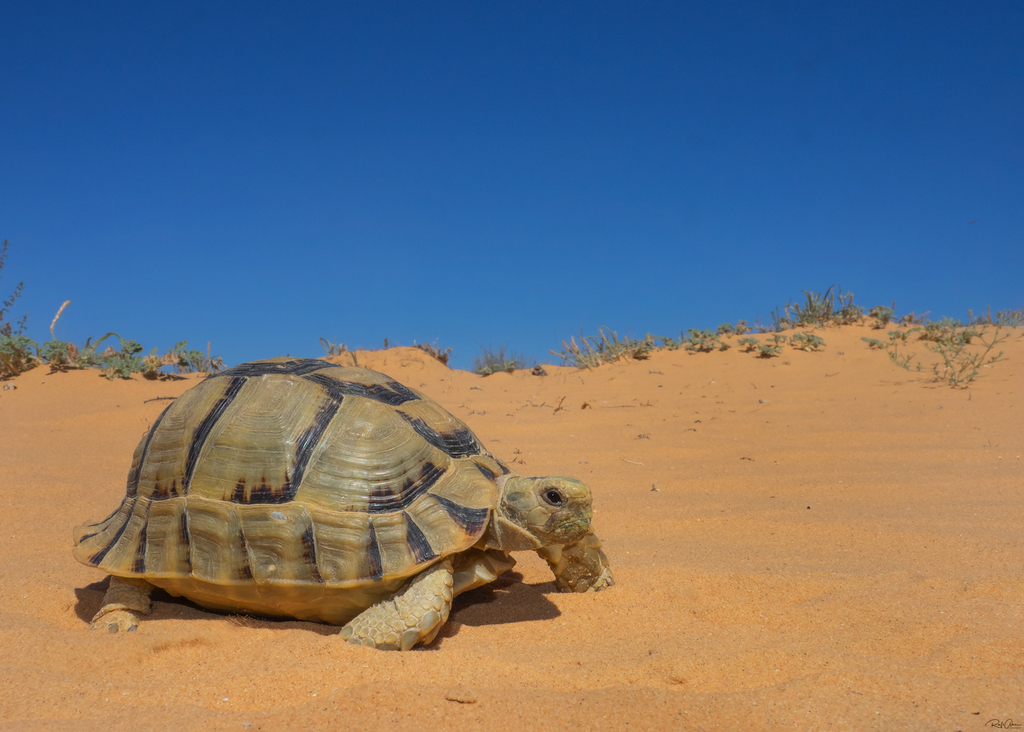
Egyptian Tortoise
Testudo kleinmanni
Kleinmann's tortoise (Testudo kleinmanni), also called commonly the Egyptian tortoise, Leith's tortoise, and the Negev tortoise, is a critically endangered species of cryptodire turtle in the family Testudinidae. The species is native to Libya and possibly extinct in Egypt. The species was once more widespread, but its numbers are now dwindling, and complete extinction in the wild is a looming threat unless more actions are taken to protect this species.
From the article Kleinmann's tortoise on Wikipedia (CC BY-SA), quoted section by section
Description
Kleinmann's tortoise is the smallest tortoise in the Northern Hemisphere. Females are larger than males; males are more slender and have a longer tail. The carapace has a high dome, and ranges in color from ivory to pale gold to dark brown to pink or dull yellow. This allows the paler tortoise to stay in the desert heat for longer. It is also an effective camouflage in the desert. The plastron is light yellow, often with two dark triangles on each abdominal scute. The plastral scutes have dark edgings that fade with age. The head and limbs are a very pale ivory-yellow to yellowish-brown colour.
Range & habitat
Kleinmann's tortoise lives in deserts and semiarid habitats, usually with compact sand and gravel plains, scattered rocks, shallow, sandy wadis, dry woodlands, shrubby areas, and coastal salt marsh habitats. In captivity, it eats grasses, fruits, and vegetables, but the diet of T. kleinmanni in the wild is unknown. Kleinmann's tortoise tend to live in habitats that receive less than 50 mm of rain every year. These habitats tend to be countries with expansive desert areas such as Egypt and Libya. It is least active when the weather is very cold or very hot. During the colder months, it is out most during midday. During the warm season, it is active in the mornings and evenings. The rest of the day is spent under bushes or in rodent burrows.
Wikipedia: “Habitat and ecology”
What it does
Kleinmann's tortoise becomes sexually mature when about 5 years old. In the wild, mating has only been observed in March, but in captivity, it mates in April and August to November. During courtship, the male will ram the female, sometimes chasing after her. Unlike any other Mediterranean tortoise, T. kleinmanni may make a mating call similar to the call of the mourning dove. Eggs are laid in shallow bowls beneath bushes, or in vacant burrows. Each clutch contains one to five eggs, which hatch in the summer or early autumn.
Wikipedia: “Reproduction”
In human culture
The specific name, kleinmanni, is in honor of Edouard Kleinmann, a French stockbroker who collected the holotype in 1875. The specific name, werneri (of the synonym Testudo werneri), is in honor of Israeli herpetologist Yehudah L. Werner.
Wikipedia: “Etymology”
Where it lives
Recorded sightings
—
geo-referenced records in GBIF, from museums, herbaria and field observers.
Drag the globe to turn it. Dots are where records exist, not a range map; darker means more records.
In the stacks
Searching the stacks…
Every page naming Testudo kleinmanni in the Biodiversity Heritage Library →
This page is assembled live from iNaturalist, GBIF, Wikipedia, the Source Library and the Internet Archive. It is not yet part of the hand-edited codex. iNaturalist taxon 40041.