On eBird ↗
White-winged Sandpiper
Live sightings near you, the range map, bar charts of when it is seen, and Macaulay Library photos and recordings.
White-winged Sandpiper
Prosobonia leucoptera
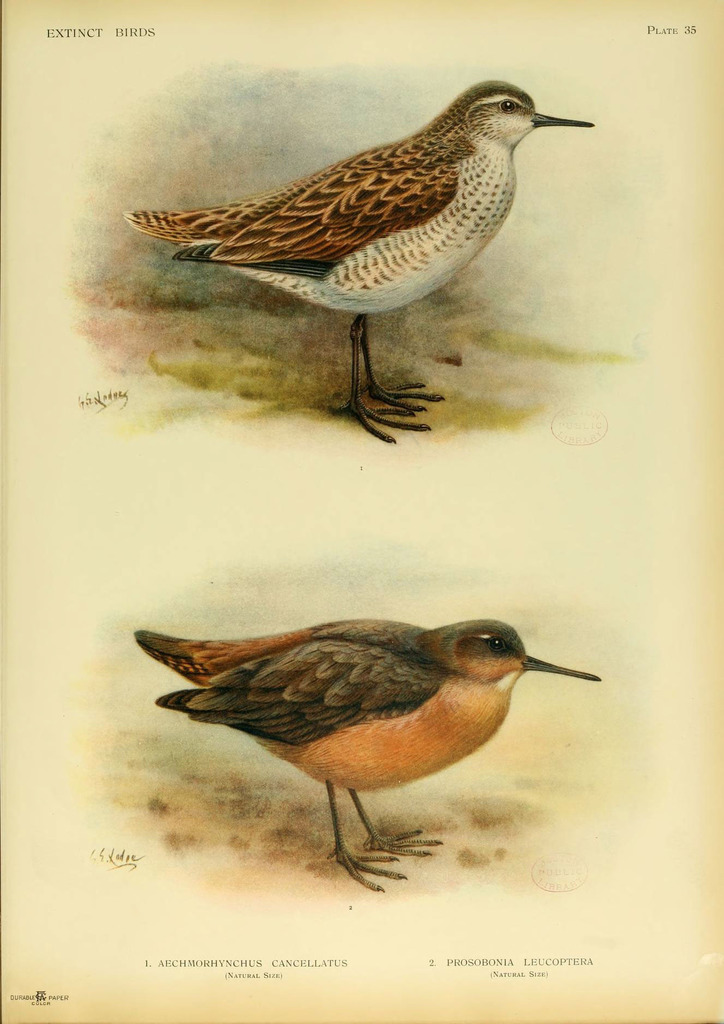
The Tahiti sandpiper or Tahitian sandpiper (Prosobonia leucoptera) is an extinct member of the large wader family Scolopacidae that was endemic to Tahiti in French Polynesia until its extinction sometime before 1819.
It was discovered in 1773 during Captain Cook's second voyage, when a single specimen seems to have been collected, but it became extinct in the nineteenth century. Only one museum specimen is known to exist, held in the Aves collection of Naturalis Biodiversity Center. The bird's name in the Tahitian language was transcribed as toromē.
From the article Tahiti sandpiper on Wikipedia (CC BY-SA), quoted section by section
Description
Based on Zusi & Jehl (1970): A small (some 18 cm long), plain-colored sandpiper, brown below, darker above, with a white wing patch. Top and sides of head and neck to wings and back sooty brown, darker on back and wings. A small white patch behind and above the eye. Chin buffish white. Lores, rump and underside rusty. Wing coverts with some rusty edging. Remiges with paler inner surfaces. Underside of wing dusky brown with paler edges to coverts. A crescent-shaped white patch formed by tertiary coverts; smaller on the underside of the wing. Ten primaries, twelve rectrices. Central tail feathers sooty brown with rusty tips; outer ones rusty with sooty brown barring. Bill blackish, lower mandible slightly paler, pointed, thin and short, rather like in an insectivorous passerine than a wader. Legs greenish-hued pale straw color. Toes unwebbed. A slim pale rusty ring around the eye. Iris a very dark brown. Two probable specimens taken on Moorea by William Anderson between September 30 and October 11, 1777, formed the basis for the description of the Moorea Sandpiper. Three specimens mentioned by John Latham in 1787 all differed from one another, but the single remaining one, RMNH 87556, cannot be positively identified with any of them. …
Listen
Looking for field recordings…
Where it lives
Recorded sightings
—
geo-referenced records in GBIF, from museums, herbaria and field observers.
Drag the globe to turn it. Dots are where records exist, not a range map; darker means more records.
In the stacks
Searching the stacks…
Every page naming Prosobonia leucoptera in the Biodiversity Heritage Library →
This page is assembled live from iNaturalist, GBIF, Wikipedia, the Source Library and the Internet Archive. It is not yet part of the hand-edited codex. iNaturalist taxon 3983.