- Animals
- ›Chordates
- ›Vertebrates
- ›Reptiles
- ›Turtles and Tortoises
- ›Pond and Box Turtles
- ›Deirochelyine Turtles
- ›Trachemys
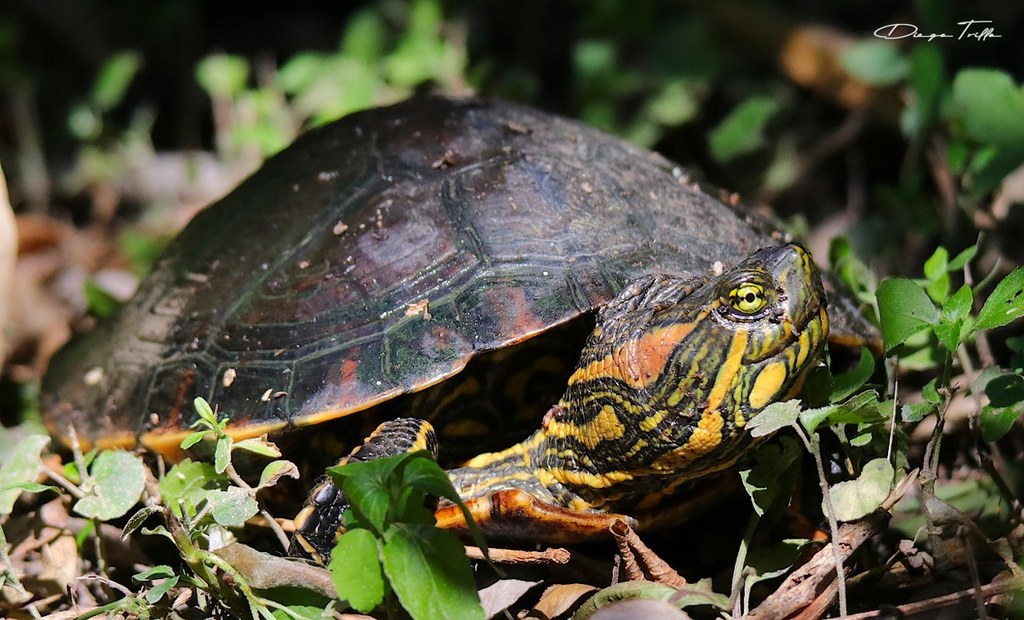
Black-bellied Slider
Trachemys dorbigni
D'Orbigny's slider or the black-bellied slider (Trachemys dorbigni ), commonly known in Brazil as tigre d'água (which means water tiger in Portuguese), is a species of water turtle in the family Emydidae. The species is found in southern Brazil, northeastern Argentina, and Uruguay. One subspecies (in addition to the nominate subspecies) is distinguished, Trachemys dorbigni brasiliensis.
From the article D'Orbigny's slider on Wikipedia (CC BY-SA), quoted section by section
Description
The gender of Trachemys dorbigni can be determined by the form of the plastron, which after a few years of life, shows differences between male and female. The males has a penis that is located in the tail and becomes apparent only during the mating season when it is inserted into the female's cloaca. D'Orbigny's slider has a life span of between 30 and 100 years in captivity. Hatchlings weigh 11 grams (0.39 oz) with a 3.5 cm (1.4 in) carapace. The average growth rate is about 3 cm (1.2 in) per year in the wild, but in captivity it can grow faster being able to grow over 9 cm (3.5 in) in a year. The female can grow up to 30 cm (12 in) straight-line carapace length and weigh over 2.7 kg (6.0 lb), while the male can only grow to 25 cm (9.8 in). When the male reaches sexual maturity (after 2 years), it acquires a dark color, while the female keeps the same green after maturity (at 5 years).
Sexual dimorphism. The sex identification is only possible when adult, at 5 or 6 years. The female is bigger and may reach 30 cm (12 in) in length and has the plastron (bottom shell) slightly convex so as to provide more space for eggs. The male reaches 20–25 cm (7.9–9.8 in) and has a longer and bulkier tail. …
Range & habitat
Trachemys dorbigni is usually found in bodies of water such as lakes, marshes, streams and rivers. It has a preference for waters with low or moderate currents, soft bottoms and abundant aquatic vegetation.
Wikipedia: “Habitat”
What it does
The female Trachemys dorbigni produces an average of 10 eggs per buried nest; usually it buries two nests per season. Incubation ranges from 2 to 4 months. The eggs are laid under approximately 10 cm (3.9 in) of sand. The eggs are white-colored. Each egg on average measures 39.3 mm (1.55 in) in length and 25.8 mm (1.02 in) in width, weighing on average 14.9 g (0.53 oz). Only 31% of the female population lays eggs each year. The sex of baby turtles is determined by the temperature of the sand during incubation, lower temperatures increase the number of females.
Wikipedia: “Reproduction”
Where it lives
Recorded sightings
—
geo-referenced records in GBIF, from museums, herbaria and field observers.
Drag the globe to turn it. Dots are where records exist, not a range map; darker means more records.
In the stacks
Searching the stacks…
Every page naming Trachemys dorbigni in the Biodiversity Heritage Library →
This page is assembled live from iNaturalist, GBIF, Wikipedia, the Source Library and the Internet Archive. It is not yet part of the hand-edited codex. iNaturalist taxon 39797.