- Animals
- ›Chordates
- ›Vertebrates
- ›Reptiles
- ›Turtles and Tortoises
- ›American Mud and Musk Turtles
- ›Kinosternine Turtles
- ›Kinosternon
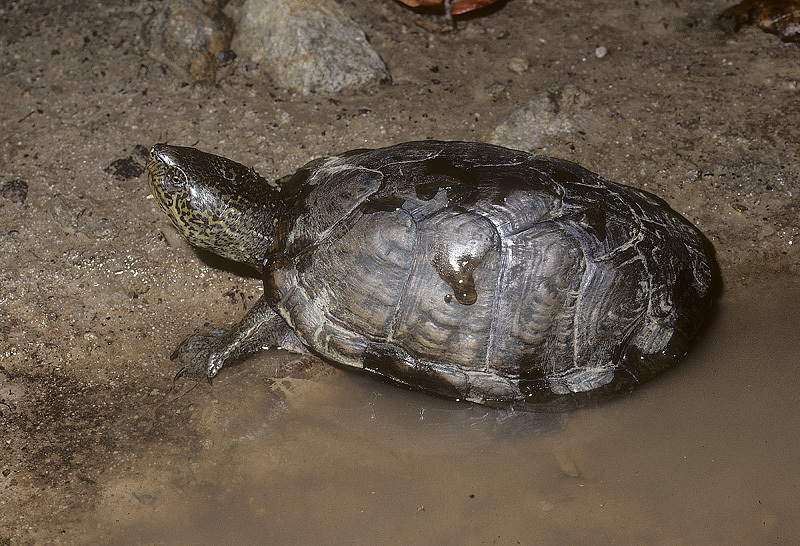
Chihuahuan Mud Turtle
Kinosternon hirtipes
The rough-footed mud turtle (Kinosternon hirtipes) is a species of mud turtle in the family Kinosternidae. The species is native to the southwestern United States and adjacent northern Mexico.
From the article Rough-footed mud turtle on Wikipedia (CC BY-SA), quoted section by section
Range & habitat
Kinosternon hirtipes is found in the United States in Texas, and it is also found in Mexico in the Mexican states of Aguascalientes, Chihuahua, Coahuila, Mexico DF, Durango, Guanajuato, Jalisco, Mexico State, Michoacán, Morelos, and Zacatecas.
Wikipedia: “Geographic range”
What it does
As an omnivore, the diet of Kinosternon hirtipes primarily consists of vegetation and insects including filamentous algae, seeds and fruits, aquatic, terrestrial, flying arthropods, as well as aquatic gastropods. K. hirtipes undergoes a dietary shift from insects to vegetation as body size increases which facilitates rapid growth. Although male K. hirtipes are larger in size than females, both sexes share a dietary overlap consuming similar foods.
Wikipedia: “Diet”
In human culture
The subspecific name, murrayi, is in honor of American zoologist Leo Tildon Murray (1902–1958).
Wikipedia: “Etymology”
Where it lives
Recorded sightings
—
geo-referenced records in GBIF, from museums, herbaria and field observers.
Drag the globe to turn it. Dots are where records exist, not a range map; darker means more records.
In the stacks
Searching the stacks…
Every page naming Kinosternon hirtipes in the Biodiversity Heritage Library →
This page is assembled live from iNaturalist, GBIF, Wikipedia, the Source Library and the Internet Archive. It is not yet part of the hand-edited codex. iNaturalist taxon 39734.